
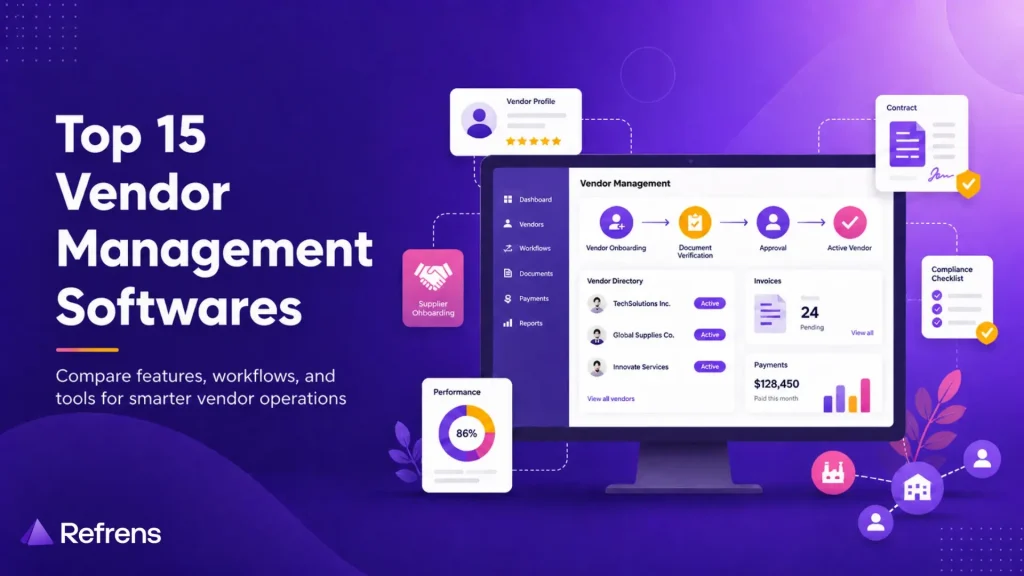
Managing a few vendors is easy. You can store details in spreadsheets, receive invoices on WhatsApp, and track payments manually. But once your vendor network grows, the same process creates scattered records, duplicate entries, delayed approvals, missed invoices, and payment confusion.
Vendor management software can help you fix this by centralising onboarding, KYC, approvals, invoices, payments, reports, and compliance. For Indian businesses, it also connects GST, TDS, PAN, banking, accounting, inventory, and cash flow to the software.
Read to know what vendor management software is, the top options in India, its key features, why it is needed and what you need to know to choose the best fit for your business.
What is Vendor Management Software?
Vendor management software helps you manage vendors and suppliers from one place.
It helps you store vendor details, collect documents, verify business information, approve vendors, request quotations or invoices, track payments, maintain vendor statements, and generate reports.
A vendor management system helps you know:
- Who are your active vendors?
- Which vendors are approved?
- Have you verified their PAN, GSTIN, and bank details?
- Who approved this vendor?
- What invoices have you received?
- Which payments are pending?
- How much do you owe each vendor?
- Do you have a clean audit trail?
Without vendor management software, this information often stays scattered across multiple platforms and individual team members.
Top 15 Vendor Management Software in India
| Software | Key Vendor Features | Pricing | Positioning |
| Refrens | Vendor onboarding, KYC, approvals, invoices, payments, statements, and accounting | Offers free trial & paid plans for 5 users starting ~₹2083/month | Strong ease-of-use and support positioning |
| Clear Supply Chain Cloud | Vendor compliance, GST workflows, vendor portal, and AP automation | Custom pricing | Strong compliance and GST-focused brand recall |
| Finifi | Vendor onboarding, payments, GST 2A/2B reconciliation, and vendor portal for enterprises | Custom pricing | Operations AI platform for enterprise finance teams |
| CashFlo | Vendor onboarding, AP automation, KYC checks, and payment communication | Custom pricing | Strong finance automation positioning |
| Procol | Vendor onboarding, supplier due diligence, sourcing, RFQs, and auctions | Custom pricing | Strong procurement and sourcing reviews |
| TYASuite | Procurement, vendor portal, PO/invoice automation, and vendor analytics | Starts at ₹899/user/month & custom pricing | Strong procurement and finance workflow use case |
| PRM360 | Source-to-pay procurement and vendor workflows | Custom pricing | Strong fit for procurement-led teams |
| Zoho Creator | Custom vendor management apps and supplier portals | Starts at ₹480/user/month & custom per-user subscription plan | Strong low-code customisation reputation |
| Kissflow | Low-code supplier workflows and procurement apps | Starts at $2500/month & custom pricing | Strong workflow automation reputation |
| Pazy | Vendor onboarding, AP workflows, GSTIN/PAN/bank verification | Starts at $109/month & custom pricing | India-focused finance workflow fit |
| mjPRO | eProcurement, sourcing, tendering, and vendor collaboration | Custom pricing | Better suited to large procurement teams |
| Volopay | Vendor database, spend management, AP, and payment workflows | Custom pricing | Strong spend management positioning |
| Zycus | Enterprise supplier management and source-to-pay | Custom pricing | Enterprise procurement fit |
| SAP Ariba | Enterprise supplier lifecycle and procurement | Custom pricing | Strong SAP ecosystem fit |
| Oracle NetSuite | ERP-based vendor management | Starts at $999/month (base platform) + $99/user/month + one time set up cost from ~$25,000 & custom pricing | Strong ERP-led vendor management fit |
| Coupa | Enterprise spend management and supplier collaboration | Starts at $400/month & custom pricing | Strong enterprise spend management fit |
1. Refrens – Best easy-to-use Vendor Management Software for Indian businesses to manage vendor onboarding, verifications, approvals, and more

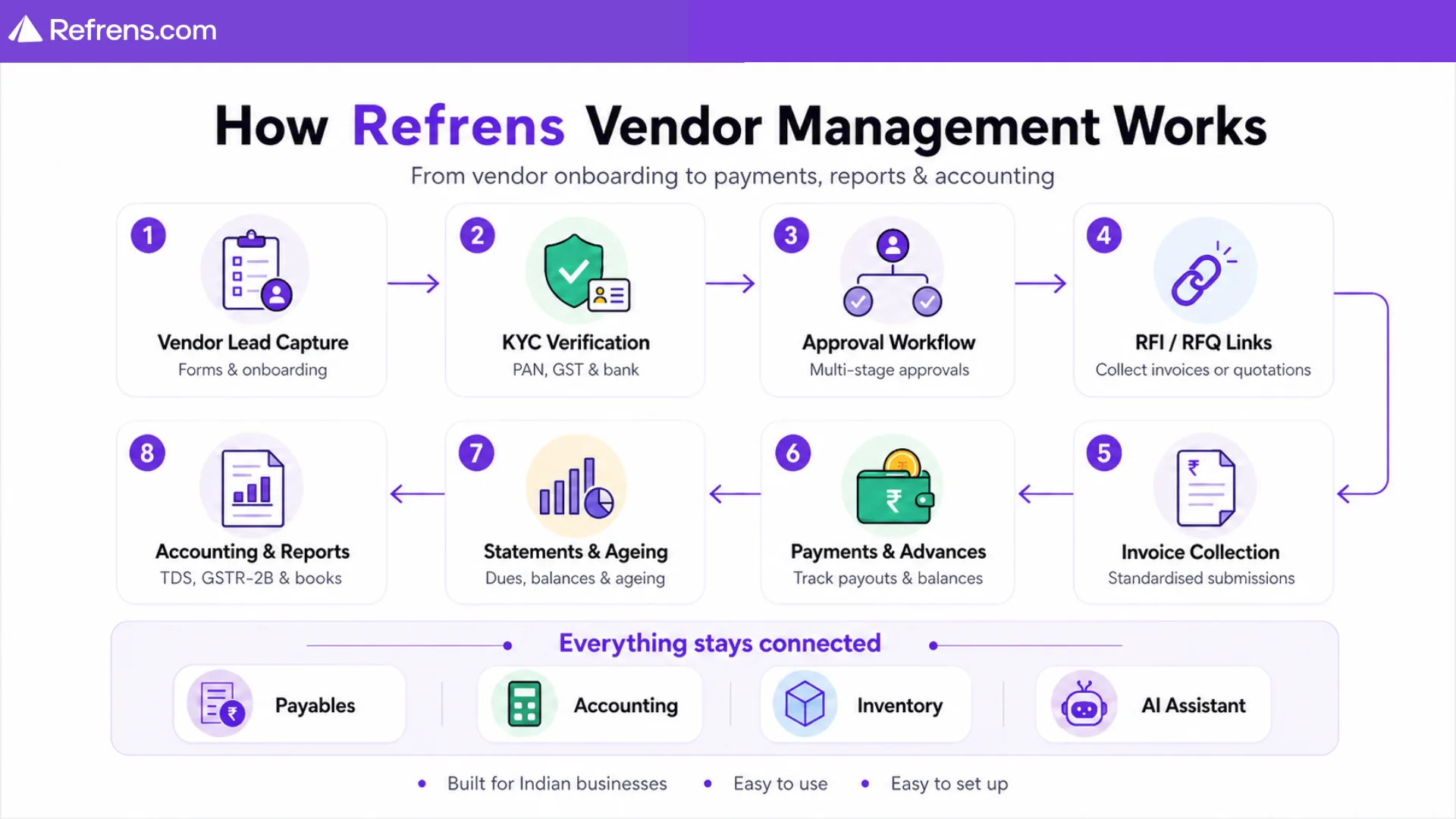
Refrens is one of the best vendor management software options for Indian businesses that want vendor onboarding, KYC verification, vendor approval workflows, invoice collection, payment tracking, vendor statements, ageing reports, accounting, and inventory-connected payables in an easy-to-use system.
It goes beyond a basic vendor database by connecting vendor management with finance and operational workflows after a vendor is added. With Refrens, businesses can collect and verify vendor details, set up approval workflows, request quotations or invoices, track payments and advances, generate payout receipts, and monitor vendor statements and ageing reports.
This makes it useful for businesses managing multiple vendors, contractors, instructors, service providers, or expense contributors. For example, Refrens helped SportsKeeda move from email-based onboarding and manual verification to structured vendor forms, 1-click KYC, RFI links, invoice approvals, and payment visibility. Read the SportsKeeda case study.
Refrens also helped upGrad simplify expense management and approval through its Expense Approval Software for a large number of freelance instructors, reducing manual coordination and improving financial efficiency. Read the upGrad case study.
Refrens is a great fit for Indian businesses looking for an easy-to-use, easy-to-set-up system with no heavy procurement complexity.
Key Features
- Centralised Vendor Dashboard – Manage all vendors from one place, with quick access to their details, documents, transactions, outstanding amounts, and activity.
- Vendor Onboarding Software – Create structured vendor onboarding processes to collect information, verify details, and move vendors through defined approval stages.
- Vendor Lead Capture Forms – Use shareable forms to collect vendor details and automatically add new vendor submissions to your onboarding workflow.
- 1-Click Vendor KYC – Quickly initiate vendor verification without manually checking information across multiple sources.
- PAN, GST, and Bank Verification – Verify important vendor details such as PAN, GSTIN, and bank information before onboarding or making payments.
- Refrens Trust Score – Review a vendor’s GST filing history, including late returns, missed filings, filing patterns, and GSTIN status before approving or working with them.
- Vendor Approval Workflows – Route new vendors through predefined approval stages so the right stakeholders can review and approve them before onboarding is completed.
- RFI Software – Send structured Requests for Information to vendors and collect the required details and documents in an organised manner.
- RFQ Software – Send Requests for Quotation to multiple vendors, collect their quotations, and maintain the responses within a structured procurement process.
- Vendor Invoice Collection – Collect and organise invoices received from vendors so they can be reviewed, recorded, and processed without relying on scattered email or WhatsApp conversations.
- Vendor Payment Tracking – Track payments made to vendors and maintain visibility into paid, pending, and outstanding amounts.
- Payout Receipts – Generate and maintain payout receipts as proof of payments made to vendors.
- Vendor Statements – View a complete statement of transactions with each vendor, including purchases, payments, credits, and outstanding balances.
- Vendor Ageing Reports – Analyse outstanding vendor payables based on how long they have been due, helping finance teams plan upcoming payments.
- Purchase Approval Software – Route purchase documents through defined approval workflows before they are finalised or processed.
- Expense Approval Software – Create structured workflows for reviewing and approving employee or business expenses before they are accounted for or reimbursed.
- OCR Expense Scanning – Scan bills and expense documents using OCR to extract information and reduce manual data entry while recording expenses.
- TDS Reports – Track TDS-related transactions and generate reports that help businesses review their TDS obligations and records.
- GSTR-2B Reports – Review purchase-side GST information against GSTR-2B to identify eligible input tax credit and reconciliation differences.
- Accounting and Inventory Connection – Connect purchases, vendor transactions, stock movements, and accounting so operational activity automatically reflects in financial records.
- AI Accounting Assistant – Use FREYA to ask questions about business and financial data and get insights without manually creating or analysing multiple reports.
- Inventory Management – Manage stock levels, purchases, warehouses, batches, serial numbers, and other inventory-related operations alongside vendor and accounting workflows.
- Multi-Approval Workflows – Create multi-stage approval processes where documents, vendors, purchases, or expenses can pass through multiple reviewers before final approval.
Benefits
Refrens helps businesses reduce manual vendor follow-ups, verify vendor details before payments, collect invoices in a structured way, track vendor dues, and keep payables connected with accounting.
Pricing
Refrens offers a free trial with paid plans starting from ~₹2083/month for five users. You can even customise plans depending on your business needs and requirements.
Rating and Review
Average rating: 4.8/5 (Based on Capterra rating of 4.9/5 and G2 rating of 4.7/5)
Total reviews: 257
Refrens has strong ease-of-use and support positioning, making it suitable for Indian businesses that want fast adoption across finance and operations teams.
Why Refrens Stands Out:
Refrens is not limited to storing vendor records. It connects vendor onboarding with real finance and operations workflows such as RFQ/RFI, expense recording, invoice approvals, payment tracking, vendor reports, accounting, and inventory. This makes it especially useful for Indian businesses that want vendor management without heavy enterprise procurement complexity.
2. Clear Supply Chain Cloud – Best for GST compliance and vendor portal workflows

Clear Supply Chain Cloud focuses on vendor onboarding, compliance, payment tracking, vendor portals, and ERP-connected vendor master workflows.
Clear is relevant for businesses that want vendor management connected with GST, compliance, and AP automation.
Key Features
- Digital vendor onboarding
- Vendor KYC
- Custom vendor forms
- Vendor portal
- Invoice upload by vendors
- Invoice status tracking
- Re-KYC
- ERP integration
- Payment tracking
- GST compliance workflows
- AP automation
Benefits
Clear is useful for businesses that need vendor management connected with GST compliance, vendor master maintenance, and accounts payable workflows.
Pricing
Follows custom pricing for enterprise and supply chain solutions.
Rating and Review
Average rating: 4.1/5 (Based on Capterra rating of 4.3/5 and G2 rating of 3.8/5)
Total reviews: 26
Clear has strong brand recall in tax, GST, compliance, and finance workflows. You should check module-specific reviews for the vendor management product before purchase.
3. Finifi– Best Operations AI platform for enterprise finance teams

Finifi is an Operations AI Platform that automates O2C and P2P Journeys for Enterprises. It’s Procure-to-Pay suite helps companies to move manual vendor onboarding, invoicing, and payments off emails and Excel onto one connected system.
It gives vendors a self-service portal to onboard, submit invoices, and track payments, while finance runs structured payment tickets through multi-level approvals before executing payments via connected banking and GSTR-2A/2B checks built in.
Key Features
- Self-service vendor portal for onboarding, invoices, and queries
- GSTIN, PAN, bank, and MSME verification with penny-drop checks
- Vendor risk assessment
- Structured payment tickets with multi-level approval workflows
- Connected banking for direct payment execution
- Real-time payment status tracking
- GSTR-2A / 2B reconciliation
- Full audit trail across onboarding, invoices, and payments
- Integrations with SAP, Oracle, Dynamics 365, Zoho, and Tally
Benefits
Finifi is useful for enterprises that want to eliminate manual vendor payment follow-ups, enforce clean vendor data, and get audit-ready payment approvals connected directly to banking.
Pricing
Follows custom enterprise pricing based on vendor volume and integrations.
Rating and Review
Rating is not publicly available.
Finifi has strong traction among Indian enterprises replacing manual vendor payment processes, with customers including Jyothy Labs, Aditya Birla Group, Chhedas and Baskin Robbins.
4. CashFlo – Best for AP automation and vendor payment visibility

It is an India-focused platform useful for teams wanting vendor onboarding, AP automation, payment tracking, and vendor communication in one workflow.
Its vendor workflows are more finance-led than procurement-led, making it relevant for teams that want to reduce vendor payment follow-ups and improve payment visibility.
Key Features
- Vendor onboarding
- Real-time KYC checks
- PAN verification
- GST verification
- Bank account verification
- MSME checks
- TDS checks
- Vendor portal
- AP automation
- Vendor payment updates
- GST compliance tools
- ERP integration
Benefits
CashFlo is useful for finance teams that want to automate accounts payable, reduce vendor payment follow-ups, and improve vendor compliance checks.
Pricing
Follows custom pricing.
Rating and Review
Rating is not publicly available.
CashFlo has review visibility around finance automation, cash-flow workflows, and AP processes.
5. Procol – Best for procurement, RFQs, sourcing, and auctions

Procol is a procurement platform with vendor onboarding and supplier due diligence features.
It is especially relevant for businesses where vendor management is closely connected with sourcing, RFQs, auctions, and procurement decisions.
Key Features
- Vendor onboarding
- Supplier due diligence
- PAN validation
- TAN validation
- MSME validation
- Vendor portal
- RFQ management
- eAuction
- Sourcing workflows
- Procurement automation
- Supplier validation
Benefits
Procol is a good choice for procurement-heavy businesses that need sourcing, vendor verification, RFQs, and auction workflows.
Pricing
Follows custom pricing.
Rating and Review
Rating: 4.8/5 (Capterra rating is not publicly available. G2 rating is 4.8/5)
Total reviews: 53
Procol has strong review visibility around sourcing, procurement workflows, bidding, and supplier collaboration.
6. TYASuite – Best for procurement and invoice automation

TYASuite is built around procurement automation, vendor portals, invoice automation, approval workflows, and vendor analytics.
It is useful for companies that want vendor management connected with purchase workflows and invoice processing.
Key Features
- Vendor onboarding
- Vendor portal
- PO automation
- Invoice automation
- Compliance workflows
- Vendor analytics
- GST data extraction
- Invoice capture from email and portal
- Approval workflows
- Procurement automation
Benefits
TYASuite is useful for companies that need a procurement-first system with vendor and invoice automation.
Pricing
Pricing starts at ₹899/user/month and can be operated by more than 50 users. It also offers custom and demo-led pricing models.
Follows demo-led or custom pricing.
Rating and Review
Average rating: 4.4/5 (Based on Capterra rating of 4.2/5 and G2 rating of 4.6/5)
Total reviews: 91
TYASuite has public review visibility around procurement, PR/PO management, approval processes, finance workflows, and invoice automation.
7. PRM360 – Best for source-to-pay procurement workflows
PRM360 is a procurement lifecycle management platform for businesses that need structure around sourcing, supplier management, purchase workflows, and spend control.
It is better suited for businesses with formal procurement processes than those looking only for basic vendor records.
Key Features
- Procure-to-pay workflows
- Source-to-pay workflows
- Supplier management
- Strategic sourcing
- RFQs
- Auctions
- Vendor master management
- Invoice processing
- Spend analytics
- ERP integration
Benefits
PRM360 is useful for procurement teams that want more structure around sourcing, purchasing, vendor workflows, and spend control.
Pricing
Follows custom pricing.
Rating and Review
Average rating: 4.9/5 (Based on Capterra rating of 5.0/5 and G2 rating of 4.8/5)
Total reviews: 144
PRM360 has review and listing visibility around procurement lifecycle management and procure-to-pay automation.
8. Zoho Creator – Best for custom vendor management apps

Zoho Creator is a low-code platform that lets you build custom vendor management apps and supplier portals.
It allows businesses to design forms, workflows, approvals, dashboards, and reports around their own process instead of giving one fixed vendor management workflow.
Key Features
- Vendor database
- Vendor contact management
- Vendor rating
- Performance tracking
- Custom forms
- Custom workflows
- Supplier portal
- PO status tracking
- Payment status tracking
- Low-code customisation
- Integrations
Benefits
Zoho Creator is useful for businesses that want a flexible, customisable vendor management system instead of a fixed workflow.
Pricing
Pricing plans start at ₹480/user/month, and are billed annually. It follows per-user pricing with different plans based on users, applications, and features. Zoho also offers a 15-day free trial.
Rating and Review
Average rating: 4.3/5 (Based on Capterra rating of 4.3/5 and G2 rating of 4.3/5)
Total reviews: 334
Zoho Creator has strong review visibility as a low-code application builder and custom workflow platform.
9. Kissflow – Best for low-code vendor and procurement workflows

Kissflow is useful for teams that want workflow automation and custom vendor processes without building software from scratch.
Its supplier and vendor management workflows can support registration, requalification, document uploads, approvals, and performance tracking.
Key Features
- Vendor forms
- Supplier onboarding
- Document uploads
- Registration workflows
- Requalification workflows
- Vendor scoring
- Certification alerts
- Vendor performance tracking
- Procurement integration
- Low-code workflows
Benefits
Kissflow is useful for businesses that want flexible vendor and supplier workflows.
Pricing
Follows sales-led or custom pricing depending on product and workflow requirements. Its basic plan starts from $2,500/month offering limited features.
Rating and Review
Average rating: 4.3/5 (Based on Capterra rating of 4.2/5 and G2 rating of 4.3/5)
Total reviews: 678
Kissflow has strong adoption in workflow automation, low-code process building, and procurement process management.
10. Pazy – Best for vendor master data and AP workflows

Pazy focuses on finance-led vendor management. It is useful for businesses that want to digitise vendor onboarding, vendor master data, compliance checks, and AP workflows.
It is especially relevant for teams that want vendor details and payables to be cleaner before invoices and payments are processed.
Key Features
- Digital vendor onboarding
- GSTIN verification
- PAN verification
- Bank verification
- MSME verification
- Vendor master management
- Document collection
- Accounts payable workflows
- Expense management
- Procurement support
Benefits
Pazy is useful for businesses that want to digitise vendor master data and reduce manual verification work.
Pricing
Pazy offers tiered flat-rate pricing ranging from $109 to $439+/month, covering features like smart vendor onboarding, contract management, spend visibility, and ERP integrations. It also offers custom pricing.
Rating and Review
Average rating: 4.95/5 (Based on Capterra rating of 5.0/5 and G2 rating of 4.9/5)
Total reviews: 13
Public review visibility for Pazy’s vendor management module is limited compared with older procurement and accounting platforms.
11. mjPRO – Best for eProcurement, tendering, and auctions
mjPRO is better suited for large procurement teams with formal procurement departments than businesses looking only for simple vendor onboarding and payment tracking.
Key Features
- eProcurement
- Source-to-pay workflows
- Vendor collaboration
- Tendering
- Auctions
- Supplier database
- Sourcing workflows
- Procurement analytics
- Supplier registration
Benefits
mjPRO is useful for large procurement teams that manage tendering, auctions, sourcing, and supplier collaboration at scale.
Pricing
Follows custom pricing.
Rating and Review
Average rating: 4.6/5 (Based on Capterra rating of 4.5/5 and G2 rating of 4.7/5)
Total reviews: 244
mjPRO has stronger relevance for eProcurement, sourcing, tendering, auctions, and large procurement-led workflows.
12. Volopay – Best for spend management and vendor payments

It is useful for businesses that want vendor payment tracking connected with broader spend control, cards, reimbursements, and finance operations.
Key Features
- Vendor database
- Bill payments
- Approval workflows
- Expense management
- Spend control
- Corporate cards
- Budget tracking
- Accounting integrations
- Vendor payment workflows
Benefits
Volopay is useful for finance teams that want vendor payments and spend management in one system.
Pricing
Follows custom pricing based on business requirements.
Rating and Review
Average rating: 4.4/5 (Based on Capterra rating of 4.5/5 and G2 rating of 4.3/5)
Total reviews: 139
Volopay has stronger positioning in spend management and finance automation than in full vendor onboarding or supplier lifecycle management.
13. Zycus – Best for enterprise supplier management and source-to-pay

Zycus is an enterprise procurement platform with supplier management, supplier risk, supplier performance, and source-to-pay capabilities. It is better suited for large procurement teams that need advanced supplier governance.
Key Features
- Supplier onboarding
- Supplier information management
- Supplier performance tracking
- Supplier risk assessment
- Compliance management
- Supplier collaboration
- Source-to-pay workflows
- AI procurement capabilities
Benefits
Zycus is suitable for large businesses with complex procurement, supplier performance, and risk management needs.
Pricing
Follows custom enterprise pricing.
Rating and Review
Average rating: 3.8/5 (Based on Capterra rating of 4.0/5 and G2 rating of 3.6/5)
Total reviews: 16
Zycus has enterprise review visibility, especially around source-to-pay and supplier management workflows.
14. SAP Ariba – Best for enterprise supplier lifecycle management

SAP Ariba is one of the strongest enterprise procurement and supplier lifecycle platforms. It is built for large organisations that need supplier onboarding, procurement controls, sourcing, supplier performance, risk visibility, and SAP ecosystem integration.
Key Features
- Supplier lifecycle management
- Supplier onboarding
- Supplier performance management
- Supplier collaboration
- Supplier risk management
- Supplier information management
- Procurement suite integration
- SAP ecosystem integration
Benefits
SAP Ariba is suitable for large enterprises, especially those already using SAP systems.
Pricing
Follows custom enterprise pricing.
Rating and Review
Average rating: 4.0/5 (Based on Capterra rating of 3.8/5 and G2 rating of 4.1/5)
Total reviews: 843
SAP Ariba has strong review visibility across enterprise procurement and spend management categories.
15. Oracle NetSuite – Best for ERP-based vendor management
Oracle NetSuite is useful for companies that want vendor management inside a larger ERP setup. It’s not only a standalone vendor management tool, but it also integrates vendor records with finance, procurement, inventory, and reporting.
Key Features
- Central vendor records
- Vendor portal
- Vendor scorecards
- Multi-subsidiary vendor management
- Vendor communication
- Supplier performance tracking
- ERP reporting
- Procurement connection
Benefits
NetSuite is useful for businesses that want vendor management as part of a larger ERP setup.
Pricing
NetSuite pricing is structured as a base platform fee ($999/month) plus per-user subscription fees ($99–$199/user/month) plus module add-ons. The base license includes core financials. Additional modules (CRM, ecommerce, manufacturing, WMS, etc.) are priced separately. One-time setup costs range from $25,000 to $150,000+. It offers custom pricing as per business requirements, too.
Rating and Review
Average rating: 4.2/5 (Based on Capterra rating of 4.2/5 and G2 rating of 4.1/5)
Total reviews: 6,501
NetSuite is widely reviewed as an ERP system. You should evaluate vendor management features as NetSuite is more comprehensive than standalone vendor management software.
16. Coupa – Best for enterprise spend management and supplier collaboration

Coupa is a global enterprise procurement and spend management platform. It is useful for large companies that need supplier collaboration, procurement workflows, spend visibility, invoice workflows, and enterprise reporting.
Key Features
- Supplier collaboration
- Supplier profiles
- Supplier qualification
- PO collaboration
- Procurement workflows
- Source-to-pay workflows
- Spend management
- Invoice and payment workflows
- Enterprise reporting
Benefits
Coupa is useful for large enterprises that need global procurement and supplier collaboration.
Pricing
Coupa offers a few free services to its users. Its paid tier starts from $549/year and can go upto $4,800/year. This is mainly for suppliers using Coupa’s supplier network/support options, not the full buyer-side vendor management software.
It follows custom buyer-side pricing depending on modules and company requirements.
Rating and Review
Average rating: 4.1/5 (Based on Capterra rating of 4.0/5 and G2 rating of 4.2/5)
Total reviews: 690
Coupa has strong public review visibility in enterprise spend management and procurement categories.
How Does Vendor Management Software Work?
Most vendor management software follows a simple vendor lifecycle.
- Vendor registration: A vendor is added manually or through an onboarding form.
- Document collection: The vendor submits PAN, GSTIN, bank details, address proof, MSME certificate, or other required documents.
- KYC and verification: The business verifies important details before approval.
- Vendor approval: The vendor goes through an internal approval workflow.
- Vendor activation: Once approved, the vendor becomes active for purchases, invoices, and payments.
- Invoice or quotation collection: The business can request invoices or quotations through forms, portals, or RFI/RFQ links.
- Purchase and payment tracking: Purchases, invoices, advances, payments, and dues are tracked.
- Reporting: The system generates vendor statements, ageing reports, payment reports, and compliance reports.
Why Indian Businesses Need Vendor Management Software
Indian businesses often work with vendors across purchases, expenses, inventory, services, logistics, manufacturing, and operations.
As the number of vendors grows, manual tracking becomes risky.
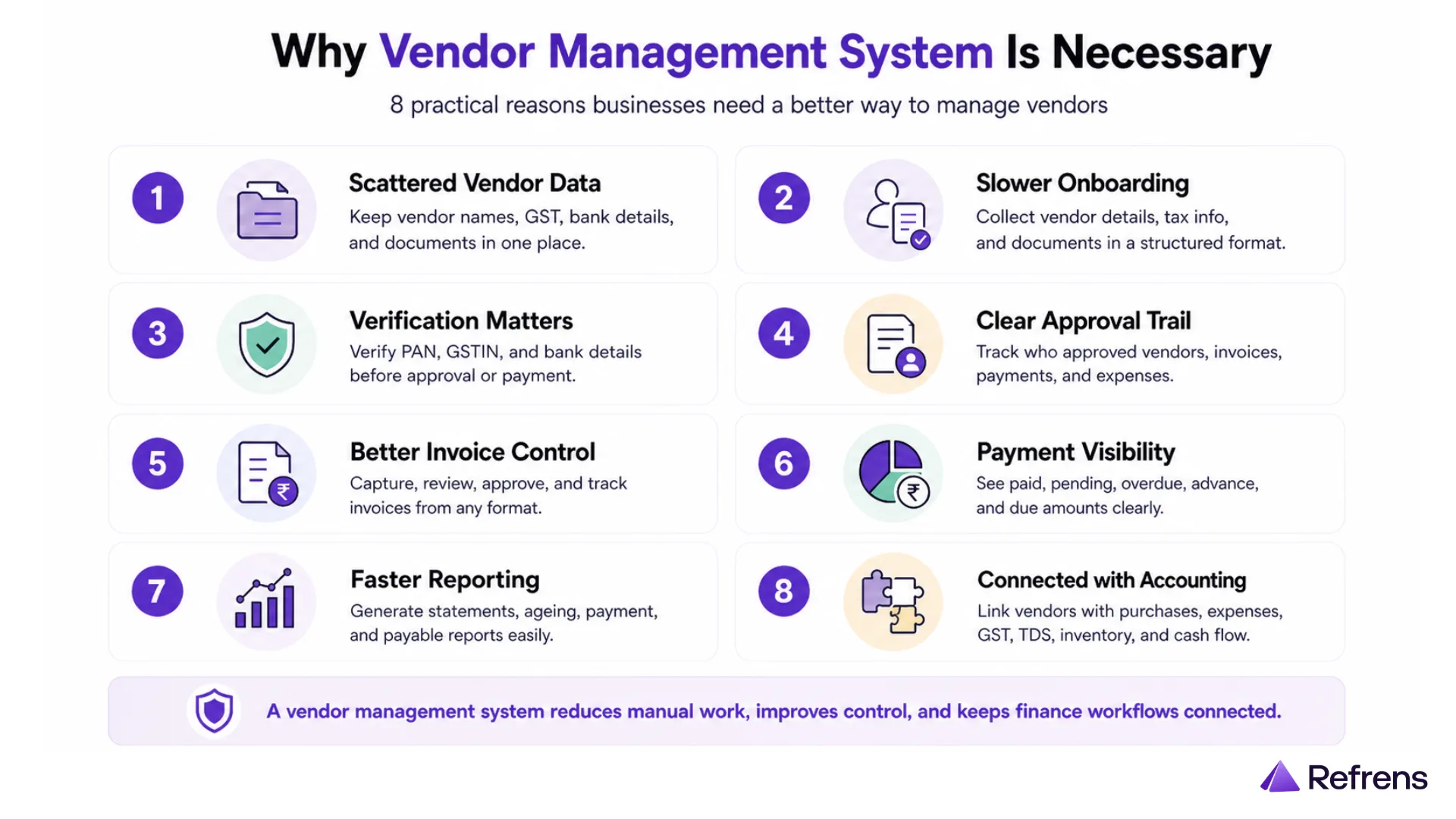
1. Vendor details get scattered
Vendor names may be in one spreadsheet. GST numbers may be in an accounting software. Bank details may be in emails. Invoices may be on WhatsApp.
This creates confusion and errors. Vendor management software keeps all vendor information in one place.
2. Vendor onboarding becomes slow
Manual onboarding leads to repeated follow-ups, missing documents, and inconsistent records.
Vendor onboarding software helps collect vendor details, tax information, documents, and payment information in a structured format.
3. Vendor verification becomes important
Wrong PAN, GSTIN, or bank details can lead to payment errors, compliance issues, and a risk of fraud.
Vendor KYC helps businesses verify details before approving vendors or making payments. Refrens’ Vendor Verification Software makes this process easy.
4. Approvals need a clear trail
If approvals happen through calls, emails, or chat messages, it becomes hard to track who approved what.
Vendor management software creates a proper approval record.
5. Vendor invoices need better control
Vendor invoices may come as PDFs, images, scanned copies, emails, or printed bills.
Vendor invoice management software helps collect, record, approve, and track these invoices properly.
6. Payments and dues need visibility
Businesses need to know what is paid, what is pending, what is overdue, and what has been paid in advance.
Vendor payment tracking helps finance teams manage payables better.
7. Vendor reports should not be manual
Vendor statements, ageing reports, payment reports, and payable reports help teams understand vendor-wise balances and pending dues.
Software makes these reports easier to maintain.
8. Vendor management should connect with accounting
Vendor data affects purchases, expenses, GST, TDS, inventory, ledgers, and cash flow.
When vendor management is connected with accounting, teams avoid duplicate work and get cleaner reports.
Types of Vendor Management Software
Vendor management software can be grouped by the part of the vendor lifecycle it manages, such as onboarding, procurement, contracts, payments, risk, performance, SaaS tools, or complete vendor operations.
| Type of Vendor Management Software | Primary Focus | Best For |
| Vendor Onboarding Software | Vendor registration, documents, KYC, approvals | Businesses adding many new vendors |
| Vendor Information Management System | Central vendor database | Businesses with scattered vendor data |
| Supplier Relationship Management System | Communication and long-term relationships | Businesses with repeat or strategic vendors |
| Procurement Management System | Purchase requests, RFQs, POs, approvals | Businesses with formal purchasing workflows |
| Contract Management System | Vendor contracts and renewals | Businesses working through formal agreements |
| Supplier Performance Management System | Vendor scorecards and performance | Businesses comparing vendor quality and reliability |
| Third-Party Risk Management System | Compliance, legal, financial, and cyber risk | Enterprises and regulated businesses |
| SaaS/IT Vendor Management System | Software vendors, licences, renewals, SaaS spend | Businesses using many SaaS or IT tools |
| Accounts Payable Management System | Vendor bills, payments, dues, reconciliation | Finance teams managing payables |
| Inventory and Supplier Management System | Suppliers, purchases, stock movement | Retail, wholesale, manufacturing, distribution |
| All-in-One Vendor Management System | End-to-end vendor operations | Indian businesses needing vendors, payments, accounting, and compliance together |
Must-Have Features of Vendor Management Software
Before choosing a vendor management system, check whether it supports the workflows your business actually needs.
| Feature | Description |
| Centralised vendor database | Stores vendor details, GSTIN, PAN, bank details, address, documents, notes, purchase and payment history in one place. |
| Vendor onboarding forms | Structured forms to collect vendor information instead of scattered emails or WhatsApp messages. |
| Vendor KYC verification | Verifies PAN, GSTIN, and bank details before approving vendors or making payments. |
| Approval workflows | Controls who can approve vendors, invoices, purchases, and payments. |
| RFI/RFQ links or vendor request forms | Enables standardized requests for invoices or quotations from vendors. |
| Vendor invoice management | Helps collect, record, approve, and track vendor invoices. |
| Vendor payment tracking | Tracks payments, advances, pending dues, payout receipts, and balances. |
| Vendor statements | Shows complete transaction history including invoices, payments, advances, and balances. |
| Vendor ageing reports | Displays how long dues have been pending to prioritize payments. |
| Contract management | Stores contracts, tracks renewal dates, and maintains records for long-term vendors. |
| Vendor performance tracking | Provides scorecards for delivery quality, delays, pricing, and service reliability. |
| Compliance tracking | Tracks compliance documents, expiry dates, certifications, and audit records. |
| GST, TDS, and payable reports | Connects vendor data with GST, TDS, purchases, and payable reports (important for Indian businesses). |
| Audit trails | Tracks who created, edited, approved, or updated records, invoices, and payments. |
| Accounting or ERP connection | Integrates with accounting, ERP, procurement, inventory, or finance systems. |
| Ease of use and setup | Ensures the system is simple to use so teams don’t revert to Excel or WhatsApp. |
For Indian businesses, Refrens is a strong fit because it is easy to use, easy to set up, and still covers vendor onboarding, KYC, approvals, invoices, payments, statements, ageing reports, and accounting-connected payables.
How to Choose Vendor Management Software
Choosing vendor management software should start with your business problem.
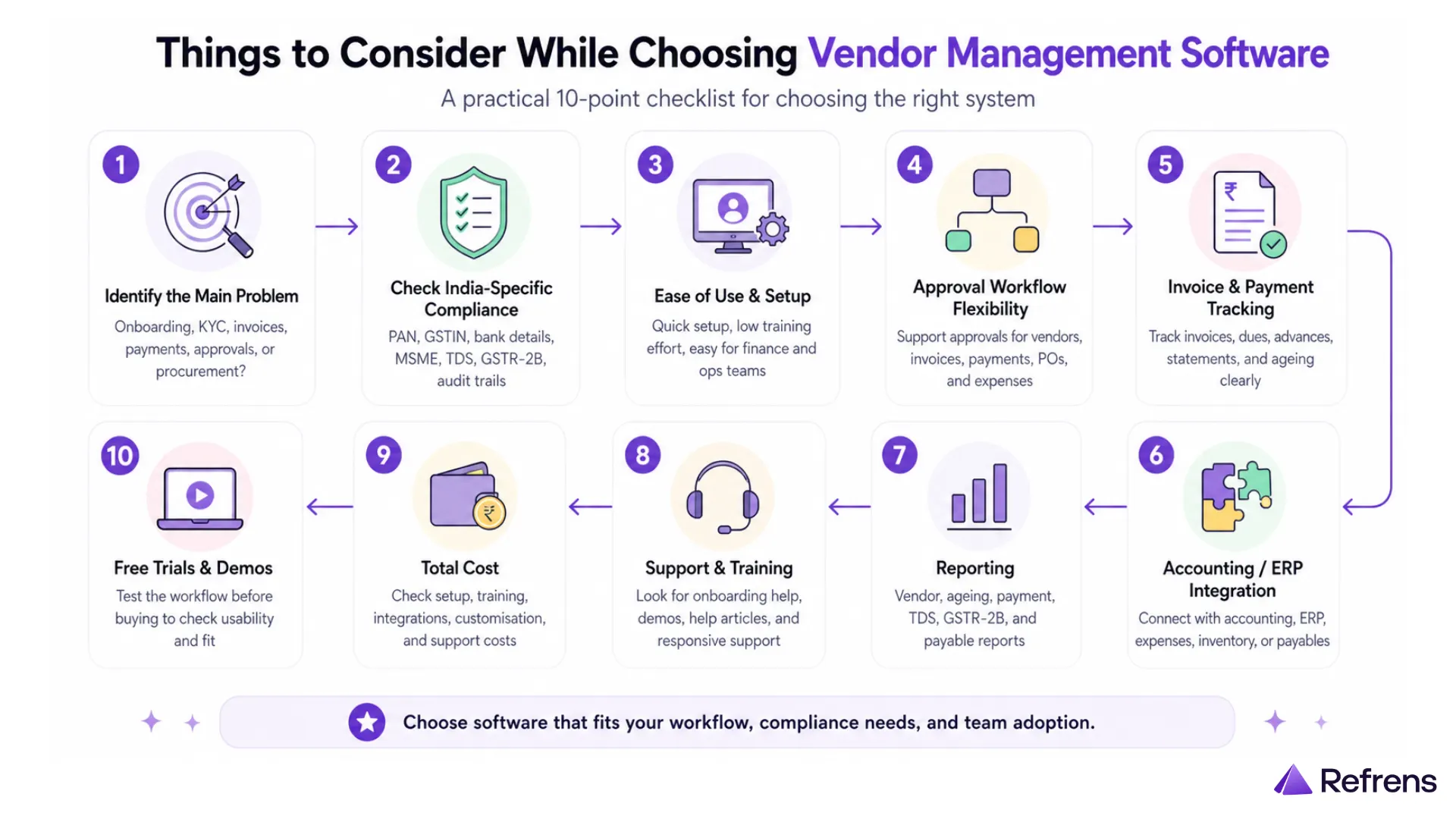
1. Identify your main vendor problem
Ask yourself what you are trying to solve.
Is your problem vendor onboarding, KYC, invoice collection, payment tracking, approval workflows, procurement, GST reports, TDS reports, vendor statements, supplier performance, or vendor risk?
If you need simple, practical control over onboarding, KYC, approvals, invoices, payments, statements, and accounting, Refrens is a strong fit.
If you need complex enterprise procurement and supplier risk management, tools like SAP Ariba, Zycus, Coupa, or PRM360 may be more relevant.
2. Check India-specific compliance needs
For Indian businesses, vendor management should support local workflows such as:
- PAN details
- GSTIN details
- Bank details
- MSME details, if relevant
- TDS tracking
- GSTR-2B reports
- Purchase records
- Vendor statements
- Payables reports
- Audit trails
India-focused platforms like Refrens, Clear, CashFlo, and Pazy are useful here.
3. Check ease of use and setup
A powerful tool is useless if your team cannot use it.
Check whether your finance and operations teams can set it up quickly, use it without heavy training, and generate reports easily.
Refrens stands out here because it is easy to use and easy to set up, while still covering key vendors, payables, and accounting workflows.
4. Check approval workflow flexibility
Choose vendor approval software that lets you clearly define approval stages, as you may need approval for new vendor onboarding, vendor KYC, purchase orders, vendor invoices, vendor payments, or expense documents.
5. Check invoice and payment tracking
If your main challenge is financial control, do not choose a tool that only stores vendor names. Look for invoice tracking, payment status, advance payments, payout receipts, vendor statements, ageing reports, payables reports, and accounting connection.
6. Check integration with accounting or ERP
Vendor management should not become another disconnected system.
Choose software that connects vendor management with accounting, ERP, expenses, inventory, procurement, or payables based on your needs.
7. Check reports
Look for reports such as vendor reports, vendor ageing reports, payment reports, TDS reports, HSN reports, GSTR-2B reports, purchase reports, payable reports, vendor statements, and audit trails.
8. Check support and training
Even easy software needs good support. Check whether onboarding help, demo videos, help articles, and support are available.
9. Check total cost
Along with monthly pricing, check setup cost, implementation effort, training cost, integration cost, customisation cost, extra user cost, support cost, and time required to go live.
10. Check free trials and demos
Always test the software before making a decision.
Look for free trials, live demos, or sandbox access to understand how the system works in real scenarios. This helps you evaluate usability, features, and fit with your workflows before committing.
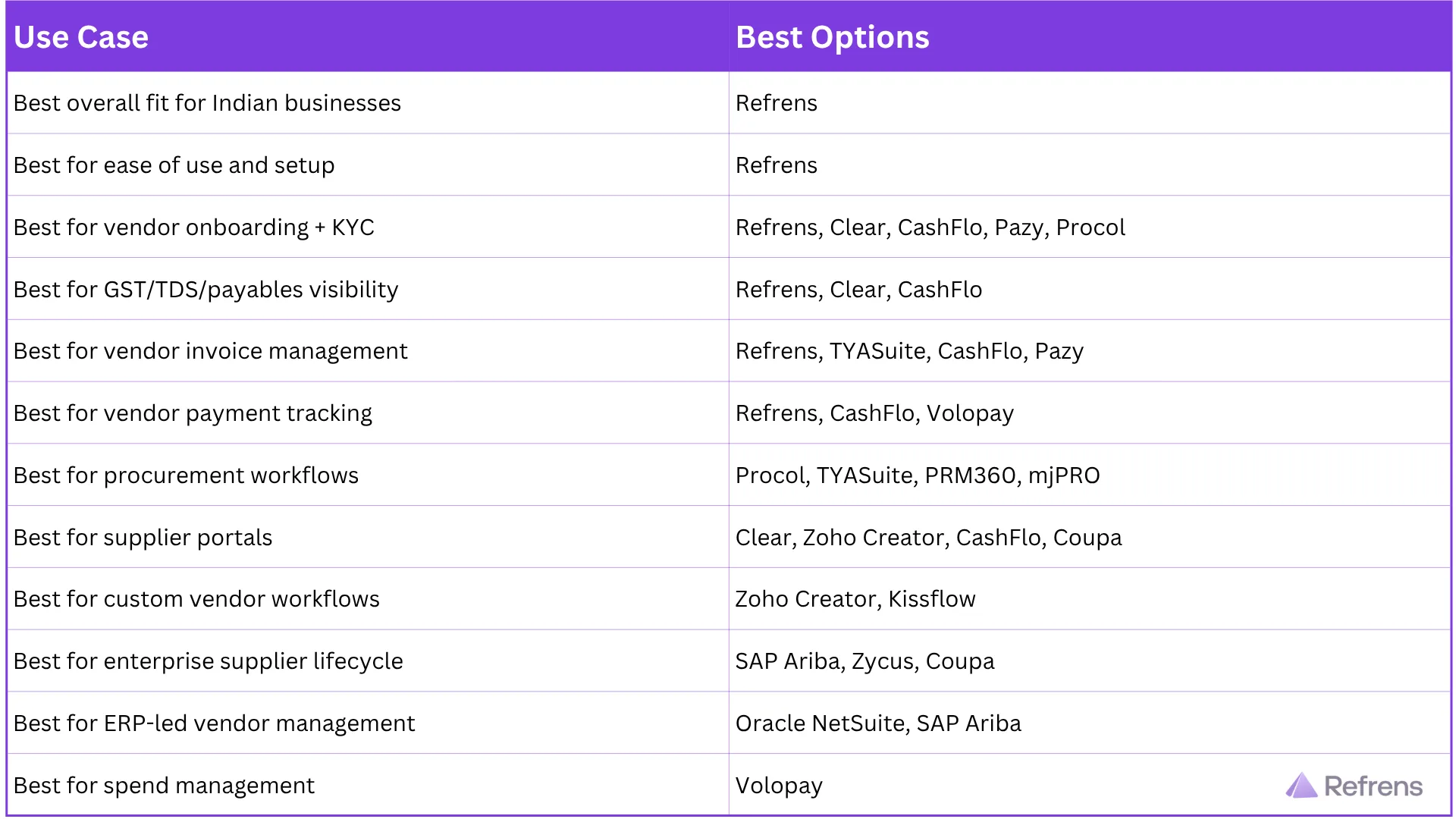
Best Vendor Management Software by Use Case
Common Mistakes While Choosing Vendor Management Software
- Choosing a heavy enterprise tool when you need a practical system: Enterprise procurement tools are powerful, but they may be too complex if you mainly need vendor onboarding, KYC, invoice collection, payment tracking, and accounting.
- Choosing a vendor database instead of a vendor management system: A vendor database only stores vendor details. A vendor management system should help with onboarding, verification, approvals, invoices, payments, statements, and reports.
- Ignoring vendor KYC: PAN, GSTIN, and bank verification should not be treated as optional. Wrong vendor details can create payment errors and compliance issues.
- Ignoring accounting connection: Vendor management is closely connected with purchases, expenses, payables, taxes, and accounting. If the vendor tool does not connect with finance workflows, your team may still need manual work.
- Not involving finance and operations teams: Vendor management affects many teams. Before choosing software, involve the people who will actually use it.
- Overlooking ease of use: If the tool is difficult, people will avoid it. The best vendor management software is the one your team actually uses every day.
- Ignoring reports: Check vendor statements, ageing reports, payment reports, GST reports, TDS reports, and audit trails before choosing.
- Not checking support: Good support matters, especially during setup. Choose a provider that can help your team adopt the system smoothly.
Risks of Not Using Vendor Management Software
If your business manages vendors manually, these risks increase over time.
- Duplicate vendor records: The same vendor may be added multiple times with slightly different names. This creates confusion in purchases, payments, and reports.
- Wrong vendor details: Incorrect bank details, GSTIN, or PAN records can create serious payment and compliance problems.
- Delayed vendor onboarding: Manual onboarding slows down vendor approval and purchase processes.
- No clear approval history: If vendor approvals happen on calls or chats, it becomes hard to prove who approved what.
- Lost invoices: Invoices may get lost in email inboxes, WhatsApp chats, or folders. This causes delayed payments and accounting gaps.
- Payment errors: Without proper tracking, businesses may miss payments, duplicate payments, or fail to adjust advances.
- Poor vendor relationships: Vendors often follow up for payment status, invoice confirmation, and balance details. If your team does not have clear records, vendor communication suffers.
- Weak audit trail: Manual vendor management makes audits harder. You may not have clean records of vendor documents, approvals, invoices, payments, and changes.
- Poor payables visibility: Without vendor ageing reports and statements, businesses may not know what is due, overdue, or already paid.
Conclusion
Vendor management software is no longer only for large procurement teams.
Indian businesses need a better way to manage vendor onboarding, PAN/GST/bank verification, approvals, invoices, payments, vendor statements, ageing reports, GST, TDS, payables, and accounting.
The right software depends on what your business needs.
Choose Zoho Creator or Kissflow if you want to build a custom vendor management workflow using low-code tools.Choose CashFlo, Pazy, or Volopay if your main focus is accounts payable automation, vendor payments, and spend control.
Choose Procol, PRM360, Zycus, SAP Ariba, or Coupa if your business needs deeper procurement, sourcing, auctions, supplier risk, and enterprise source-to-pay workflows.
Choose Refrens if you want an easy-to-use vendor management system for Indian businesses that connects vendor onboarding, KYC verification, approvals, invoices, payments, statements, ageing reports, accounting, and inventory.
So instead of managing vendors through scattered spreadsheets, WhatsApp messages, emails, payment screenshots, and disconnected accounting records, businesses can use Refrens to manage the full vendor workflow from one place.
Frequently Asked Questions
Related Posts:
 Vendor Approval Process: Prequalification, Vetting, Due Diligence & Risk Checks
 Vendor Onboarding Process: Steps, Checklist & Documents
 A Complete Guide to the Types of Invoices
 Best Accounting Software in India: Features, Pricing, Reviews, and more (Updated 2026 List)
 10 Best Invoice Approval Workflow Software
 Everything You Need to Know About Purchase Orders: A Complete Guide
 Streamlining Vendor Onboarding & Invoice Approvals for Sports Media Company: Refrens x SportsKeeda Case Study
 Best Supplier Invoice Software
 Best Invoicing and Billing Software In India (Updated 2026 List)
 The Ultimate Guide to the Best Invoicing and Client Management Software (Updated 2026 List)
 Top AI accounting Software in India
 Top 8 Project Management Software With Invoicing (Updated 2026 List)
 Best Workshop Invoice Software: Features, Pricing, and Reviews
 Top 9 Expense Management Software in India
 10 Best AI OCR Invoicing Software for Invoice Scanning and Accounting Automation
 Top 10 Accounting Software in Saudi Arabia: Features, Benefits, and Pricing
 Best 10 Invoice Reminder Software (Updated 2026 List)
 Best Invoice OCR Software in India: Top 5 Tools Compared