
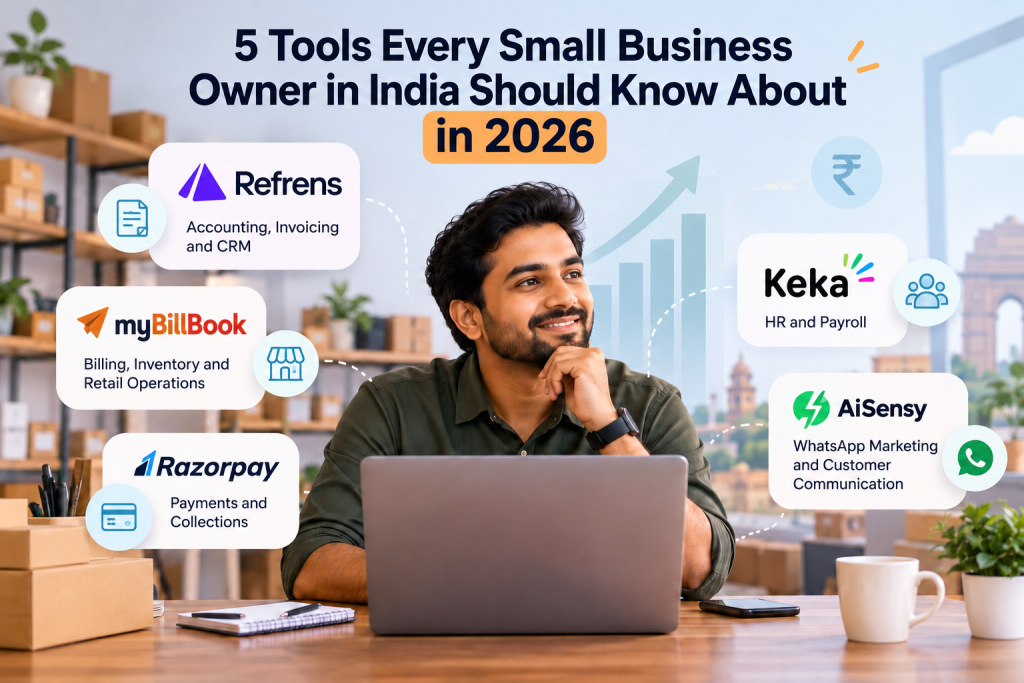
Running a small business in India in 2026 increasingly means managing more than just sales.
A business owner may need to handle invoicing, GST compliance, inventory, payments, employees, customer communication, and reporting, often with a small team and limited time.
The scale of the market itself shows why better business systems matter. As of October 2026, India had around 9.78 crore MSMEs registered through Udyam and the Udyam Assist Platform, with these enterprises reporting more than 43 crore employment opportunities. MSMEs also contribute about 31.1% of India’s GDP, 35.4% of manufacturing output and 48.58% of exports, according to the Economic Survey 2025–26. Press Information Bureau
Digital payments have grown alongside them. NPCI recorded approximately 24.5 billion UPI transactions in August 2026, worth nearly ₹29.82 lakh crore in a single month. NPCI
These numbers point to a simple shift: digital tools are no longer just for larger companies. They are becoming part of the day-to-day operating system of Indian small businesses.
The challenge is choosing tools that solve real problems rather than adding another dashboard to manage.
India’s Small-Business Digital Landscape in 2026
| Indicator | Latest figure |
| Udyam + Udyam Assist registrations | ~9.78 crore |
| Employment reported by registered MSMEs | ~43.28 crore |
| MSME contribution to India’s GDP | 31.1% |
| MSME share of manufacturing output | 35.4% |
| MSME share of exports | 48.58% |
| UPI transactions in August 2026 | 24.51 billion |
| UPI value in August 2026 | ~₹29.82 lakh crore |
Sources: Ministry of MSME/PIB and NPCI. Press Information Bureau
Against that backdrop, here are five tools worth knowing about in 2026.
Quick Comparison
| Tool | Main Category | Particularly Useful For | Standout Capability |
| Refrens | Accounting, invoicing & Sales CRM | Service businesses, agencies, consultants, traders and growing SMBs | AI-assisted accounting combined with invoicing and sales CRM |
| myBillBook | Billing, inventory & accounting for SMBs | Retailers, wholesalers and distributors | GST billing & accounting connected with POS and real-time inventory |
| Razorpay | Payments & collections | Businesses collecting digital payments | Payment gateway, payment links and payouts |
| Keka | HR & payroll | Businesses building larger teams | Payroll connected with attendance, leave and employee records |
| AiSensy | WhatsApp marketing & support | Businesses selling and supporting customers through WhatsApp | Official WhatsApp Business API campaigns, chatbots and team inbox |
1. Refrens – For Accounting, Invoicing and Sales Management
As a business grows, invoicing alone is rarely enough.
For service businesses in particular-such as agencies, professional services firms and IT companies customers have to be followed up with, payments reconciled, expenses recorded, GST-related information maintained, quotations converted into invoices and financial reports reviewed.
Refrens brings invoicing, accounting, sales CRM, expenses, inventory and client/vendor management into one platform.
One of the notable developments in Refrens in 2026 is its use of AI across accounting workflows.
Its Freya AI assistant allows users to ask questions about financial information such as revenue, expenses, receivables, ageing, and cash flow using natural language. Refrens also offers Eagle, which can process bills or receipts received through WhatsApp or email and prepare them for review.
What can businesses use Refrens for?
- Creating GST-compliant invoices and quotations
- Managing customer and vendor records
- Tracking receivables and payables
- Maintaining accounting records and financial reports
- Managing leads through a sales CRM
- Converting quotations into invoices
- Sending invoices and quotations through WhatsApp or email
- Capturing bills and expenses using AI-assisted document processing
- Analysing business data through Freya AI
Refrens also integrates its CRM with its invoicing workflow. Leads can be captured, moved through a pipeline, contacted over WhatsApp or email, and eventually converted into quotations and invoices without recreating customer information.
Who is Refrens best suited for?
Refrens is particularly useful when a business sells services or deals in trading/distribution of products rather than primarily managing a physical retail counter.
For example, a digital agency may need to:
- Capture a lead.
- Send a quotation.
- Convert it into an invoice.
- Track payment.
- Record expenses associated with the project.
- Review profitability.
Keeping those activities connected can reduce repeated data entry.
2. myBillBook – For Billing, Inventory and Retail Operations
A retail or trading business has a different operational problem.
Every sale can affect:
- inventory,
- outstanding payments,
- GST records,
- customer balances,
- barcode stock,
- godown quantities,
- and daily sales reports.
This makes the connection between billing and inventory particularly important.
myBillBook is designed around this workflow for Indian retailers, wholesalers, distributors and other product-led small businesses.
The platform combines GST billing, inventory management, POS billing, payment tracking, reports, e-invoicing and e-Way Bills within one business-management system.
What can businesses use myBillBook for?
- Creating GST and non-GST invoices
- POS billing at the counter
- Barcode scanning
- Automatically updating inventory after sales
- Monitoring low-stock items
- Managing multiple godowns
- Tracking batches and expiry dates
- Tracking serial numbers and IMEI numbers
- Recording outstanding payments
- Generating e-invoices and e-Way Bills
- Reviewing sales and stock reports
For a retail business, the main advantage of connecting these activities is that the owner does not have to maintain billing and inventory separately.
When a sale is recorded, the relevant stock records can be updated at the same time.
Where does it become particularly useful?
Consider a mobile-phone retailer.
The business may need to create GST invoices while also tracking individual devices using IMEI or serial numbers.
A pharmacy may instead need batch and expiry tracking.
A distributor may care more about multiple godowns and stock transfers.
myBillBook supports these inventory workflows alongside billing.
Its POS system also supports features such as barcode scanning, multiple bills, keyboard shortcuts and payment recording for cash, UPI and cards.
Refrens vs myBillBook: where do they fit?
Because both products include invoicing and accounting-related capabilities, businesses should choose based on their core workflow rather than simply comparing feature counts.
| Business requirement | More natural fit |
| Agency or consulting invoicing | Refrens |
| Integrated sales CRM + invoicing | Refrens |
| AI-driven queries on accounting data | Refrens |
| Retail counter billing | myBillBook |
| Barcode-heavy inventory | myBillBook |
| Multi-godown stock management | myBillBook, Refrens |
| Batch, expiry, serial or IMEI tracking | myBillBook, Refrens |
| GST billing | Both, depending on workflow |
| Trading/Distribution Billing | Both |
The important distinction is not that one tool replaces the other in every situation. They are designed around somewhat different types of small-business operations.
3. Razorpay – For Digital Payments and Collections
Getting an invoice out is only half the process.
The business still needs to collect the money.
With UPI alone processing more than 24 billion transactions in a month, digital collections are now central to the way Indian businesses receive payments. NPCI
Razorpay provides payment infrastructure for businesses that need to accept and manage online payments.
Businesses can collect money through:
- UPI
- debit and credit cards
- net banking
- wallets
- payment links
Razorpay Payment Links are particularly useful for businesses that do not operate a full e-commerce website.
A business can create a payment link and share it over WhatsApp, SMS, or email, allowing the customer to pay online.
Where is Razorpay useful?
Consider a consulting business that sends an invoice digitally.
Instead of adding only bank-transfer instructions, the business can send a payment link.
Similarly, an online seller, coaching company or service provider can use payment links to collect deposits or partial payments.
Razorpay’s wider ecosystem also supports payouts and business-banking workflows through RazorpayX. The company notes that RazorpayX-powered current accounts are provided through partner banks rather than Razorpay itself operating as a bank. Razorpay
Best suited for
Businesses that need a reliable digital collection layer alongside their invoicing, website or online selling workflow.
4. Keka – For HR, Attendance and Payroll
A business owner can manage five employees informally.
Managing fifty is much harder.
Attendance affects salary. Leave affects attendance. New hires need onboarding. Employees leave or change roles. PF, ESI, professional tax, and TDS may have to be calculated as applicable.
When these records sit in separate spreadsheets, payroll becomes increasingly difficult to manage.
Keka combines HR, payroll, attendance, leave, employee records, hiring and related workforce workflows.
Keka’s current platform connects attendance, leave, and salary inputs directly with payroll calculations and supports Indian payroll requirements, including TDS, PF, ESI, and professional tax.
Businesses can use Keka for:
- Attendance tracking
- Leave management
- Payroll processing
- Employee records
- Shift management
- Recruitment
- Onboarding
- Performance management
- HR workflows and approvals
The benefit comes from connecting these systems.
For example, once approved leave is reflected in attendance records, the same data can flow into payroll instead of requiring someone to update multiple spreadsheets manually.
When should a small business consider an HR platform?
Probably not on day one.
But once payroll, attendance, and employee administration begin consuming significant management time, having one system becomes much more useful.
Keka is therefore most relevant to small businesses that have moved beyond the founder-plus-a-few-employees stage and are building a structured team.
5. AiSensy – For WhatsApp Marketing and Customer Communication
For many Indian small businesses, customer communication happens primarily on WhatsApp.
Businesses use it for:
- enquiries,
- order confirmations,
- offers,
- payment reminders,
- customer support,
- appointment booking,
- and repeat sales.
But running these activities from a normal WhatsApp account becomes difficult once message volumes grow.
AiSensy is built on the official WhatsApp Business API and combines marketing campaigns, automated conversations, customer support, and WhatsApp-based lead management.
Key capabilities include:
- Bulk WhatsApp campaigns
- Audience segmentation
- Drag-and-drop chatbots
- AI WhatsApp agents
- Shared team inbox
- Click-to-WhatsApp ads
- WhatsApp forms
- Payment workflows
- Campaign analytics
- Retargeting
- Ecommerce integrations
One practical benefit is that multiple employees can respond to customers through a shared WhatsApp setup instead of everyone relying on one phone.
Its chatbot builder can also automate tasks such as answering common questions, qualifying leads, booking appointments, and sending order updates.
Best suited for
Businesses where WhatsApp already plays an important part in sales or customer support and manual conversations are becoming difficult to manage.
Which Tools Does a Small Business Actually Need?
The answer is usually not all five.
The right technology stack depends on how the business operates.
| Business Type | Useful Starting Stack |
| Digital/creative agency | Refrens + Razorpay + Keka as the team grows |
| Retail shop | myBillBook + Razorpay |
| Wholesaler/distributor | myBillBook/Refrens + Razorpay |
| Growing service company | Refrens + Keka + Razorpay |
| WhatsApp-led ecommerce brand | Razorpay + AiSensy + accounting/billing tool |
| Multi-employee retail business | myBillBook + Keka + AiSensy where relevant |
The goal should be to solve a business problem before adding another subscription.
How to Choose Small-Business Software in 2026
Before choosing any tool, ask five practical questions.
1. What repetitive work is costing you time?
Start with the problem.
If the team spends hours creating invoices, the answer may be invoicing software.
If stock numbers constantly mismatch, inventory management may be more urgent.
If leads get forgotten, CRM may come first.
2. Does the tool fit the way your business actually works?
A feature-rich product can still be the wrong choice.
A retailer with thousands of SKUs may care more about barcode billing and inventory than advanced CRM functionality.
A consulting firm may have little need for warehouse management but require quotations, receivables, and lead pipelines.
3. Can your tools exchange information?
Every manual export creates another opportunity for errors.
Where possible, connect payments, accounting, CRM, and communication systems rather than operating each tool as a separate island.
4. Will your team actually use it?
Software only creates value when people consistently use it.
For smaller businesses, a simpler system that employees understand can be more useful than a complicated platform with dozens of unused modules.
5. Can the system grow with the business?
A business with five customers and one employee has very different requirements from one with five branches and fifty employees.
Look beyond the immediate problem and check whether the software supports the next stage of growth.
A Practical Small-Business Tech Stack
Instead of thinking in terms of software brands, think in terms of the jobs your business needs technology to perform.
| Business Function | Example Tool |
| Accounting, invoicing & sales CRM | Refrens |
| Retail billing, inventory & small business accounting | myBillBook |
| Payments & collections | Razorpay |
| HR & payroll | Keka |
| WhatsApp marketing & support | AiSensy |
There will naturally be some overlap.
That is not necessarily a problem.
The aim is not to buy one application for every row. It is to build the smallest possible stack that covers your business’s important workflows.
Final Thoughts
India’s small-business ecosystem is becoming increasingly digital.
Nearly 9.8 crore enterprises are now part of the Udyam/Udyam Assist ecosystem, while digital payment infrastructure processes tens of billions of transactions every month. Press Information Bureau
That makes choosing the right business software less about whether to digitise and more about what to digitise first.
For service businesses, that may mean connecting leads, quotations, invoices and accounting through a platform such as Refrens.
For retailers and distributors, the priority may instead be connecting GST billing with physical inventory through myBillBook.
Razorpay can simplify digital collections, Keka can bring structure to growing teams, and AiSensy can make high-volume WhatsApp communication manageable.
The best software stack is therefore not the one with the most tools.
It is the one that removes the most repetitive work while keeping the business simple enough to run.
Related Posts:
 Best International Payment Gateway That Supports Recurring billing for Indian SaaS companies
 The Ultimate Guide to Inventory Management Metrics: Key Ratios, Costs, and Calculation Methods
 The Ultimate Guide to Basics of Inventory Management
 28 Best Business Management Software In 2026
 A Complete Guide to the Types of Invoices
 Best Accounting Software in India: Features, Pricing, Reviews, and more (Updated 2026 List)
 Best Invoicing and Billing Software In India (Updated 2026 List)
 Which Indian Payment Gateway Delivers the Best ROI at Scale? (2026 PG Pricing Guide)
 8 Best Small Business Invoicing Software (Updated 2026 List)
 Top 15 Vendor Management Software in India for 2026: Features, Pricing, Ratings & Reviews
 Why Your Accounting Software Should Have WhatsApp OCR Scanning
 Top Accounting and Inventory Management Software for Businesses (Updated 2026 List)
 Top 10 Best Recurring Billing Software Options for Your Business (Updated 2026 List)
 A Comprehensive Guide to GST Compliance for E-Commerce Operators in India
 The Ultimate Guide to the Best Invoicing and Client Management Software (Updated 2026 List)
 GSTR: What is GST Return? Types, Rules, Procedures, and Penalties
 Top Electronic Invoicing Software In India
 Everything To Know About GSTR-3A: Issuance, Actions to Take, and Consequences of Non-Compliance