
It’s about time we see AI in accounting as well!
The world of accounting is no longer about dusty ledgers, endless spreadsheets, and hours of manual data entry. With the rise of Artificial Intelligence (AI), the finance industry has entered a new era, one where algorithms analyze transactions in seconds, detect errors automatically, and even predict future cash flow with uncanny accuracy.
And this is just the beginning. The AI in the accounting market is already a 7.52 billion industry, and is expected to be 50.29 billion in 2030 with 46.2% CAGR.
And this transformation isn’t just for tech giants or finance powerhouses.
From small businesses to large enterprises, everyone is embracing AI-powered accounting tools to save time, reduce errors, and make smarter financial decisions. Because AI can help you turn endless data into actionable insights.
In this blog, I’ll walk you through the Top 6 AI Accounting Software that are redefining the industry, exploring their key features, pricing, ratings, and real-world performance.
| Software | Pricing | Highlight Feature | Free Plan | Free Trial | Rating | Best For |
| Refrens | ₹4,900 per year | FREYA – Virtual AI CFO offering real-time insights & predictive automation | ✅ Yes | ✅ Yes | 4.9/5⭐ | Solopreneurs, SMBs, Startups |
| Trullion | Custom | AI-driven Audit & Lease Accounting Automation | ❌No | ❌(Demo available) | 4.8/5⭐ | Mid-size & Enterprise Finance Teams |
| Zeni.ai | Around ₹492,000 per year | AI + Human Finance Team for complete financial management | ❌No | ❌ No (Custom Demo) | 4.3/5 ⭐ | Startups & Growth-stage Businesses |
| Zoho | ₹8,988 per year | AI-powered Automation + Zoho Ecosystem Integration | ❌No | ✅ Yes (14-day Free Trial) | 4.4/5⭐ | SMEs & Scalable Enterprises |
| Odoo | Custom | AI-powered Invoice Automation & Fully Integrated ERP Suite | ❌No | ❌(Demo available) | 4.2/5⭐ | Businesses of all sizes needing ERP + AI Accounting |
| Suvit | ₹ 9,500 per year | AI-powered Data Entry, GST Automation & Client Communication | ❌No | ✅ Yes (7 days) | 3.7/5⭐ | CAs, Tax Consultants & Accounting Firms |
1. Refrens
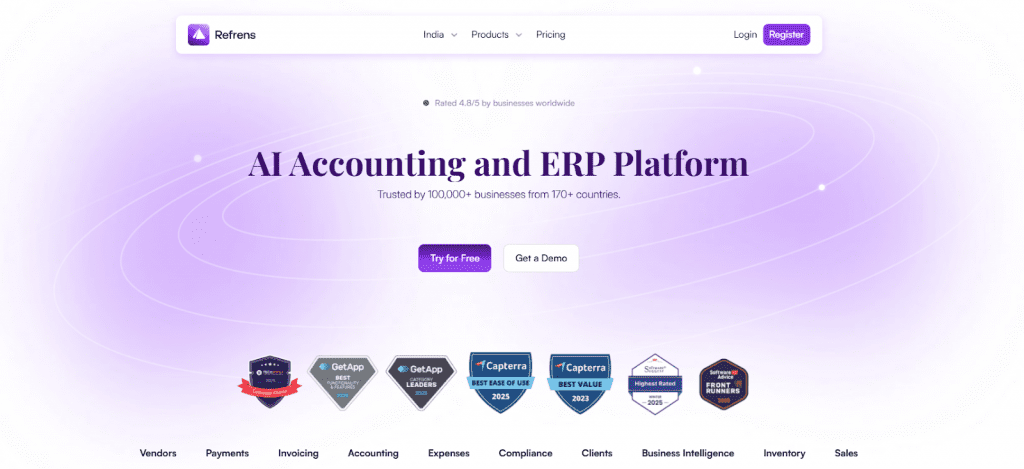
Over 1.5 lakh businesses trust Refrens AI accounting software across 170+ countries. It offers an all-in-one AI-powered platform for managing every aspect of business finance, including invoicing, accounting, payments, compliance, expenses, inventory, and client/vendor management.
Recently, Refrens introduced FREYA, an intelligent AI accounting assistant that acts like a virtual CFO for small and growing businesses. FREYA provides real-time financial insights, helping users make smarter financial decisions without relying on spreadsheets or guesswork.
Key AI-Powered Features
- Freya: AI Insights on Demand: Freya is our virtual CFO that helps get answers to all your business queries in plain English in mere seconds. That means, you instantly get insights and spot trends that generally take days (even weeks) to fetch.
- Automated Bookkeeping: Every time you create an invoice, record an expense, or add a payment, Refrens automatically creates ledgers, updates vouchers, and passes journal entries, without any manual intervention.
- Real-Time Financial Reports: Get trial balance, balance sheet, profit & loss, daybook, and cash flow statements generated instantly, always updated as your business records change.
- AI-Powered OCR Scanning: Automatically capture and record expenses by uploading or scanning vendor invoices. Refrens extracts key data such as vendor details, invoice amount, and tax information, and automatically uploads that into your system.
- Bank & Payment Reconciliation: Refrens AI automatically matches transactions with your bank statements, flags mismatches, and suggests quick fixes. It also lets you resolve issues with one-click actions, helping you finish reconciliations in minutes instead of hours.
- Built-In Taxation and Compliance: Stay compliant without additional effort. Refrens supports e-invoicing, e-way bills, and GSTR reports while also enabling automatic GSTR-2B reconciliation.
Rating:
- Trustpilot: 4.4/5 ⭐
- Glassdoor: 4.7/5 ⭐
- SoftwareSuggest: 4.9/5 ⭐
- Google Play: 4.4/5 ⭐
- Capterra: 4.9/5⭐
- Software Advice: 4.9/5⭐
- GetApp: 4.9/5⭐
2. Trullion
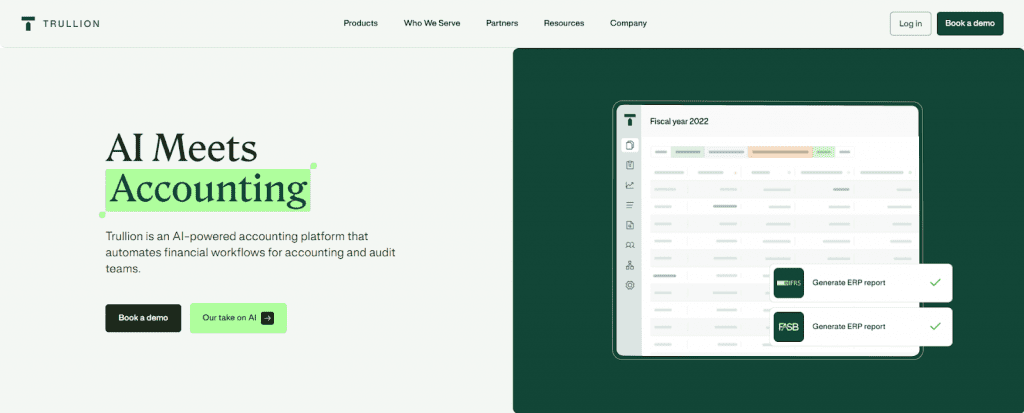
Trullion is an AI-powered accounting platform that helps finance teams with lease accounting and revenue recognition, and automates by transforming complex workflows into simple, intelligent processes.
It also comes with Trulli, an agentic AI assistant that provides answers based on your accounting policies and reporting standards.
Key AI-Powered Features
- Smart Document Extraction: Upload any lease or contract, and Trullion’s AI scans, reads, and extracts critical data like names, dates, and payments — no manual entry needed.
- Automated Lease Accounting: Handles everything from initial contract setup to modifications, journal entries, and disclosures, keeping you compliant with ASC 842 and IFRS 16.
- AI-Driven Audit Trail: Automatically matches data with source documents, performs accuracy checks, and flags inconsistencies for review — making audits faster and cleaner.
- Trulli – The AI Assistant: Trulli helps you interpret complex terms, reconcile data, and clarify accounting treatments, directly within your workflow.
- Revenue Recognition Automation: Extracts and applies rules for ASC 606 and IFRS 15, so revenue schedules update accurately and on time.
- Exception Detection: Identifies unusual transactions or policy deviations in real time, helping teams act before small issues become big ones.
Rating:
- Capterra: 4.8/5⭐
- Software Advice: 4.8/5⭐
- GetApp: 4.8/5⭐
3. Zeni.ai
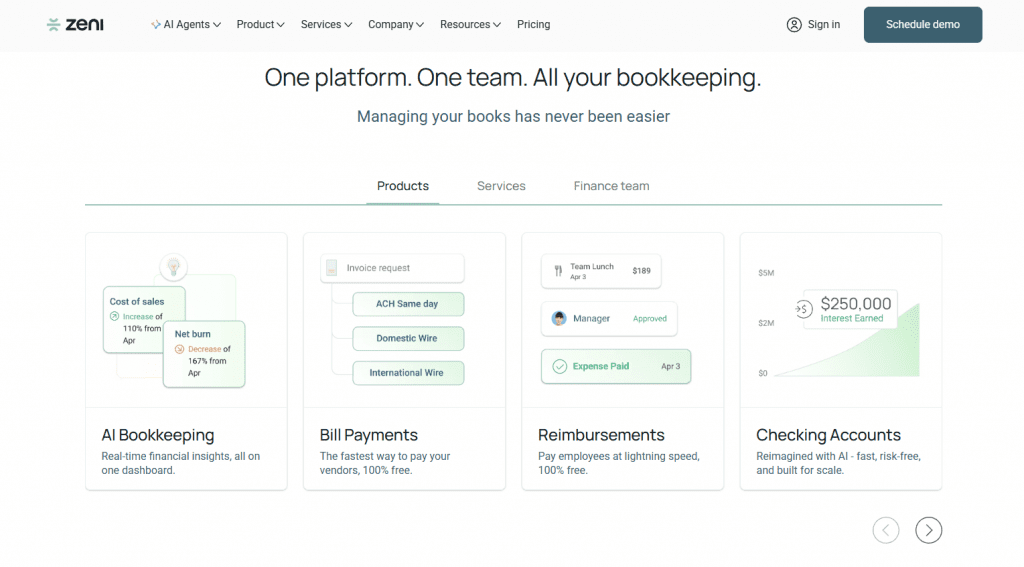
Zeni – an AI-powered finance platform that combines intelligent automation with expert support to manage every aspect of your business finances – bookkeeping and bill pay to reimbursements, banking, and strategic planning.
At the heart of Zeni is a suite of specialized AI agents, each designed to handle a core financial function – be it tracking expenses, forecasting cash flow, or reconciling transactions.
Key AI-Powered Features
- Expert Financial Support: Every customer gets a dedicated finance team that ensures GAAP compliance, manages reporting, and offers ongoing strategic support.
- AI Bookkeeping: Zeni connects your QuickBooks, bank, and credit accounts to automatically categorize transactions and deliver real-time reports.
- Smart Bill Payments: Upload a vendor bill and Zeni’s AI extracts key details, sets up approvals, and processes same-day ACH or international payments.
- Automated Reimbursements: The system reads uploaded receipts, validates them against policies, and reimburses employees quickly through ACH.
- AI-Powered Banking: Zeni Business Checking auto-categorizes every transaction, gives a unified cash view, and offers high-yield accounts with FDIC protection.
- Integrated Credit Cards: Business credit cards sync directly with Zeni’s platform, auto-organize purchases, and track spending with built-in cashback rewards.
Rating:
- AmbitionBox: 3.5/5 ⭐
- Glassdoor: 4.3/5 ⭐
- Google Play: 3.8/5 ⭐
4. Zoho
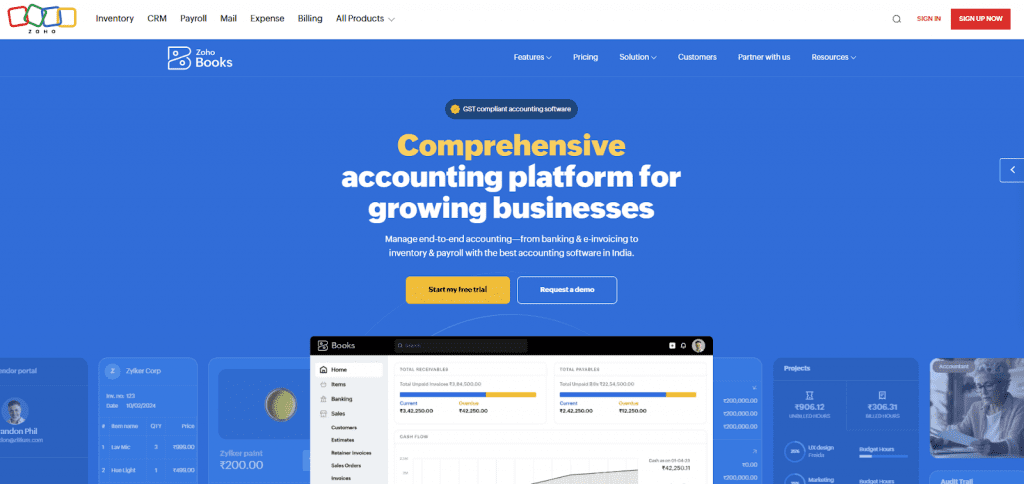
Zoho Books is a cloud-based accounting software that combines automation and AI to simplify financial management for growing businesses. Its intelligence layer, Zia, adds analytical capabilities that help users identify trends, detect anomalies, and get answers to accounting questions in natural language.
As part of the larger Zoho ecosystem, Zoho Books integrates seamlessly with CRM, Payroll, Inventory, and Analytics, giving businesses a unified financial view.
Key Features
- Ask Zia (Conversational Queries): Ask business questions like and get instant visual charts or summaries through Zoho Analytics.
- Anomaly Detection: Zia continuously monitors financial data and flags unusual activity such as spending spikes or revenue drops.
- Forecast & Trend Analysis: It uses past transaction data to project cash flow, revenue, and expenses, helping you plan ahead.
- Cross-App Contextual Insights: Zia connects Books with other Zoho apps, linking sales, invoices, and payments for more complete business analysis.
- Bank Reconciliation: Zoho Books connects with bank feeds and imports transactions automatically. The system then compares these records with entries in the ledger, helping accountants verify balances and spot discrepancies more efficiently.
Rating:
- Glassdoor: 4.3/5⭐
- Capterra: 4.4/5⭐
- GetApp: 4.3/5⭐
5. Odoo
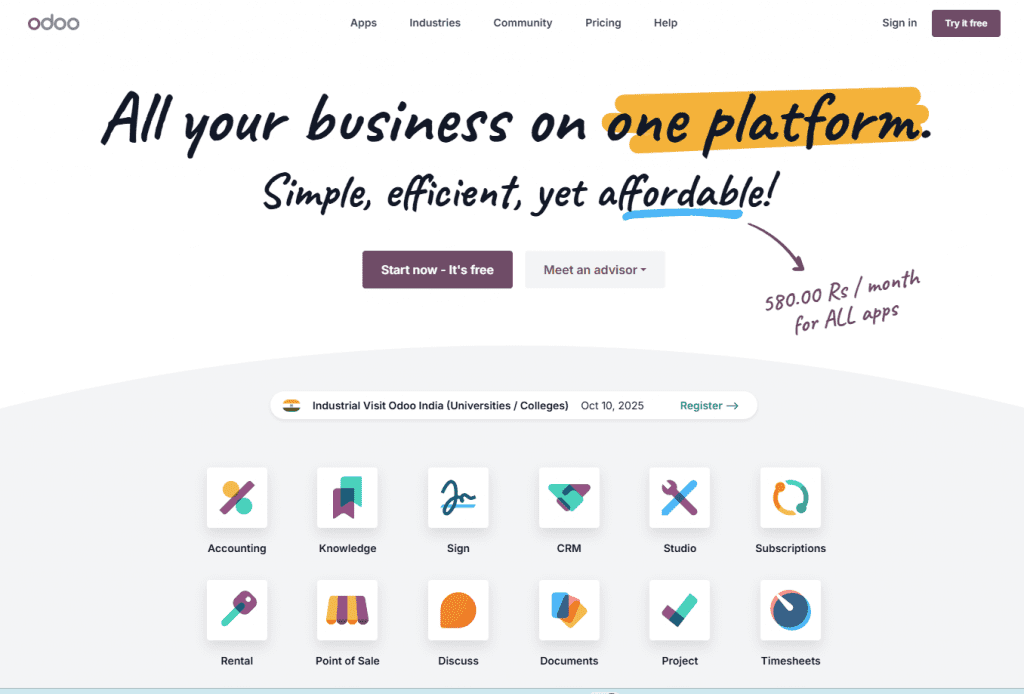
Odoo is an AI-powered, fully integrated business suite that covers accounting, CRM, eCommerce, inventory, project management, and more. Its AI-driven accounting features make managing finances effortless, accurate, and highly automated. Odoo’s invoice automation system reduces manual errors, streamlines workflows, and frees your team to focus on strategic tasks rather than paperwork.
Key AI-Powered Features
- AI-Based Invoice Digitization: Upload bills or invoices, and Odoo’s OCR engine extracts key details, like vendor name, date, and total, automatically creating draft entries.
- Smart Reconciliation: The system uses AI to match bank transactions with invoices and payments, reducing manual reconciliation work.
- Expense Classification: Odoo’s AI identifies recurring vendors and expense patterns, helping categorize costs automatically.
- Duplicate Detection: It flags potential duplicate bills or mismatched data entries, cutting down on accounting errors.
- Insightful Reporting: AI assists in identifying trends or anomalies in financial data, giving accountants a clearer picture of cash flow and performance.
- Seamless ERP Integration: Because Odoo connects accounting with CRM, inventory, and projects, AI can draw data from multiple modules for more complete financial insights.
Rating
- Capterra: 4.2/5 ⭐
- Glassdoor: 3.7/5⭐
- Trustpilot: 3.7/5⭐
- GetApp: 4.2/5 ⭐
- Software Advice: 4.2/5⭐
6. Suvit
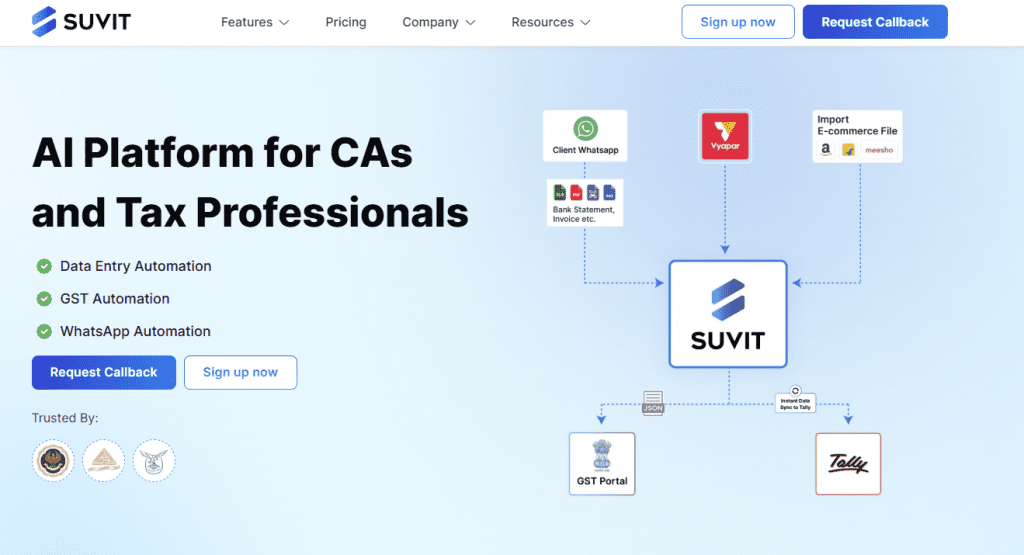
Suvit is an AI-powered accounting platform designed specifically for Chartered Accountants and Tax Professionals in India. It automates data entry, GST filing, and client communication, helping accounting practices save time, reduce errors, and scale efficiently.
Key AI-Powered Features
- Automated Document Collection: Suvit connects with WhatsApp Business to send upload links and reminders to clients. Clients can upload invoices, bank statements, and Excel sheets directly through WhatsApp, which Suvit then processes and imports into the accounting system.
- Auto-Sort & Organize: Uploaded files are automatically read and categorized into sales, purchase, and banking records. The system also alerts accountants about missing documents to keep workflows on track.
- Data Entry Automation: Using OCR and ML, Suvit extracts and maps data from uploaded invoices, statements, and ledgers into Tally-ready entries—reducing manual typing to a single review step.
- GST Reconciliation: The platform performs automated GST validation and reconciliation using over 30 internal checks, matching data from Tally, Vyapar, and Suvit Chat for compliance accuracy.
- Client Communication (PMS): Built-in practice management tools centralize client communication, reminders, and task tracking, reducing manual follow-ups and improving collaboration.
- Seamless Integrations: Works with Tally, Vyapar, and Excel to ensure smooth data synchronization without disrupting existing workflows.
Rating:
- Glassdoor: 3.7/5⭐
- AmbitionBox: 3.0/5⭐
- Glassdoor: 3.7/5⭐
- AmbitionBox: 3.0/5⭐
How to Choose the Right AI Accounting Software
Options can be overwhelming. Let’s take a minute to talk about how to actually choose one. Because not every AI accounting software is built the same, some excel at automation, others at analytics, or collaboration. The right fit depends on your goals, team size, and workflow.
Here are the key things you should look for 👇
1. Core AI Capabilities
At its heart, AI accounting should do more than basic automation. Look for features like:
- Smart data extraction (OCR that reads invoices, receipts, and bank statements automatically)
- Predictive analytics to forecast cash flow or spot irregularities
- Anomaly detection to flag unusual transactions
- Natural language processing that lets you ask financial questions conversationally
2. Integration with Your Ecosystem
Good AI tools don’t work in isolation. Make sure your accounting software integrates seamlessly with:
- Payment gateways (Stripe, PayPal, Razorpay)
- ERPs and CRMs
- Payroll systems
- Banking APIs
3. Accuracy, Auditability & Compliance
AI can make lightning-fast calculations, but financial accuracy is non-negotiable. Always choose a tool with transparent audit trails, version tracking, and compliance with local tax regulations (GST, IFRS, GAAP, etc.).
4. Pricing Transparency
Some tools charge per feature, others per seat. Always compare pricing tiers and look for:
- Free trials or demo access
- Clear cancellation policy
- Transparent pricing (no hidden API or user fees)
5. Scalability & Support
You want a tool that grows with your business, not one you’ll outgrow in a year. Look for:
- Scalable plans for expanding teams
- 24/7 customer support or onboarding help
- Community or knowledge base
When you evaluate software with these in mind, you’ll be better equipped to find a tool that genuinely simplifies your accounting, not just adds another dashboard to manage.
Benefits of AI Accounting Software
Adopting AI in accounting isn’t just about technology—it’s about transforming how your finance team works. Here are the key benefits:
1. Time Savings
AI automates repetitive tasks like data entry, invoice matching, and reconciliation, freeing up accountants to focus on strategic decision-making. Teams can reduce hours of manual work every week.
2. Enhanced Accuracy
AI tools minimize human errors by automatically validating transactions, matching invoices, and checking financial statements against source documents. This ensures more reliable and error-free accounting.
3. Real-Time Insights
AI-powered dashboards and analytics provide up-to-date financial insights. From cash flow trends to expense tracking, teams can make smarter, faster decisions without waiting for month-end reports.
4. Improved Compliance & Audit Readiness
Most AI accounting software offers built-in audit trails, version control, and compliance tracking for standards like GST, IFRS, ASC 606/842, and GAAP. This reduces the risk of non-compliance and simplifies audits.
5. Scalability
AI platforms can easily handle increasing transaction volumes and support growing teams without the need to hire additional staff, making them ideal for businesses of all sizes.
6. Cost Efficiency
By automating time-intensive tasks and reducing errors, AI accounting tools help businesses save on labor costs and avoid costly mistakes, delivering a high ROI.
7. Actionable Predictions
Advanced AI features can forecast cash flow, detect anomalies, and provide recommendations, turning raw financial data into actionable insights that guide business growth.
Future Trends in AI Accounting
The accounting landscape is evolving rapidly, and AI is at the forefront of this transformation. Here’s what to expect in the coming years:
1. Hyper-Automation of Finance Processes
Beyond bookkeeping, AI will automate complex tasks like tax planning, financial forecasting, audit preparation, and compliance reporting, reducing manual intervention almost entirely.
2. Predictive & Prescriptive Analytics
AI won’t just report what happened—it will predict cash flow, detect anomalies before they become problems, and even suggest actions to optimize financial performance.
3. AI-Powered Advisory Services
Accountants will increasingly act as strategic advisors, leveraging AI insights to guide investment, budgeting, and growth decisions rather than just processing transactions.
4. Natural Language Interfaces
Conversational AI will allow finance professionals to interact with systems using plain language queries, like “Show me last month’s top expenses” or “Forecast next quarter’s revenue,” making accounting more intuitive.
5. Enhanced Security & Compliance
Future AI tools will proactively monitor for fraud, ensure regulatory compliance, and maintain secure audit trails in real-time, reducing risk for businesses globally.
6. Integration with Emerging Technologies
AI will integrate seamlessly with blockchain, IoT, and cloud ERP systems, creating fully connected financial ecosystems for smarter, more transparent accounting.
7. Democratization of Finance Intelligence
AI accounting tools will become more accessible to small and medium businesses, enabling even non-financial managers to leverage data-driven insights for smarter decision-making.
Conclusion
AI is no longer a futuristic concept in accounting; it’s here, transforming the way businesses handle finances. From automating repetitive bookkeeping tasks to providing predictive insights and real-time analysis, AI accounting software empowers teams to save time, reduce errors, and make smarter decisions.
The top tools bring unique strengths, whether it’s lease accounting, client management, startup-focused finance, cash flow forecasting, or enterprise-grade close automation.
Choosing the right AI accounting software depends on your business size, workflow complexity, integration needs, and desired automation level. With the right solution, finance teams can shift from manual data entry to strategic decision-making, unlocking growth and operational efficiency.
Key Takeaway: AI in accounting isn’t just about efficiency; it’s about turning raw financial data into actionable insights that drive smarter business outcomes.
FAQs
1. Can AI accounting software replace a human accountant?
AI can automate repetitive tasks, detect errors, and provide insights, but it cannot fully replace a human accountant. Strategic decision-making, advisory, and nuanced financial interpretation still require human expertise.
2. Is AI accounting software secure for sensitive financial data?
Most leading platforms are ISO or SOC 2 certified and follow strict encryption protocols. Always verify a tool’s security compliance before connecting bank accounts or confidential financial information.
3. How much time can AI save in accounting tasks?
Depending on the tool and business size, AI can reduce bookkeeping, reconciliation, and reporting tasks by 50–80%, freeing up teams for strategic work.
4. Can small businesses benefit from AI accounting software?
Absolutely. Many tools, like Zeni.ai and Digits, are specifically designed for startups and small to mid-sized businesses, offering automation, forecasting, and reporting without complex ERP systems.
5. Do these tools integrate with existing accounting software?
Yes. Most AI accounting platforms support popular accounting software like Tally, Zoho Books, QuickBooks, Xero, and ERP systems, allowing seamless data sync without changing existing workflows.
6. How difficult is it to implement AI accounting software?
Implementation is usually straightforward. Most tools offer guided onboarding, integration support, and real-time dashboards to minimize disruption.
Related Posts:
 Best Accounting Software in India: Features, Pricing, Reviews, and more (Updated 2024 List)
 Top 10 Accounting Software in Saudi Arabia: Features, Benefits, and Pricing
 10 Best Accounting Software in the UK
 Top 12 VAT Accounting Software in UAE (Updated 2026)
 Top 10 Accounting Software in Indonesia
 10 Best Accounting Software in the USA
 Top 9 Expense Management Software in India
 10 Best Accounting Software in Singapore
 10 Best Accounting Software in Australia
 A Complete Guide to the Types of Invoices
 Top Electronic Invoicing Software In India
 Top 10 Accounting Software in Malaysia: A Detailed Analysis (Updated 2025 List)
 Top Alternatives to Tally Accounting Software: Free & Paid
 The Ultimate Guide to Choosing the Right Accounting Software
 Top Accounting and Inventory Management Software for Businesses (Updated 2025 List)
 Top 10 Best Accounting Software For Travel Agencies (Updated 2025 List)
 Top 11 Invoicing Software For Contractors (Updated 2024 List)
 Top 8 Inventory Management Software in India