
As India approaches its 76th Republic Day, the air is thick with patriotism. For brands, this is a golden opportunity to connect with the emotional pulse of the nation. However, marketing during national holidays is a double-edged sword. While it can foster a deep sense of belonging, a single misstep regarding the National Flag or cultural context can lead to legal battles, PR nightmares, and a total boycott of the brand.
Case Study: When Global Giants Stumble
The Amazon “Flag Doormat” Controversy
One of the most significant examples of how things can go wrong involves the e-commerce giant, Amazon.
The Story: In 2017, Amazon’s Canadian website listed doormats featuring the Indian National Flag.
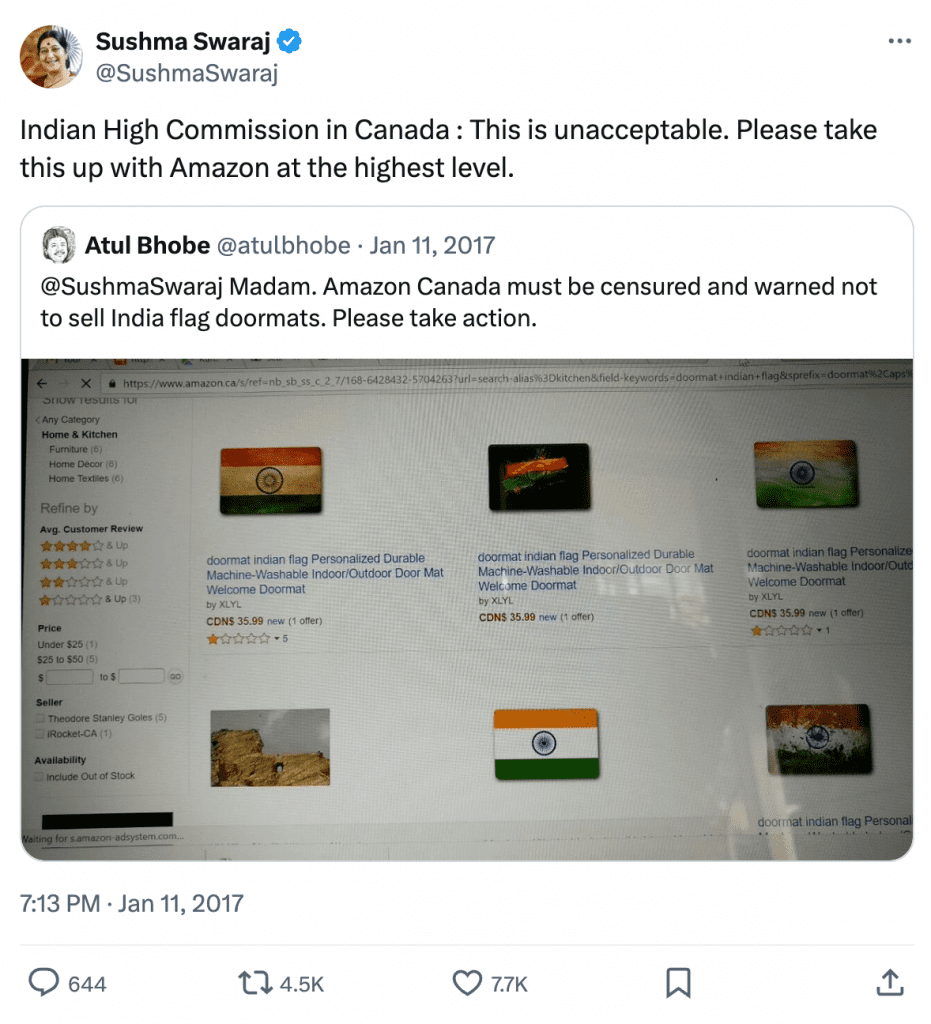
The Backlash: The reaction in India was swift and severe. It wasn’t just a social media trend; it became a diplomatic incident. The then External Affairs Minister, Sushma Swaraj, took to Twitter to demand an unconditional apology, even threatening to rescind visas for Amazon officials.
The Fallout: Amazon had to immediately withdraw the product and issue a formal apology. The incident caused long-term damage to the brand’s perception in India, portraying them as a “foreign entity that doesn’t respect Indian sentiments.”
The Lesson: For global companies, “standardized” global designs don’t work in India. What might be seen as a “patriotic product” in the US (where the flag is often used on apparel and household items) is a criminal offense and a deep insult in India.
Source Link: BBC News: Amazon ‘flag doormat’ sparks India’s ire
If a giant like Amazon with a big creative and legal team can commit such an error, it serves as a lesson to all companies to understand the nuances of the Flag Code of India, 2002, and the Emblems and Names (Prevention of Improper Use) Act, 1950, appropriately in order to avoid misuse.
Here is a comprehensive guide for companies on how to navigate the complexities of using the Indian context and the National Flag in advertisements.
1. The Legal Mandate: Understanding the Flag Code
The foremost thing every marketer must understand is that the Indian National Flag (the Tiranga) is not a “prop.” Its use is strictly governed by the Flag Code of India, 2002, and the Emblems and Names (Prevention of Improper Use) Act, 1950.
The Golden Rules:
- No Commercial Exploitation: The flag should not be used for commercial purposes. You cannot use the flag as a trademark, design, or logo to sell a product.
- No Clothing or Drapery: The flag cannot be used as a portion of a costume or uniform. It should not be embroidered or printed on cushions, napkins, or undergarments.
- Positioning Matters: If the flag is displayed with other corporate flags, it must be on the extreme right (the observer’s left). It should never be displayed upside down or dipped in salute to any person or thing.
- Disposal: After the campaign, if you have distributed paper flags, they must not be discarded on the ground. They should be disposed of in private with dignity.
2. Contextual Sensitivity: Beyond the Saffron and Green
Using “Indian context” isn’t just about the colors of the flag; it’s about the soul of the country. India is a land of diverse religions, languages, and traditions.
- Avoid Stereotypes: Moving beyond the “Snake Charmer” or “Taj Mahal” tropes is essential. Modern India is a hub of tech, space exploration, and startups. Reflecting the current India is essential for a successful campaign.
- Religious Neutrality: Republic Day celebrates the Constitution, which is secular. Avoid leaning too heavily into specific religious imagery unless it is inclusive.
- Language Matters: If you are a pan-India brand, don’t just translate a Hindi slogan into English. Localize. A Republic Day wish in Tamil, Bengali, or Marathi shows genuine respect for India’s federal structure.
The case study of Fabindia’s “Jashn-e-Riwaaz” controversy for a Diwali ad serves as a vital lesson to understand why language matters.
The Fabindia “Jashn-e-Riwaaz” Controversy (2021)
For decades, Fabindia was the darling of the Indian middle class, known for celebrating indigenous textiles and “India Modern.” However, in October 2021, the brand released its festive collection titled “Jashn-e-Riwaaz.”
https://youtu.be/8-QTP176oJI
What Went Wrong
- The Naming: The collection was launched ahead of Diwali. Critics and social media users argued that using an Urdu/Persian phrase like Jashn-e-Riwaaz (meaning “Celebration of Tradition”) for a major Hindu festival was an attempt to “de-Hinduize” the festival.
- Visual Context: The models were shown in traditional attire but were missing the Bindi (a cultural and religious symbol often associated with Indian festive wear). To many, this felt like the brand was “sanitizing” Indian culture to fit a global or “secular” aesthetic, thereby losing the authentic Indian context.
The Backlash: The reaction was swift and organized. The hashtag #BoycottFabindia trended for days. High-profile political figures and influencers joined the fray, accusing the brand of “cultural displacement.” The pressure became so immense that Fabindia pulled the advertisement and the name within days of the launch.
Source link: The Times of India- Fabindia withdraws ‘Jashn-e-Riwaaz’ ad after social media backlash
3. The “Cringe” Factor: Authenticity vs. Opportunism
Consumers are increasingly “woke” to performative patriotism. If your brand has no history of supporting Indian craftsmen or contributing to national causes, a sudden 26th January post about “loving the nation” might come across as hollow.
- Align with Values: If you are a food brand, talk about Indian farmers. If you are a tech brand, talk about Indian engineers. Make patriotism relevant to your industry.
- Action over Ads: Instead of spending crores on a flashy ad, consider a CSR initiative. Pledging to support the education of martyrs’ children or cleaning a local monument carries more weight than a tricolor-themed logo.
4. Digital Etiquette: Social Media Hazards
In the age of viral screenshots, a mistake in a digital creative can go global in minutes.
Aspect Ratios: Ensure that the flag is not distorted or stretched to fit a mobile screen.
- Hashtag Hygiene: Don’t use hashtags like #RepublicDay to sell products that have no connection to the day (e.g., “Get 50% off on vacuum cleaners #RepublicDay”). It feels disrespectful.
5. How to Get It Right: A Checklist for Brands
If you are planning a Republic Day campaign, run it through this 5-point checklist:
1. Legal Review: Has our legal team vetted the use of the Tricolor against the Flag Code of India?
2. Moral Compass: Are we using the flag to sell a product, or to celebrate a value? (Hint: The latter is safer).
3. Visual Integrity: Is the Ashoka Chakra clearly visible and centered? Are the colors accurate? (The top band must be Saffron, not orange or red).
4. Inclusivity: Does our ad represent the diversity of India (gender, caste, region, and religion)?
5. Post-Event Plan: If we are using physical branding (banners/balloons), how will we dismantle them without disrespecting the colors?
Final thoughts
Patriotism is a powerful emotion that can build a lifelong bond between a brand and its customers. However, in the Indian context, it must be handled with reverence, not just relevance.
Companies that succeed this Republic Day will be those that look beyond the three colors and focus on the constitutional values of justice, liberty, and equality. Use the “Indian context” to tell a story of progress, resilience, and unity. Remember, the nation’s pride is not a marketing tool; it is a responsibility.
Happy Republic Day! Jai Hind.
About the Author: Kajal Agarwal is a qualified Chartered Accountant and Assistant Vice President – Finance at a U.S.-based multinational corporation, where she manages financial operations for clients generating over $100 million in revenue. A mentor to aspiring CAs and author of a widely acclaimed book on Company Law, she has also appeared live on DD News as a Budget 2025 expert, sharing insights on national fiscal policy. Outside her professional life, Kajal is deeply committed to holistic living as a long-time practitioner of Iyengar Yoga and a certified Pranic Healer, finding balance through yoga, meditation, and mindful leadership.

Related Posts:
 E-Invoicing Around the World: A Global Overview
 Forget Bengaluru – These Are The Best Startups to Build Your Career in Surat
 A Comprehensive Guide to GST Compliance for E-Commerce Operators in India
 Best Accounting Software in India: Features, Pricing, Reviews, and more (Updated 2024 List)
 Complete Guide to GSTR 5A: Filing Process, Key Features, Penalties, and FAQs
 Export Invoice: A Complete Guide for Seamless Trade
 Your Complete Guide to GSTR 5: Filing Process, Due Dates, Penalties, Amendments, and FAQs
 Top Hosting Solutions for Freelancers and Small Businesses: Why Amazon Web Hosting Stands Out
 Best Invoicing and Billing Software In India (Updated 2025 List)
 A Complete Guide to the Types of Invoices
 Crafting Digital Narratives: Spotlight on Refrens’ Marketers and Creators
 Healthcare Tourism – How It’s Boosting India’s Economy
 Everything To Know About GSTR-3A: Issuance, Actions to Take, and Consequences of Non-Compliance
 Top 10 Billing Software for Law Firms
 Top 9 Expense Management Software in India
 Streamlining Vendor Onboarding & Invoice Approvals: SportsKeeda Case Study
 Automating Invoicing For Your Resellers With Refrens Invoice API: AiSensy Case Study
 Top Electronic Invoicing Software In India