
Buying something for a business is simple when one person makes the decision. Need something? Check the price and order it. Simple.
As your business grows, it rarely stays that straightforward.
The person requesting something may not control the budget. The person approving it may not know the vendor. Larger purchases may need finance, department heads, or senior management to get involved.
Sooner or later, you need a clear answer to the question: who can authorise a purchase, and under what circumstances?
That is what a Purchase Order approval process is for. It gives you a clear way to review purchases before committing, without turning every routine order into a meeting.
What is Purchase Order approval?
Purchase Order approval is the internal process a business uses to review and authorise a PO before the purchase moves ahead.
Say your operations team wants to order ₹2 lakh worth of packaging material for next month. They create a PO with the vendor, items, quantities, prices, taxes, payment terms and delivery details. A purchase order generator can help standardise these details before the PO enters the approval process.
The PO records what you plan to buy. The approval process decides whether the business is authorised to proceed.
What gets checked before a Purchase Order is approved?
Approval should involve more than looking at the total and clicking “Approve.”
The exact checks will vary from one purchase to another, but most reviews come down to a few basic questions.
1. Does the business actually need it?
If your company normally uses 10,000 packaging units a month, an order for 60,000 should have a reason behind it.
Demand may be expected to rise. The vendor may have offered a worthwhile bulk discount. Or somebody may simply have added an extra zero. You should be able to understand why the purchase is needed before it goes ahead.
2. Is the vendor the right one?
A regular supplier with a good track record may not need much checking. With a new vendor, you may want to look at reliability, tax details and any vendor onboarding requirements before placing the first order.
Sometimes a small purchase from an unfamiliar supplier deserves more attention than a much larger repeat order from a vendor you have dealt with for years.
For vendors that require internal review before purchasing begins, a formal vendor approval process can clarify who verifies and authorises them.
3. Do the price and terms make sense?
Price matters, but it is not the whole deal. One vendor may quote less but ask for full payment in advance. Another may charge slightly more but offer better payment terms or faster delivery.
Depending on the purchase, you may want to compare previous prices, collect quotations through RFQ software, and evaluate payment terms and delivery timelines before approving the order.
4. Is there a budget for it?
A purchase can be necessary and reasonably priced and still fall outside your available budget. Your finance team or budget owner may need to check whether the spend was planned and whether enough budget is still available.
They may also review existing purchases, payables and financial records in the accounting software before committing to additional spend.
5. Is anything unusual about the order?
Anything outside your usual buying pattern deserves a closer look. The quantity may be much higher than normal. Payment terms may have changed. The order may be urgent. Or the purchase may involve a category you choose to control more closely.
How does the Purchase Order approval process work?
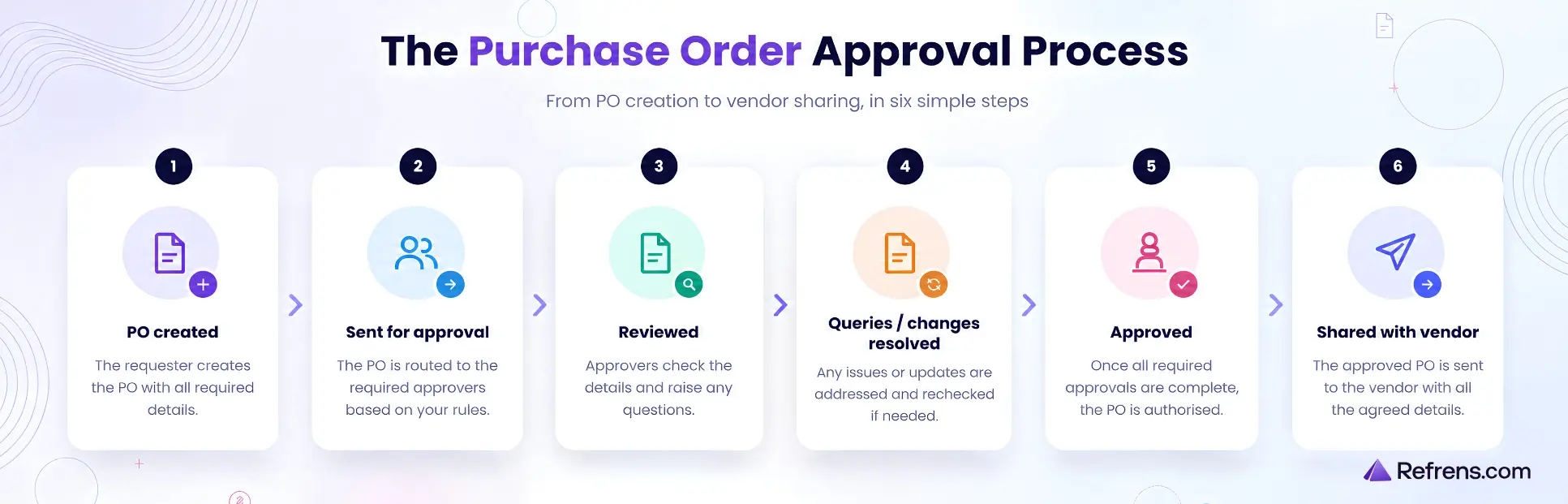
The exact process will differ between businesses, but a typical PO approval may look like this.
1. The Purchase Order is created
The requester creates the PO with enough information for someone else to understand the purchase properly. The vendor, items, quantities, prices, taxes, payment terms and delivery details should be clear.
If your approver has to chase someone to understand why the quantity doubled or where the quoted price came from, the delay has already started.
2. The PO goes to the required approvers
The PO follows the approval rules you have already set. A routine purchase may need only one approval, while a larger or less routine purchase may need additional review.
3. The approvers review the purchase
The required approvers review the PO and decide whether the purchase should be authorised.
4. Questions or changes are resolved
Not every PO will be approved exactly as submitted. An approver may ask for more information, question the price, spot the wrong quantity or send the PO back for correction.
Important changes may also need fresh approval. Correcting a spelling mistake is one thing. Changing your ₹2 lakh order to ₹2.8 lakh is another.
5. The purchase is authorised
Once the required approvals are complete, you can move ahead with the purchase based on the approved PO.
6. The PO is shared with the vendor
You can then send the approved PO to the vendor with the items, quantities, prices, delivery details and agreed terms.
The PO also becomes your reference for what was originally agreed. If the quantity delivered or the price billed later is different, you have something clear to compare against.
For stock purchases, you can then connect what was ordered and received with inventory management, making it easier to track available stock and pending quantities.
When the vendor later sends the invoice, RFI software can help collect invoice details and supporting documents in a structured format before they are reviewed and converted into purchase records.
How do you decide who should approve what?
One of the quickest ways to make your approval process painful is to send every PO to the same group of people.
A ₹15,000 repeat order from a regular vendor does not need the same attention as a ₹15 lakh equipment purchase.
Even two POs for the same amount may need different levels of review. One could be a normal reorder. The other could involve a new supplier asking for full advance payment.
An approval matrix helps you define who can approve which purchases.
Start with purchase value
Purchase value is usually the simplest place to begin.
For example:
| Purchase value | Approval required |
| Up to ₹50,000 | Department head |
| Above ₹50,000 and up to ₹2 lakh | Department head + Finance |
| Above ₹2 lakh and up to ₹10 lakh | Department head + Finance + Senior management |
| Above ₹10 lakh | Department head + Finance + Senior management + Leadership |
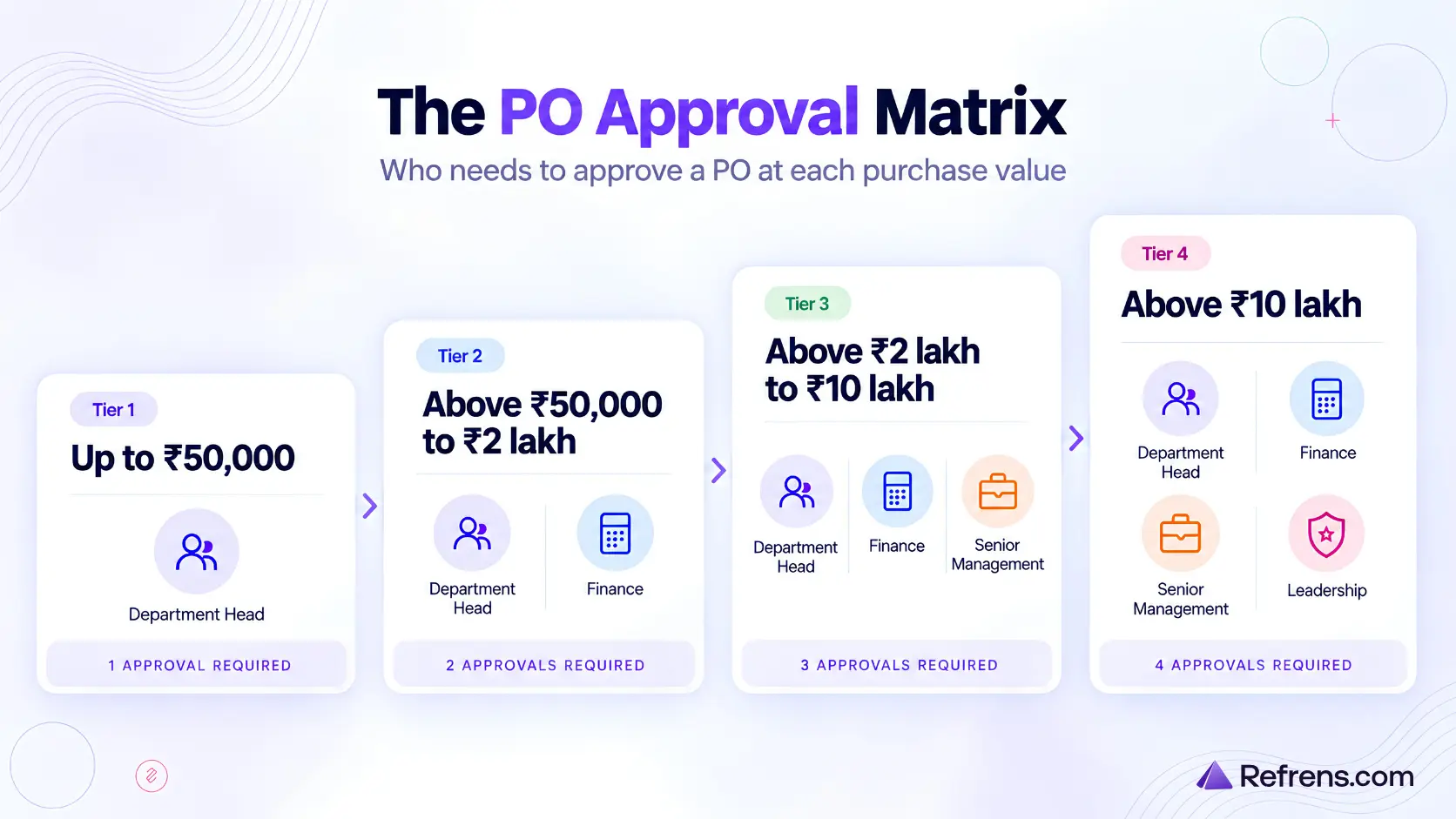
These are only examples. Your limits should reflect the size of your business, its usual spending, and who is responsible for making those decisions. You should also decide whether a higher-value purchase needs the approvals below it as well.
Once these approval rules are defined, the next step is choosing a system that can apply them consistently. Compare the best Purchase Order approval software to understand how different tools handle approval routing, permissions, workflows and purchasing controls.
If a ₹6 lakh order needs senior management approval, for example, does it also need the department head and finance to approve first?
Either setup can work. The rule just needs to be clear.
Look beyond the purchase amount
Consider these two orders:
PO A: ₹2 lakh for packaging material from a supplier you have used every month for three years.
PO B: ₹2 lakh paid in advance to a new overseas supplier you have never worked with.
The amount is identical. The circumstances are not.
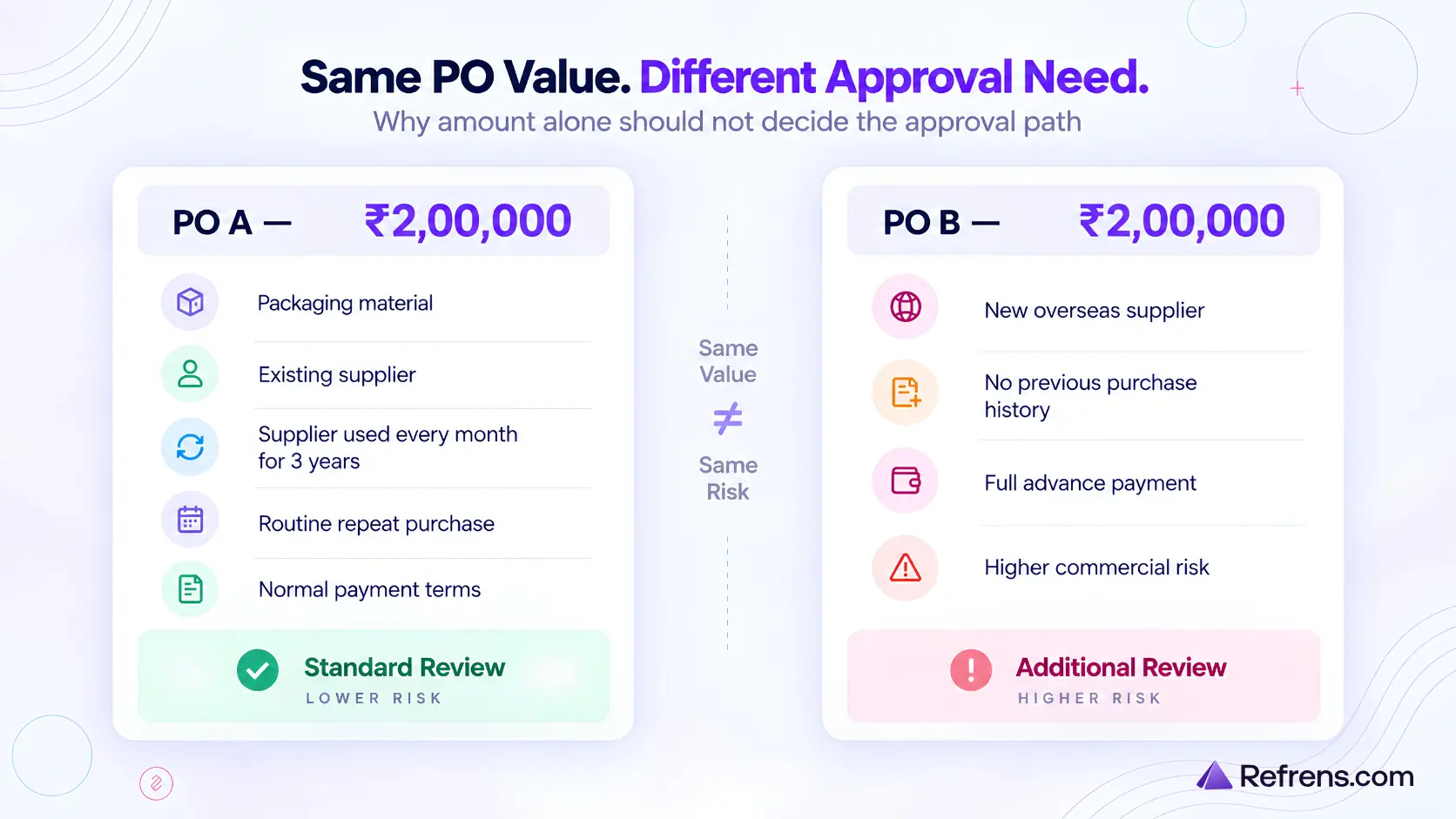
PO A may be a routine purchase. PO B involves a new vendor and an advance payment, so it may deserve additional review even though the value is the same.
Purchase value is a useful starting point for an approval matrix, but it should not be the only thing that decides how much review a purchase needs.
Match the approver to the decision
People should approve things they are actually in a position to judge.
| Role | What they would typically check |
| Department head | Do we need this purchase? |
| Finance / budget owner | Can we afford it within the budget? |
| Procurement | Is this the right vendor, price and terms? |
| Senior management | Is this commitment large or risky enough to need senior approval? |
As more people become involved, roles and permissions can also help control who is allowed to create, edit, review or approve different business records.
The exact responsibilities will differ from one business to another. What matters is that each approval has a clear purpose. Otherwise, several people can approve the same PO without anyone being clear about what they were actually supposed to check.
One way to think about it is this: the approver should change when the decision changes, not just when the purchase amount changes.
Where do Purchase Order approval processes usually go wrong?
When approvals start causing problems, slow approvers are often the first people to get blamed. Sometimes they are the problem. Quite often, though, the problem is in the process itself.
1. Routine purchases need too many approvals
More approvals do not always mean more control.
If a ₹12,000 repeat order needs approval from the department head, finance, procurement and senior management, there is probably too much process for a routine purchase.
Someone who sees dozens of low-risk orders every week may eventually start approving them out of habit. If routine purchases regularly reach senior management, your approval limits are probably too low.
2. The purchase happens before approval
Someone places an urgent order, the vendor starts supplying, and the PO is raised afterwards so the paperwork can catch up. There is not much left to approve by then.
Genuine emergencies happen. The problem starts when “urgent” becomes your usual way to buy first and get approval later.
3. Everything ends up with the same senior approver
You may have several approval levels on paper, but if every important PO eventually lands with the founder, CFO or purchase head, that person has effectively become the approval process.
The queue grows, and routine purchases start waiting too. Your approval limits may be too low, too many purchases may be getting escalated, or managers may not have enough authority.
4. The real approval happens somewhere else
The PO says “Pending,” but somebody has already approved it over WhatsApp, Slack, email or the phone. Now your official record says one thing, and the people involved know another.
The problem usually appears later, when somebody asks who approved the purchase and what they actually approved. If this happens regularly, your formal process is probably too slow, too difficult or too disconnected from how people actually work.
Final Takeaway
Once you are clear on what should be checked and who has the authority to approve it, the next challenge is making sure every PO follows those rules consistently.
That is where a Purchase Order approval workflow comes in. If you are ready to turn your approval rules into an automated workflow, read our guide on how to design, automate, and improve a Purchase Order approval workflow.
Build and automate Purchase Order approval workflows with Refrens
FAQs
What is the difference between Purchase Order approval and invoice approval?
They happen at different stages. Purchase Order approval happens before you commit to the purchase. It checks whether the order should be allowed to go ahead.
Invoice approval happens later, after the vendor has billed you. It checks whether the invoice is correct and should be paid. A PO can therefore be properly approved, and the related vendor invoice may still need a separate approval.
Does the vendor need to approve the Purchase Order?
Not as part of your internal PO approval process. Internal approval confirms that your business has authorised the purchase. The PO can then be sent to the vendor.
The vendor may separately confirm the order, delivery date, availability or agreed terms, but that is different from your internal Purchase Order approval.
Can the person who creates a Purchase Order also approve it?
That depends on the size of your business and the internal controls you want to maintain.
In a small business, the same person may sometimes create and authorise a purchase. As responsibilities spread across more people, larger or more sensitive purchases are usually better reviewed by someone other than the person who created the PO.
The important thing is to define the rule clearly rather than let self-approval happen by default.
Related Posts:
 7 Best Purchase Order Approval Software
 Why Your Accounting Software Should Have WhatsApp OCR Scanning
 Best Invoice OCR Software in India: Top 5 Tools Compared
 How to Design, Automate, and Improve a Purchase Order Approval Workflow
 Accounts Payable OCR Software: What Happens Between Receiving a Bill and Recording It
 Top 15 Vendor Management Software in India for 2026: Features, Pricing, Ratings & Reviews
 Vendor Approval Process: Prequalification, Vetting, Due Diligence & Risk Checks
 Vendor Onboarding Process: Steps, Checklist & Documents
 Everything You Need to Know About Purchase Orders: A Complete Guide
 10 Best Invoice Approval Workflow Software
 A Complete Guide to the Types of Invoices
 Everything To Know About GSTR 3
 Master GST Reconciliation: Process, Tools, and Best Practices
 Managing Custom Quotation Approvals for Robotics & Industrial Automation Company: Refrens x Suprak Technologies Case Study
 Everything to know about GSTR 9C: Eligibility, Filing Process, Amendments, and FAQS
 The Ultimate Guide to Basics of Inventory Management
 Centralising Multi-branch Quotation Approval for Machinery Manufacturing Company: Refrens x DOIT Industries Case Study
 Comprehensive Guide to Sales Orders