
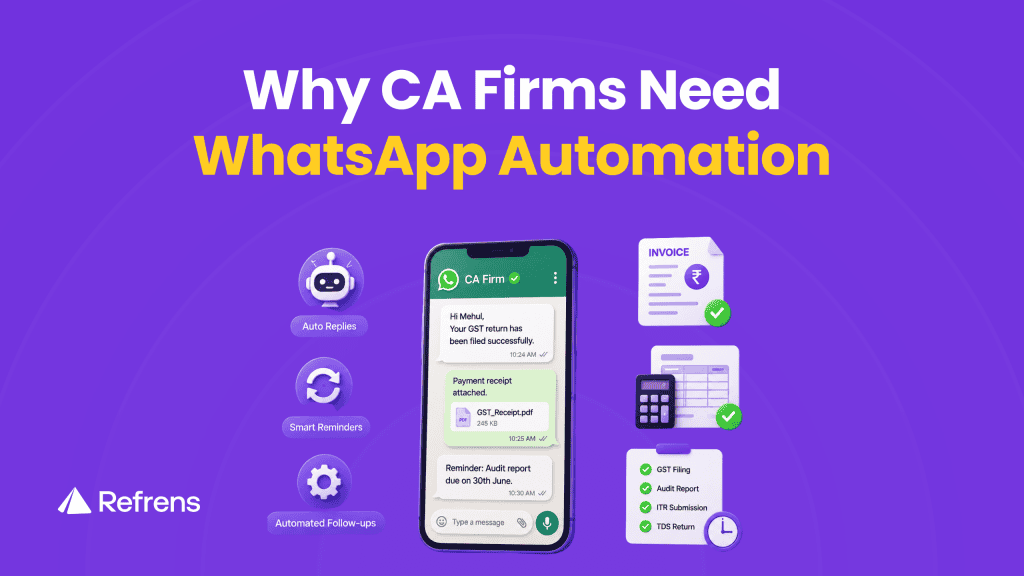
| Key Takeaways Most CA firms in India already have practice management or GST filing software in place, but client communication, chasing documents, sending GST reminders, updating clients on notice status, still happens over email, phone calls, and personal WhatsApp chats that never touch the practice management system. A WhatsApp Business API integration changes that by turning reminders, document requests, and status updates into automated, trackable workflows inside the same system a firm already uses to manage clients. Over 1,00,000 CA firms are registered with ICAI, and more than seven in ten are single-partner practices, which means most firms don’t have the headcount to manually chase every client for every document or deadline. India has the largest WhatsApp user base in the world, and a large majority of Indian small businesses already use WhatsApp for some form of customer communication, making it the channel clients already check, rather than one they have to be trained to use. The right question isn’t whether to use WhatsApp, most firms already do, informally, it’s whether that communication is automated and logged, or scattered across individual staff members’ phones with no record anyone can search later. |
Every CA firm sends the same messages, over and over, every filing season: “Please share your GSTR-2A mismatches,” “Your GST payment is due in 3 days,” “Notice received, please review and respond.” Right now, most firms send these one by one, from a partner’s or associate’s personal phone, with no record in any system. Here’s why that gap is becoming harder to ignore, and what closing it actually looks like.
This piece looks at where WhatsApp fits into a CA firm’s practice management stack, what a proper WhatsApp Business API setup does differently from a staff member manually messaging clients, and the practical questions worth asking before adding it to your workflow.
| 1,00,138Registered CA firms with ICAI, per the Institute’s own 2025 data | 72%+Share of those firms that are single-partner practices | 500M+WhatsApp users in India, the platform’s largest market globally |
Why Client Communication Is the Weak Link in CA Practice Management
Most practice management conversations focus on the parts that are easy to demo: task assignment, document storage, workflow stages, GST filing status. Client communication rarely gets the same attention, even though it’s often where the actual time goes.
A mid-sized firm handling GST returns, TDS filings, and notices for even fifty clients is sending reminders, chasing documents, and pushing status updates constantly. When that communication happens over calls and personal WhatsApp chats instead of inside the practice management system, three things go wrong quietly:
- Nothing is logged against the client record. If a partner leaves or an associate is on leave, whatever they discussed with a client over WhatsApp goes with them.
- Reminders depend on someone remembering to send them. There’s no automated trigger tied to a filing deadline sitting in the system, it’s a manual task on top of everyone’s actual work.
- Clients get inconsistent experiences. One client gets a friendly nudge two days before their GST deadline, another gets nothing until the day of, purely based on which associate is handling them and how busy that associate is that week.
| TipBefore evaluating any WhatsApp tool for your firm, check one thing: does it write messages and replies back into the client’s record inside your practice management system, or does it just send messages from a connected number with no link back to the client file? A lot of “WhatsApp integration for CA firms” claims are really just a bulk-sending tool bolted on the side, not a genuine part of the workflow. |
What Practice Management Software Actually Covers
Practice management software for a CA firm typically centralizes client records, task and deadline tracking, document storage, staff workload, and billing, replacing the mix of spreadsheets, shared drives, and individual inboxes most firms start out with. The better ones also track statutory deadlines automatically, so a GST return due date or a notice response window shows up as a task rather than something a partner has to remember on their own.
What most of these systems still don’t do well is close the loop with the client. A task can be marked “pending client documents” inside the system, but the actual chase, the message asking for those documents, usually happens outside it, over a channel the system has no visibility into.
Where WhatsApp Fits Into That Gap
This is where WhatsApp Business API integration, as distinct from a staff member’s personal WhatsApp, becomes relevant. The API lets a firm send and receive WhatsApp messages from a verified business number, with those messages tied directly into whatever system is managing the client relationship, rather than sitting in someone’s personal chat history.
In practice, that means a reminder for an upcoming GST deadline can be triggered automatically from the same task that already exists in the practice management system, sent from the firm’s verified WhatsApp number, and logged back against that client’s record the moment it’s sent, delivered, or read.
| Manual WhatsApp / Calls | WhatsApp Business API Integration |
| Sent from an individual staff member’s personal number | Sent from the firm’s verified WhatsApp Business number |
| No record in the practice management system | Logged against the client’s record automatically |
| Reminders depend on someone remembering to send them | Triggered automatically from task deadlines already in the system |
| Client replies land in a personal chat, easy to miss or lose | Replies route back into the client’s file, visible to whoever’s covering that client |
| One-on-one only, doesn’t scale past a small client list | Handles reminders and document requests across the full client base at once |
| No record of who was told what, or when | Full message history retained per client, useful during audits or handovers |
Where WhatsApp Business API Genuinely Helps
- GST and filing deadline reminders that send themselves. Once a due date is set on a task, the reminder goes out on schedule, without anyone having to remember to type and send it.
- Document chasing without repeated manual follow-up. A client who hasn’t uploaded their Form 16 or bank statements gets a nudge automatically, instead of a staff member checking a spreadsheet and remembering to message them.
- A message channel clients already check. Clients open WhatsApp far more readily and far faster than email, so a GST deadline reminder is more likely to actually be seen in time.
- A searchable record when something’s disputed. If a client claims they were never told about a deadline or a document requirement, there’s an actual message log to check, rather than one staff member’s recollection of a phone call.
- Consistency across staff and clients. Every client on a given filing type gets the same reminder cadence, regardless of which associate is handling their file that month.
Where It Falls Short, or Gets Misused
- It’s not a replacement for judgment calls. Automated reminders work well for routine, predictable deadlines. A genuinely complex client situation, a notice that needs real explanation, still needs a human conversation, not a template message.
- Consent and opt-in aren’t optional. WhatsApp Business API messaging outside a client’s active reply window generally requires pre-approved message templates and the client’s consent to be contacted that way; firms that skip this step risk messages being blocked or clients being annoyed rather than helped.
- Poorly configured automation creates noise. If every task update triggers a message, clients start muting the number, defeating the entire purpose. The reminders that matter need to be separated from routine internal status changes.
- It’s only as good as the practice management system behind it. A WhatsApp integration bolted onto a firm’s existing spreadsheet-based process doesn’t fix the underlying disorganization, it just adds another channel to that same disorganization.
| Must Know: WhatsApp Business API Basics for CA FirmsFirms need a Meta-verified WhatsApp Business number to use the WhatsApp Business Platform, distinct from the free WhatsApp Business app most firms already use informally. Messages sent proactively, not in reply to a client, generally need to use pre-approved templates, which Meta reviews before they can be sent. Clients need to have opted in to being contacted this way; unsolicited proactive messaging risks the number being restricted. None of this replaces a firm’s obligations under India’s data protection framework, client financial information shared over any channel, WhatsApp included, still needs to be handled the way the firm already handles it elsewhere. |
| “Client trust in a CA firm is built less in the audit report and more in whether they hear from you before they have to chase you.” |
Common Use Cases Inside a CA Firm’s Existing Workflow
- Automated WhatsApp reminders for GST clients: due-date nudges tied to actual filing deadlines already tracked in the practice management system, not a separate manual reminder list.
- Document collection nudges: automatic follow-ups when a client hasn’t uploaded required documents by a set point before the deadline.
- Notice status updates: a short, templated update when a client’s notice moves to a new stage, reviewed, response drafted, submitted, without a partner having to personally call every client with a pending notice.
- Appointment and meeting confirmations: for firms that still do in-person or scheduled calls with clients, particularly useful during ITR season when scheduling volume spikes.
Who This Actually Makes Sense For
- Solo practitioners and small firms: Given that over seven in ten registered CA firms in India are single-partner practices, the honest case for automation here isn’t scale, it’s time. A solo practitioner chasing forty clients individually loses hours a week that WhatsApp automation can give back.
- Mid-sized firms with multiple associates handling the same client pool: This is where the record-keeping benefit matters most, if a client’s file gets reassigned between associates, the message history travels with it instead of staying in one person’s phone.
- Firms handling high reminder volume, GST, TDS, ROC compliance work: The more recurring, date-driven client touchpoints a firm manages, the more time automation actually saves, compared to a firm doing mostly one-off advisory work with few repeat deadlines.
- Firms where clients already prefer WhatsApp over email: If clients are already replying faster on WhatsApp than email, formalizing that channel makes more sense than fighting client behavior with a channel they check less.
Questions Worth Asking Before You Adopt This
Does it log messages against the client record, or just send them?
A tool that sends WhatsApp messages but doesn’t tie them back into your practice management system is solving half the problem.
Does it trigger off deadlines you’ve already set, or require a separate reminder list?
If someone still has to manually decide when to send each reminder, you’ve automated the sending but not the actual work.
How does it handle client replies?
A client responding to a document request needs that reply to reach whoever’s handling their file, not disappear into a WhatsApp inbox nobody’s monitoring.
Have your clients actually opted in?
This determines whether proactive reminders can go out at all, and whether the number stays in good standing with Meta.
What happens when an associate covering a client is out sick or leaves the firm?
If the answer is “whoever takes over has to ask the client to repeat everything,” the automation isn’t actually solving the continuity problem it’s meant to solve.
The Bottom Line
Most CA firms already communicate with clients over WhatsApp, informally, from personal numbers, with no record anywhere. The gap isn’t whether to use the channel, it’s whether that communication is tied into the same system tracking deadlines, documents, and client files, or living separately in someone’s phone.
For the roughly seven in ten Indian CA firms running as single-partner practices, that gap tends to show up as hours spent manually chasing clients every filing season. For larger firms, it shows up as inconsistent client experience and no continuity when staff change. Either way, the fix isn’t adopting WhatsApp, most firms already have. It’s making the WhatsApp conversation part of practice management, instead of a parallel, unrecorded channel next to it.
That shift is already underway. Turia, a practice management platform built for CA and CS firms, is one example: a firm’s WhatsApp Business number can be worked from by the whole team at once, instead of the four-device limit WhatsApp itself imposes on a single number, so a 20-person firm isn’t stuck with four people logged in while the rest wait for a phone to be free. Clients get an automatic WhatsApp update the moment a task is created and again when it’s marked complete, with the finished file attached, without anyone typing a status update by hand. And an incoming client message or document can be converted into a tracked task with one click, so it stays linked to the work it relates to instead of sitting in a chat thread someone has to remember to check back on. More on how that works: Turia’s WhatsApp automation for CA firms.
Related Posts:
 Top Practice Management Software for Chartered Accountants
 Top 10 Billing Software for Law Firms
 GSTR: What is GST Return? Types, Rules, Procedures, and Penalties
 Everything To Know About GSTR-3A: Issuance, Actions to Take, and Consequences of Non-Compliance
 9 CRM Tools Fintech Firms Should Use in 2024
 Mastering Input Tax Credit (ITC) Under GST: A Comprehensive Guide for Businesses in India
 A Comprehensive Guide to GST Compliance for E-Commerce Operators in India
 Mastering GST Compliance: A Growth Hack for Service Businesses with Smart Automation Tools
 10 Best Invoicing Software for Therapists
 Understanding Reverse Charge Mechanism (RCM) Under GST: A Complete Guide for Businesses
 Everything you need to know about Audit under GST
 10 Best AI OCR Invoicing Software for Invoice Scanning and Accounting Automation
 How To Create a GST Invoice In Shopify?
 Delivery Challan Under GST: A Complete Guide
 Your Complete Guide to GSTR 3B: Filing Process, Due Dates, Penalties, and FAQs
 Top Accounting Software for GST filing
 A Complete Guide to the Types of Invoices
 Master GST Reconciliation: Process, Tools, and Best Practices