
If you run a B2B business, you know the pain. A buyer asks for a quote. Sales takes hours – sometimes days to send it back. Finance then chases approvals, raises an invoice and waits for payment. Somewhere in that chain – deals slow down, errors creep in and revenue quietly leaks out.
This entire journey, from the moment a buyer requests pricing to the moment cash lands in your account, is called Quote-to-Cash, or Q2C. In 2026, automating it isn’t optional. It’s the difference between a business that scales smoothly and one that keeps hiring just to keep up with manual work.
This post breaks down what Q2C automation really means, why most companies only automate half of it, and how the right eCommerce web development company can help you close the full cycle.
What Is Quote-to-Cash (Q2C) ?
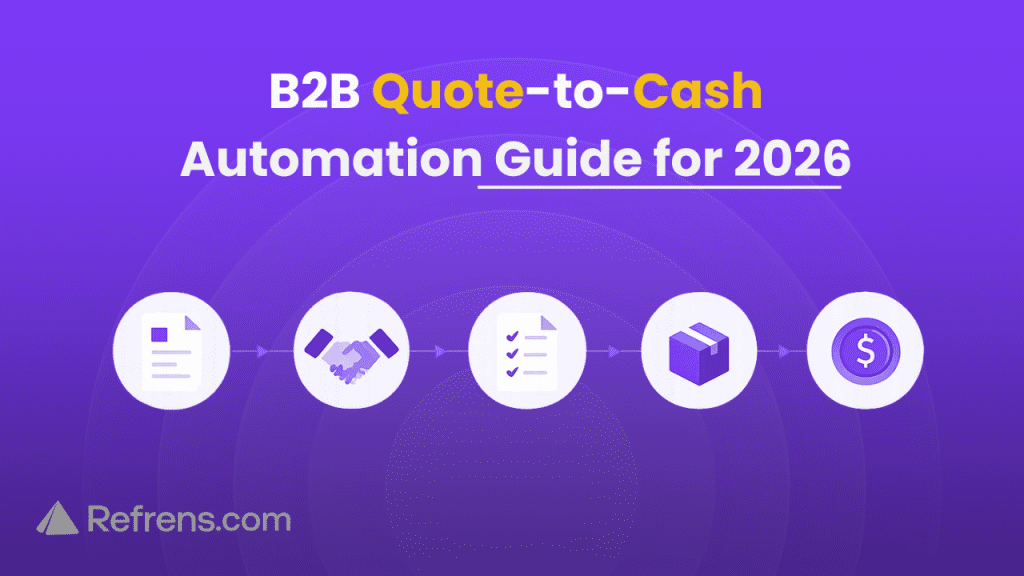
Quote-to-Cash covers six connected stages:
• Quote generation – pricing a product or service for a buyer
• Order validation – checking pricing, stock, and contract terms
• Approval workflow – internal sign-off when discounts or terms need review
• Order entry – pushing the confirmed order into your ERP
• Invoicing – generating and sending the invoice
• Payment collection – following up, processing, and reconciling payment
“Automating” Q2C for most businesses means that they are utilizing a quoting tool. Quoting is just the first step of the process. The true cost lies in the interstices between these processes wherein an individual still has to manually transfer data from one system to another and chase an approval over email.
Why This Matters More in 2026
B2B buyers now expect the same speed they get as customers. If a competitor sends an accurate quote in minutes and you take two days, you’re already behind before pricing even gets discussed.
The financial impact is bigger than most teams realise. According to Zilliant’s B2B benchmark research, businesses can lose up to 31.8% of annual revenue through the gaps between quoting, contracts, billing, and collections. That’s not a small leak; it’s nearly a third of potential revenue disappearing in handoffs nobody directly owns.
31.8%of annual B2B revenue can be lost through gaps between quoting, contracts, billing, and collections – Zilliant B2B benchmark research
Payments tell a similar story. Businesses relying only on invoice-based net terms typically report Days Sales Outstanding (DSO) 12 to 18 days higher than businesses offering digital payment alternatives. Every extra day of DSO is cash sitting outside your business instead of funding your next order or hire.
Where Most Companies Get Q2C Automation Wrong
A lot of B2B companies automate the easy parts, like generating a quote PDF, and leave the painful parts manual. Common gaps we see:
• CPQ tools that stop at the quote. Configure-Price-Quote software handles pricing logic well, but usually doesn’t touch order entry, invoicing, or collections.
• Disconnected CRM and ERP. The sale is closed in the CRM system but then entered again in the ERP. Each entry is an opportunity for a price or quantity error.
• Email-based ordering. A large share of B2B orders, especially repeat orders, still arrive by email or phone, bypassing whatever automated system is already in place.
• Manual approval chains. Discount approvals stuck in an inbox can stall a deal for days.
• Reactive Collections. Reacting to accounts receivable only when they are already past due rather than setting up automated systems and processes beforehand.
If any of this sounds familiar, your Q2C process has gaps, and that’s where revenue and customer trust leak out.
CPQ vs Full Quote-to-Cash Automation
It helps to see the difference side by side.
| Stage | CPQ Tool Alone | Full Q2C Automation |
| Quote generation | Automated | Automated |
| Pricing & discount rules | Automated | Automated |
| Order validation | Manual | Automated |
| Internal approvals | Manual / email-based | Automated workflow with rules |
| ERP / order entry | Manual re-entry | Auto-synced, no re-keying |
| Invoicing | Manual or semi-automated | Automated, triggered instantly |
| Payment collection | Manual follow-up | Automated reminders + digital payments |
| Reconciliation | Manual | Automated matching |
The pattern is clear: CPQ automates the front door. Full Q2C automation closes every door behind it.
What a Truly Automated Q2C Process Looks Like in 2026
The Q2C process in the present age, which is a fully automated one, is usually made up of:
1. Automatic quoting for live prices, availability, and contract terms.
2. Order validation based on rules that ensure every order conforms to pricing, credit and inventory requirements.
3. Workflow-driven quote approvals that only send orders requiring a human intervention to the next step.
4. ERP system integration whereby approved orders get entered into the record-keeping system without any additional input.
5. Immediate invoicing when orders get confirmed or shipped.
6. Automated collections using reminders, e-payments and reconciliation.
For most growing B2B and B2B eCommerce businesses, this isn’t built by stitching together five SaaS tools. It needs custom integration work connecting your CRM, ERP, payment gateway, and storefront so data moves automatically in both directions.
How a B2B eCommerce Website Development Company Fits In
This is exactly where B2B eCommerce website development services become the backbone of Q2C automation, not just a sales channel.
A well-built B2B eCommerce platform can:
• Let customers self-serve quotes based on their contract pricing, instead of waiting on a sales rep
• Validate orders automatically against live inventory and credit terms
• Push confirmed orders directly into your ERP without manual entry
• Trigger invoicing and digital payment collection the moment an order is confirmed
• Give sales and customers real-time visibility into order and payment status
This is why more Australian and global B2B brands work with an experienced eCommerce web development company rather than patching this together internally. Integration between CRM, ERP, payment systems, and storefront is technical work, and getting it wrong creates more manual effort, not less.
A Quick Example: Before and After Automation
Picture a mid-sized B2B distributor in Australia selling to retail buyers.
Before: Buyer sends email for quotation. Sales verifies pricing and stock manually, responds after several hours, and the order that was confirmed is entered manually in the ERP system, invoiced, and payment is chased after several weeks.
After: The buyer signs in on the B2B portal, views his/her contract price and real-time stock position, and places the order himself/herself. The order is validated and enters into the ERP system automatically. The invoice is generated instantly with a digital payment link attached to it.
The difference isn’t just speed. It’s fewer errors, faster cash collection, and a sales team that sells instead of processing paperwork.
Getting Started: Where to Begin
You don’t need to automate everything at once.
1. Map your current process: Note every step from quote to cash, and where humans do manual work.
2. Find your biggest leak: Slow quoting, manual ERP entry, or slow collections? Fix the highest-impact gap first.
3. Choose tools that integrate, not isolate: Pick a CPQ, ERP, and payment stack that can talk to each other through APIs.
4. Bring in integration expertise: This is where a skilled eCommerce web development company pays off, connecting your existing systems instead of forcing you to replace them all.
5. Don’t skip collections: It’s the most overlooked stage, and the one with the most direct cash flow impact.
Final Thoughts
Quote-to-cash automation in 2026 isn’t about replacing sales or finance teams. It’s about removing the manual handoffs that slow them down and quietly drain revenue. With up to 31.8% of annual revenue at risk through process gaps, and DSO running well over a week higher for businesses still relying on manual invoicing, the cost of doing nothing is measurable.
Related Posts:
 A Complete Guide to the Types of Invoices
 Comprehensive Guide to Sales Orders
 Everything You Need to Know About Purchase Orders: A Complete Guide
 How to Master In B2B Lead Generation with Effective Strategies?
 Top 10 Construction Quoting Software
 E-Invoicing Around the World: A Global Overview
 Top 15 Vendor Management Software in India for 2026: Features, Pricing, Ratings & Reviews
 The Ultimate Guide to Basics of Inventory Management
 Top 7 Most Trusted Invoice APIs to Automate Invoicing For Your Business (Updated 2024 List)
 Export Invoice: A Complete Guide for Seamless Trade
 Top 10 Best Recurring Billing Software Options for Your Business (Updated 2026 List)
 Top 11 CRM Systems For Facebook Integration (Updated 2026 List)
 Your Complete Guide to GSTR 3B: Filing Process, Due Dates, Penalties, and FAQs
 Everything You Need To Know About Sales CRM
 12 Best Ways to Generate More B2B Sales Leads
 Top 10 Inventory Management System in the USA
 Top 8 Inventory Management Software in India
 Zatca Compliant E-Invoices: A Detailed Guide for Businesses in Saudi Arabia