
The countdown has officially begun. On April 1, 2026, the 64-year-old Income Tax Act of 1961 will be retired, making way for the Income Tax Act, 2025.
For the Indian business community, this isn’t just another compliance update; it is a complete structural overhaul. The new Act cuts the legal text by nearly 50%, moving from over 800 sections to a leaner 536. If you are a business owner or a CFO, you have exactly 75 days to align your systems. Here is everything you need to know and the “cheat code” to navigate this transition smoothly.
1. The Core Shift: From “Assessment Year” to “Tax Year”
The most significant mental shift for Indian businesses will be the removal of the confusing “Previous Year” (PY) and “Assessment Year” (AY) distinction.
- The Old Reality: You earned money in FY 2024-25 (Previous Year) and paid/assessed it in 2025-26 (Assessment Year).
If you are filing income tax return for FY2024-25, it would be classified as Previous Year (PY) 2024-25 i.e. the year in which income is earned and also can be called as Assessment Year (AY) 2025-26, creating terminology confusion amongst people.
- The New Reality: The Act introduces a unified ‘Tax Year’ framework. This aligns the period of earning with the period of reporting.
The FY 2025-26 will be denoted as below as per the Old and New Income Tax Act –
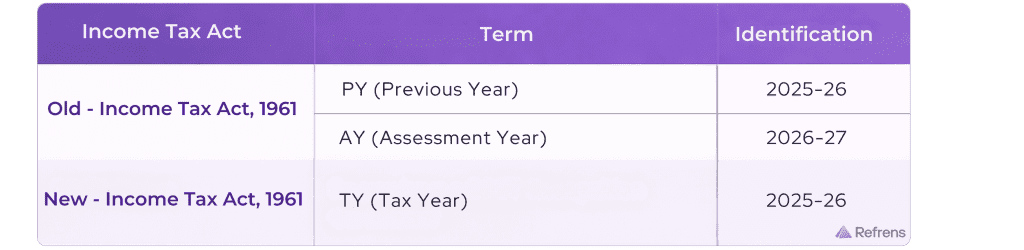
What to fix: Your ERP and accounting software likely use AY/PY logic for tagging vouchers and tax provisions. You must update your internal reporting templates to reflect a single “Tax Year” to avoid data mapping errors during the first filing cycle.
2. Digital-First & Faceless Everything
The 2025 Act codifies what was previously just a “scheme.” Faceless assessments, reassessments, and even appeals are now the standard legal mandate, not an option.
- Standardization: The new law relies heavily on pre-filled data from the Annual Information Statement (AIS) and Taxpayer Information Summary (TIS).
- The Risk: If your internal books don’t match the AIS perfectly, the “system” will flag you automatically. There is no longer a “friendly officer” to explain a minor mismatch.
What to fix: Conduct a pre-emptive reconciliation of your 26AS, AIS, and TIS data against your sales and purchase registers now.
3. Virtual Digital Assets (VDA) Expansion
If your business deals in crypto, NFTs, or even certain tokenized loyalty points, the 2025 Act has widened the net. The definition of VDAs has been broadened to cover any value operating on a cryptographic ledger.
What to fix: Review your balance sheet for any digital holdings. The new Act demands more granular disclosure of these assets. Ensure your “cost of acquisition” records are bulletproof, as the new law leaves little room for estimated valuations.
4. The “MSME 45-Day Rule” is Non-Negotiable
While introduced earlier, the 2025 Act reinforces the strictness of Section 43B(h) (now mapped to Section 37 of the new Act). Any payment due to a registered Micro or Small Enterprise must be made within 45 days (if there’s a contract) or 15 days (if no contract).
What to fix:
1. Filter your “Sundry Creditors” list by MSME status immediately.
2. Clear all MSME dues before the March 31st deadline to ensure tax deductibility.
3. Automate alerts in your accounting system for invoices reaching the 30-day mark to provide a 15-day safety buffer.
The “Cheat Code”: Your 75-Day Survival Strategy
Transitioning to a new law is usually expensive, but if you follow this “cheat code,” you can turn a compliance headache into a competitive advantage. The ultimate secret lies in using the Government’s own mapping tools to re-align your business.
Deploy the Official Navigators
The CBDT has released two essential tools that serve as your “Rosetta Stone” for this transition. Use them to bridge the gap between 1961 and 2025 logic:
- Interactive Section-to-Clause Utility: A web-based search engine where you enter an old section and instantly get the new clause number.
- Official PDF Mapping Navigator: A comprehensive document that lists every re-numbered provision.
Why this is a cheat code: Most businesses will wait for their CAs to tell them what changed. If you give these links to your IT and ERP teams today, they can re-code your tax logic (like the new consolidated Section 393 for all TDS) before your competitors even realize the sections have changed.
Tool 1: The Vendor Communication Letter
Subject: Urgent: Declaration of MSME Status for Compliance under Income Tax Act, 2025
Dear Vendor Partner,
As we transition to the Income Tax Act, 2025, effective from April 1, 2026, our company is committed to ensuring seamless compliance and timely payments. To comply with the reinforced provisions regarding payments to Micro and Small Enterprises, we require your updated registration status. Please provide the following by [Insert Date]:
1. MSME Category: (Micro / Small / Medium / Non-MSME)
2. Udyam Registration Number: (Please attach a copy of the certificate)
3. Nature of Business: (Manufacturer / Service Provider / Trader)
Regards, [Your Company Name]
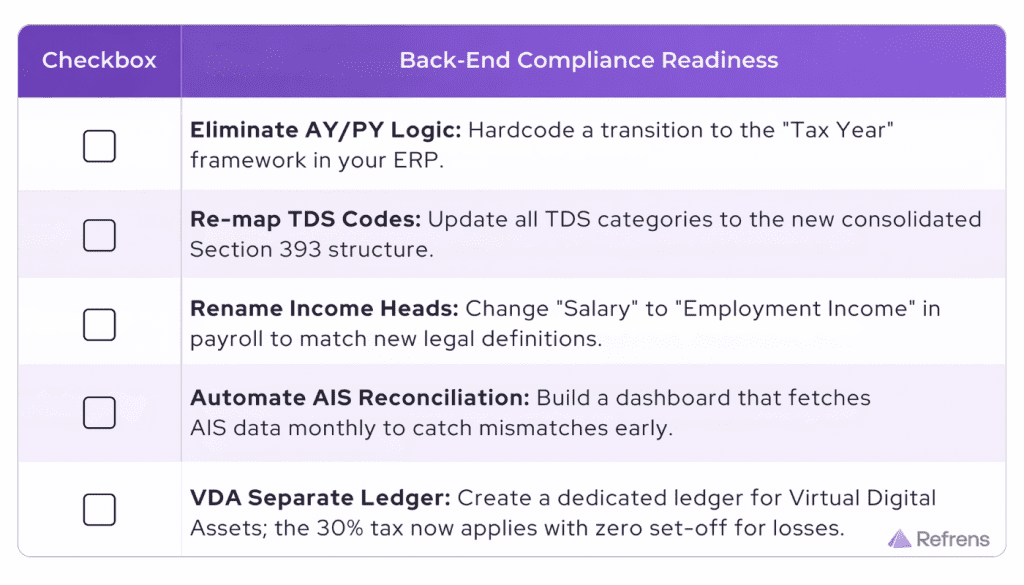
Tool 2: The CFO’s 75-Day System Blueprint
Hand this checklist to your IT team to ensure your “back-end” doesn’t fail on April 1.
Final Thoughts: Don’t Wait for April
The 1961 Act was written when India used typewriters. The 2025 Act is written for a world of APIs, AI, and blockchain. Indian businesses that treat this as a “simple name change” will be hit with litigation in 2027. Those who use these 75 days to digitize their records and reconcile their data via the official CBDT Navigators will find that the new law actually makes their life significantly easier.
The goal is simple: Be so digitally clean that the “Faceless System” has no reason to look at you.
About the Author: Kajal Agarwal is a qualified Chartered Accountant and Assistant Vice President – Finance at a U.S.-based multinational corporation, where she manages financial operations for clients generating over $100 million in revenue. A mentor to aspiring CAs and author of a widely acclaimed book on Company Law, she has also appeared live on DD News as a Budget 2025 expert, sharing insights on national fiscal policy. Outside her professional life, Kajal is deeply committed to holistic living as a long-time practitioner of Iyengar Yoga and a certified Pranic Healer, finding balance through yoga, meditation, and mindful leadership.

Related Posts:
 TDS & TCS Filing Deadlines FY 2025-26: A Complete Guide
 Everything To Know About GSTR-3A: Issuance, Actions to Take, and Consequences of Non-Compliance
 Q4 Action Plan for Indian Business Leaders: 9 Proven Tactics to Finish FY26 on a High Note
 Your Complete Guide to GSTR 3B: Filing Process, Due Dates, Penalties, and FAQs
 Top 10 Billing Software for Law Firms
 A Comprehensive Guide to GST Compliance for E-Commerce Operators in India
 Mastering Input Tax Credit (ITC) Under GST: A Comprehensive Guide for Businesses in India
 SST vs. GST: Understanding Tax Systems in Malaysia
 Understanding Reverse Charge Mechanism (RCM) Under GST: A Complete Guide for Businesses
 Advance Tax: Who Needs to Pay, When to Pay & How to Avoid Penalties
 Everything To Know About GSTR 3
 Your Complete Guide to GSTR 4: Due Dates, Formats, Filing Process, Penalities, and FAQs.
 Zatca Compliant E-Invoices: A Detailed Guide for Businesses in Saudi Arabia
 Your Complete Guide to GSTR 5: Filing Process, Due Dates, Penalties, Amendments, and FAQs
 A Complete Guide to the Types of Invoices
 Understanding the Structure of GST: Simplifying Compliance and Driving Growth in India
 How MSME Owners Can Benefit from Budget 2026: A Practical Guide
 Everything to know about GSTR 9C: Eligibility, Filing Process, Amendments, and FAQS