
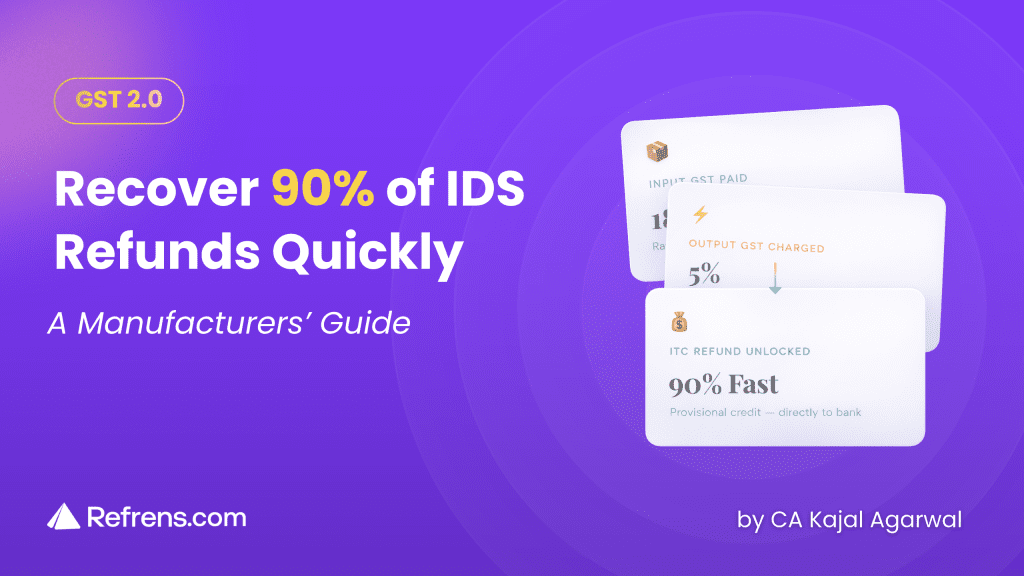
For every business owner, managing cash flow is paramount. It’s the lifeblood that keeps operations running, enables growth, and helps navigate unexpected challenges. Yet, for years, many Indian businesses operating under the Goods and Services Tax (GST) regime found their working capital getting stuck in an often-overlooked but significant problem: the Inverted Duty Structure (IDS).
What Exactly is an Inverted Duty Structure (IDS)?
- Imagine you’re manufacturing a product. You buy various raw materials, components, and services (your ‘inputs’), and you pay GST on all of them.
- Then, you process these inputs and sell your finished product (your ‘output’).
- An Inverted Duty Structure (IDS) occurs when the GST rate you pay on your inputs is higher than the GST rate you charge on your finished product.
Let’s break it down with an example:
- Scenario: You manufacture electric vehicles (EVs).
- Input GST: You purchase components like batteries, motors, and electronic systems, all attracting a standard GST rate of, say, 18%. You also pay 18% GST on services like logistics, warehousing, and consultancy. Let’s assume the total cost of these inputs were INR 20 Lakhs, making the Input GST as INR 3.6 Lakhs.
- Output GST: When you sell the finished EV, the government, to promote green energy, has kept the GST rate at a much lower 5%. Assuming the finished goods are sold at INR 30 Lakhs, the Output GST will be INR 1.5 Lakhs.
- The Output GST of INR 1.5 Lakhs will be set off against the claimed ITC of INR 3.6 Lakhs. However, we will still be left with INR 2.1 Lakhs in Input GST.
In this scenario, you’ve paid significantly more GST on your purchases (18%) i.e. INR 3.6 Lakhs, than you collect on your sales (5%) i.e. INR 1.5 Lakhs. This difference of INR 2.1 Lakhs accumulates as Input Tax Credit (ITC) in your electronic credit ledger. While ITC is generally a good thing, under an IDS, you accumulate excess ITC that you can’t fully utilize against your output tax liability. This surplus ITC remains stuck, effectively becoming a “working capital trap.”
What Was Wrong Earlier? The Pre-GST 2.0 Challenges
Before the recent amendments, businesses facing IDS could claim a refund of their accumulated ITC. However, the process was fraught with challenges:
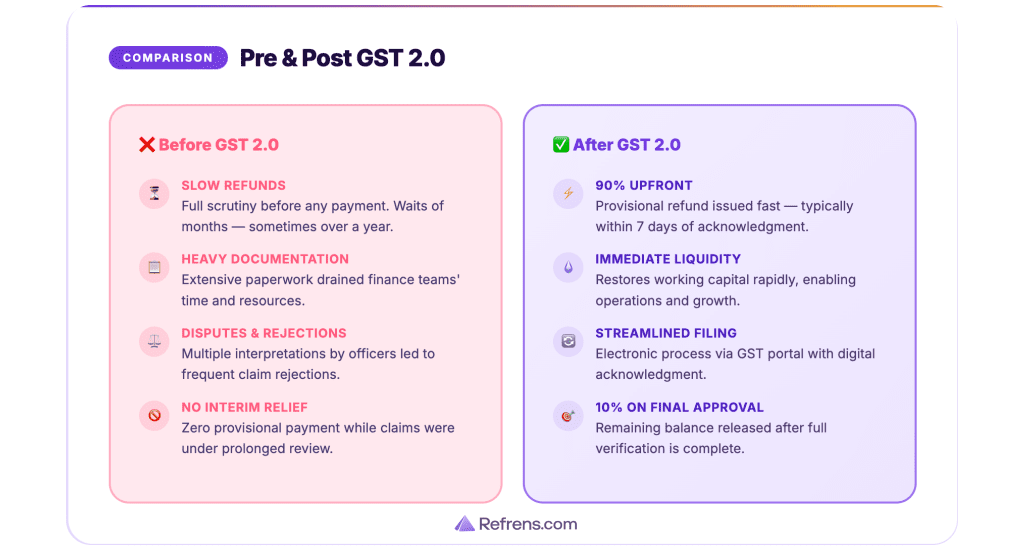
- Slow Refund Process: Refunds for IDS were often delayed. The entire claim would undergo detailed scrutiny and audit before being sanctioned. This meant businesses had to wait months, sometimes even over a year, to get their money back.
- Administrative Burden: The documentation and procedural requirements for refund claims were extensive, requiring significant time and effort from finance teams.
- Disputes and Rejections: Claims were often subject to various interpretations by tax authorities, leading to disputes and sometimes outright rejections, further prolonging the recovery of funds.
- Lack of Provisional Relief: There was no mechanism to provide immediate, partial relief while the full claim was being processed, exacerbating the working capital crunch.
These issues collectively created a situation where the promise of a seamless tax credit mechanism under GST was undermined by the realities of the IDS, particularly for manufacturers.
GST 2.0: The Solution – Faster Refunds and Liquidity Boost
The government has acknowledged these pain points and introduced significant changes in the Union Budget 2026-27 and subsequent amendments, to streamline the IDS refund process. The most impactful change is the introduction of the Provisional Refund Facility.
The Game-Changer: Provisional Refund of 90%
Under the amended Section 54(6) of the CGST Act, businesses claiming refunds due to an inverted duty structure are now eligible for a provisional refund of 90% of the claimed amount.
What this means for you:
Instead of waiting for the entire refund to be sanctioned after a lengthy verification process, you can now receive 90% of your eligible refund amount relatively quickly. The remaining 10% will be processed after the full verification and final sanction.
Think of it as an interim relief measure that acknowledges the legitimate block in your funds and provides rapid access to most of it.
Other Strategic Corrections
While the 90% provisional refund is the biggest operational change, the government has also used Customs Duty rationalization to address IDS in specific sectors. By strategically lowering customs duties on certain imported raw materials and components (e.g., for lithium-ion cells in battery manufacturing or specific textile inputs), they aim to prevent an IDS from occurring at the import stage itself, ensuring that the input tax burden doesn’t exceed the output tax in crucial manufacturing sectors.
Who is Eligible and How to Avail the Benefits?
Eligibility:
Any registered taxpayer whose accumulated Input Tax Credit (ITC) arises due to an Inverted Duty Structure (i.e., the rate of GST on inputs is higher than the rate of GST on output supplies) is eligible to claim a refund. This typically applies to manufacturers and sometimes service providers who primarily make zero-rated or exempt supplies with higher-taxed inputs.
Important Note: The refund is generally limited to the ITC accumulated from inputs (goods) and input services. It typically does not include ITC on capital goods, as the law currently provides for specific rules regarding their utilization and depreciation.
How to Avail the Benefits (The Process):
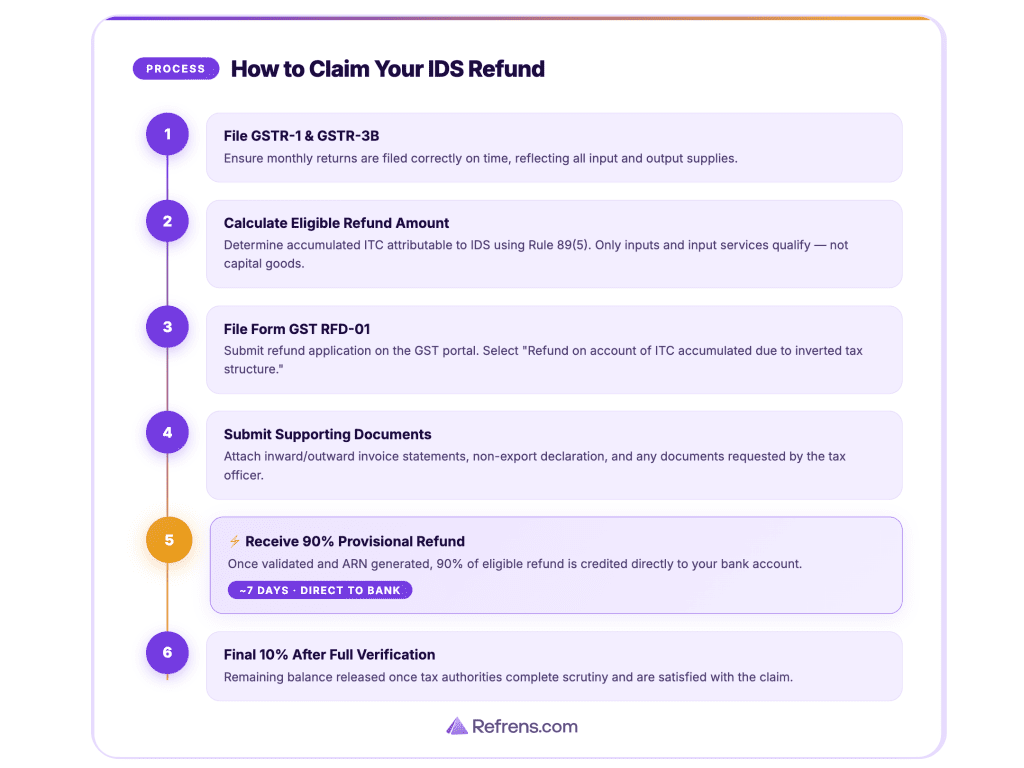
- File your GSTR-3B and GSTR-1: Ensure these monthly returns are filed correctly and on time, reflecting all your input and output supplies.
- Determine your Refund Amount: Calculate the amount of accumulated ITC attributable to the inverted duty structure as per Rule 89(5) of the CGST Rules. The formula is designed to ensure only the ITC pertaining to the IDS is refunded.
- File Form GST RFD-01: This is the application for a refund. It needs to be filed electronically through the GST portal. You will select “Refund on account of ITC accumulated due to inverted tax structure” as the reason for the refund.
- Submit Supporting Documents: Along with RFD-01, you’ll need to submit documents like: (i) A statement containing the number and date of invoices of output supplies. (ii) A statement containing the number and date of invoices of inward supplies (inputs). (iii) A declaration that the goods have not been exported or that the benefit of tax on such goods has not been availed. (iv) Any other document requested by the tax officer.
- Provisional Refund (90%): Once your application for refund is found to be complete and valid, the tax officer will process the provisional refund. This usually happens within a short timeframe (often 7 days) of the refund application acknowledgment (ARN) being generated. The 90% amount will be credited directly to your bank account.
- Final Refund (Remaining 10%): The remaining 10% of the refund, along with any balance after detailed verification, will be sanctioned and disbursed after the tax authorities complete their full scrutiny and are satisfied with the claim.
Additional Important Information for Business Owners
- Continuous Monitoring: Keep a close eye on your ITC ledger. Regularly reconcile your GSTR-2B with your purchase register to ensure all eligible ITC is captured.
- Proper Documentation: Maintain meticulous records of all your input and output invoices. This is crucial for smooth refund processing and to avoid future disputes.
- Professional Guidance: Given the complexities of tax laws, it’s always advisable to consult with a GST expert or Chartered Accountant. They can help you correctly calculate your eligible refund, ensure proper documentation, and navigate the refund application process efficiently.
- Rule 89(5) Formula: The refund amount for IDS is calculated using a specific formula provided in Rule 89(5) of the CGST Rules, which is:
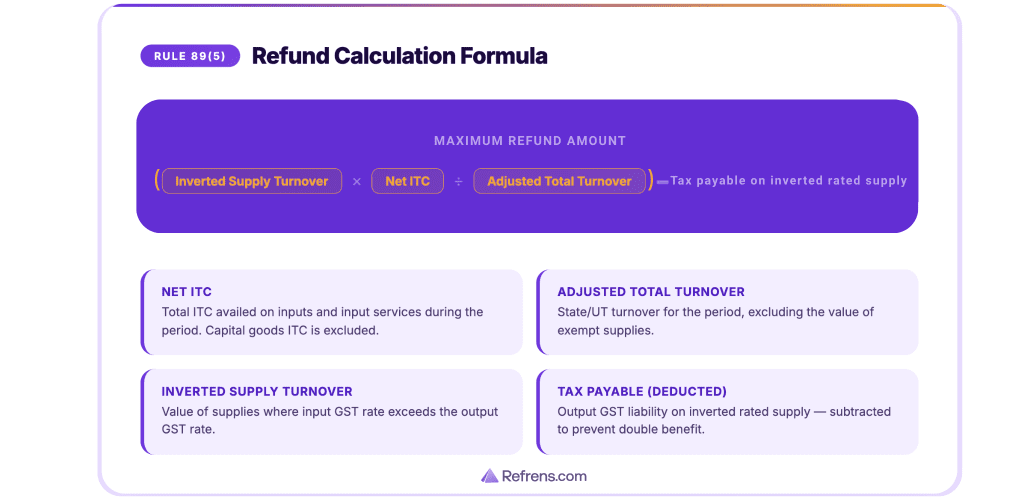
Maximum Refund Amount = [(Turnover of Inverted Rated Supply of goods and services) x Net ITC ÷ Adjusted Total Turnover] – Tax Payable on such inverted rated supply of goods and services.
Where:
Net ITC means ITC availed on inputs and input services during the relevant period.
Adjusted Total Turnover means the turnover in a state or union territory, excluding the value of exempt supplies.
Understanding this formula correctly is vital to claiming the accurate refund amount.
- Impact of GST Council Decisions: GST rates and rules are subject to decisions by the GST Council. Stay updated with their notifications, as future changes could impact your IDS position
Conclusion: A Brighter Outlook for Working Capital
The introduction of the 90% provisional refund facility under GST 2.0 is a significant step forward in making the GST regime more business-friendly, especially for manufacturers plagued by the Inverted Duty Structure. It directly addresses the critical issue of trapped working capital, providing much-needed liquidity and breathing room for businesses to invest, grow, and operate more efficiently.
If your business has been struggling with accumulated ITC due to an IDS, now is the time to understand these changes, assess your eligibility, and actively claim your rightful refunds. This new approach not only simplifies the process but truly empowers businesses by returning crucial funds to where they belong – back into your operations.
About the Author: Kajal Agarwal is a qualified Chartered Accountant and Assistant Vice President – Finance at a U.S.-based multinational corporation, where she manages financial operations for clients generating over $100 million in revenue. A mentor to aspiring CAs and author of a widely acclaimed book on Company Law, she has also appeared live on DD News as a Budget 2025 expert, sharing insights on national fiscal policy. Outside her professional life, Kajal is deeply committed to holistic living as a long-time practitioner of Iyengar Yoga and a certified Pranic Healer, finding balance through yoga, meditation, and mindful leadership.

Related Posts:
 Mastering Input Tax Credit (ITC) Under GST: A Comprehensive Guide for Businesses in India
 Your Complete Guide to GSTR 3B: Filing Process, Due Dates, Penalties, and FAQs
 Everything To Know About GSTR 3
 GSTR 6: Filing Process, Eligibility, Recent Updates, and FAQs
 GSTR 2A: How It Works and Why It Matters
 Understanding Reverse Charge Mechanism (RCM) Under GST: A Complete Guide for Businesses
 Everything to know about GSTR 9C: Eligibility, Filing Process, Amendments, and FAQS
 A Quick Overview of GSTR-2B: Features, Benefits, and How to Use It
 A Comprehensive Guide to GST Compliance for E-Commerce Operators in India
 A Complete Guide to the Types of Invoices
 Complete Guide to GSTR 9: Filing Process, Penalties, Tips, Mistakes to Avoid, and FAQs
 Master GST Reconciliation: Process, Tools, and Best Practices
 Understanding the Structure of GST: Simplifying Compliance and Driving Growth in India
 SST vs. GST: Understanding Tax Systems in Malaysia
 GSTR 2: Everything You Need To Know
 GSTR: What is GST Return? Types, Rules, Procedures, and Penalties
 Everything To Know About GSTR-3A: Issuance, Actions to Take, and Consequences of Non-Compliance
 Everything to know about GSTR 11:Eligibility, Filing Process, Amendments, Mistakes to Avoid, and FAQs