
India’s transition from a “back-office” to a global “knowledge office” has been one of the most significant economic shifts of the last decade. As we step into 2026, the Knowledge Process Outsourcing (KPO) and Global Capability Centre (GCC) sectors are no longer just about cost arbitrage; they are about high-value research, Intellectual Property (IP) creation, and sophisticated AI-driven analytics.
The Union Budget 2026 has fundamentally rewritten the rules of engagement. With the introduction of the “Safe Harbour 2.0” regime and a landmark tax holiday for digital infrastructure, the Indian government has sent a clear message: India aims to be the world’s undisputed nerve center for high-end services.
The Evolution: From BPO to the “Knowledge Hub” of 2026
While Business Process Outsourcing (BPO) focuses on process efficiency and volume, KPO thrives on specialized expertise and judgment-based decision-making. Today, India’s KPO sector handles complex workloads including legal research (LPO), clinical trials for global pharma, high-frequency financial modeling, and the tuning of Large Language Models (LLMs).
According to recent projections, India’s outsourcing exports are set to hit $45 billion in 2026, capturing a staggering 20% of the global market share. However, the growth of this sector was historically throttled by “tax terrorism” specifically Transfer Pricing (TP) disputes. KPOs were often embroiled in years of litigation over whether their profit margins should be 17% or 25%. Budget 2026 seeks to end this ambiguity once and for all.
Safe Harbour 2.0: Moving from “Scrutiny” to “Certainty”
The most transformative change in the 2026 Budget is the overhaul of the Safe Harbour (SH) Rules. A “Safe Harbour” is a set of defined circumstances under which the tax authorities accept the transfer price declared by the taxpayer without question, effectively bypassing the audit stage.
1. Unified Category & Competitive Margin
Previously, services were fragmented into BPO, KPO, and software development, each with different margin requirements that often reached as high as 24%. This caused confusion for multifaceted GCCs that did a bit of everything.
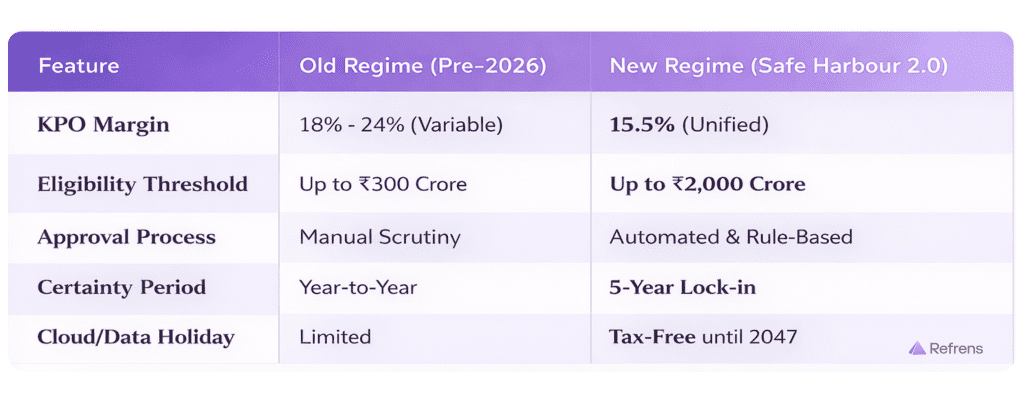
- The Change: Budget 2026 clubs all IT and IT-enabled services (including KPO and R&D) into a single “Information Technology Services” category.
- The Margin: A uniform safe harbour margin of 15.5% has been proposed. This is a significant reduction from the earlier 18–24% brackets, making the Indian fiscal environment highly competitive compared to rival hubs like Poland or the Philippines.
2. Massive Threshold Hike to Include Large GCCs
- Old Limit: Only companies with an aggregate transaction value up to ₹300 crore ($36M) could opt for Safe Harbour.
- New Limit: The threshold has been raised to ₹2,000 crore ($240M). This shift moves Safe Harbour from a “small player” benefit to a strategic tool for mid-sized and large GCCs. It is estimated that this change alone will cover up to 80% of the firms currently operating in India, removing thousands of potential cases from the judicial pipeline.
3. Automated Rule-Based Approval & 5-Year Lock-in
In a push for “Minimum Government, Maximum Governance,” SH applications will now be processed via an automated, rule-driven system on the tax portal. If the data points match the criteria, acceptance is instant. Once opted for, the certainty remains valid for 5 consecutive years, allowing global CFOs to plan long-term capital allocation without fear of mid-year policy shifts.
Tax Holiday 2.0: Powering India’s Data Sovereignty
Modern KPOs do not just use human brains; they require massive compute power and data storage. Recognizing this, Budget 2026 has introduced a strategic tax holiday to turn India into a “Data Sovereign” hub.
- Tax Holiday until 2047: Foreign companies providing cloud services to global customers using Indian data center infrastructure are now eligible for a 100% tax holiday on profits through March 31, 2047.
- The Objective: This long-term certainty (over 20 years) is designed to encourage MNCs to host their global AI workloads on Indian servers. By housing the data and the “knowledge workers” in the same jurisdiction, the latency in decision-making and the legal complexities of cross-border data transfer are minimized.
A Case Study: The Financial Impact
Consider a mid-sized US-based KPO with Indian operations generating a revenue of ₹500 Crore ($60M).
- Under the Old Rules: They might have been forced into a 24% margin to avoid litigation, resulting in a taxable profit of ₹120 Crore.
- Under Safe Harbour 2.0: With the 15.5% margin, their taxable profit would be ₹77.5 Crore
- The Result: A reduction of over ₹42.5 Crore in the tax base, significantly boosting the Net Present Value (NPV) of their Indian investment and providing more capital to hire specialized AI talent locally.
Alignment with Global Minimum Tax (Pillar Two)
A critical concern for MNCs in 2026 is the OECD Pillar Two global minimum tax of 15%. India’s new 15.5% Safe Harbour margin is no coincidence, rather it is perfectly calibrated. By ensuring a 15.5% profit margin, India ensures that these KPOs meet the global minimum tax threshold, preventing “Top-Up Taxes” from being collected by the MNC’s home country (like the US or Germany). India effectively keeps the tax revenue while providing the company with total compliance safety.
Beyond the Metro: Decentralized KPO Hubs
Budget 2026 also introduced the “Digital Infrastructure Viability Gap Funding” for Tier-2 and Tier-3 cities. With Bengaluru and Gurgaon reaching saturation, the government is incentivizing KPOs to set up shops in cities like Coimbatore, Indore, and Jaipur. KPOs setting up in these “Emerging Knowledge Zones” receive an additional 2% reduction in the safe harbour margin (down to 13.5%) for the first three years of operation.
Fast-Track Advance Pricing Agreements (APA)
For the mega-KPOs that exceed the ₹2,000 crore threshold, the Budget introduces a Fast-Track Unilateral APA process. The government now guarantees a conclusion to these agreements within 2 years (down from the current average of 4-5 years). This provides the “Big Four” and large tech firms a clear roadmap for their multi-billion dollar operations.
Quick Summary:
Conclusion: The New Gold Standard
India is no longer just a “cost-saving” destination; it is a “certainty” destination. By simplifying the Safe Harbour rules, aligning with global tax standards, and offering a multi-decade tax holiday for digital infrastructure, Budget 2026 has laid the foundation for India to become the “Cognitive Capital” of the world.
For global enterprises, the message is clear: the focus should be on innovation, not litigation. The 2026 fiscal framework turns the Indian KPO model from a “tactical cost-play” into a “strategic anchor” that is safe, predictable, and highly profitable.
About the Author: Kajal Agarwal is a qualified Chartered Accountant and Assistant Vice President – Finance at a U.S.-based multinational corporation, where she manages financial operations for clients generating over $100 million in revenue. A mentor to aspiring CAs and author of a widely acclaimed book on Company Law, she has also appeared live on DD News as a Budget 2025 expert, sharing insights on national fiscal policy. Outside her professional life, Kajal is deeply committed to holistic living as a long-time practitioner of Iyengar Yoga and a certified Pranic Healer, finding balance through yoga, meditation, and mindful leadership.
Related Posts:
 Explore 250+ open roles at 33 top startups in Surat – from SaaS and AI to fashion and fintech.
 Don’t Leave Money on the Table: Startup Tax Incentives Every Founder Should Know (And How to Qualify)
 How MSME Owners Can Benefit from Budget 2026: A Practical Guide
 Top 15 Vendor Management Software in India for 2026: Features, Pricing, Ratings & Reviews
 How to Build a Production-Ready AI Voice Calling Workflow for Sales Qualification
 TDS & TCS Filing Deadlines FY 2025-26: A Complete Guide
 E-Invoicing Around the World: A Global Overview
 Are You Ready for the New Income Tax Act? 75-Day Action Plan for Business Leaders & CFOs.
Republic Day Marketing in India: Dos, Don’ts, and Case Studies for Brands
Are You Ready for the New Income Tax Act? 75-Day Action Plan for Business Leaders & CFOs.
Republic Day Marketing in India: Dos, Don’ts, and Case Studies for Brands
 Navigating the 180-Day ITC Reversal Rule: What Businesses Must Know in 2026
 Your Complete Guide to GSTR 3B: Filing Process, Due Dates, Penalties, and FAQs
 Mastering Input Tax Credit (ITC) Under GST: A Comprehensive Guide for Businesses in India
 Understanding the Structure of GST: Simplifying Compliance and Driving Growth in India
 SST vs. GST: Understanding Tax Systems in Malaysia
 Everything To Know About GSTR 3
 Manufacturers’ Guide to Recovering 90% of IDS Refunds Quickly
 Best Accounting Software in India: Features, Pricing, Reviews, and more (Updated 2026 List)
 A Complete Guide to the Types of Invoices