
If you are a founder or product manager in 2026, you likely have a spreadsheet open right now comparing Payment Gateway (PG) fees.
- Gateway A: 1.8%
- Gateway B: 2.0%
- Gateway C: 1.7%
The math seems simple: pick the lowest percentage and save money. This is the most expensive mistake startups make.
In the current Indian fintech landscape, “Cost” is no longer just the Platform fee or TDR (Transaction Discount Rate). Cost includes downtime, failed transactions, slow settlements, and engineering hours spent fixing bad APIs.
We analyzed the top 5 Indian Payment Gateways, Razorpay, Paytm PG, Cashfree, PhonePe, and PayU—to determine which one actually delivers the best Return on Investment (ROI) when you scale beyond ₹10 Lakhs/month or even at ₹1–10L/month.
The Real Cost of Payments: A Financial Breakdown
Before we critique individual providers, we need to run the numbers. Most founders stop at the Platform fee or TDR (Transaction Discount Rate)—the percentage fee the gateway charges.
But in 2026, TDR is the least important variable in your revenue equation. The metrics that actually determine your bank balance are Success Rate (SR) and Net Realised Revenue.
Let’s compare two archetypes:
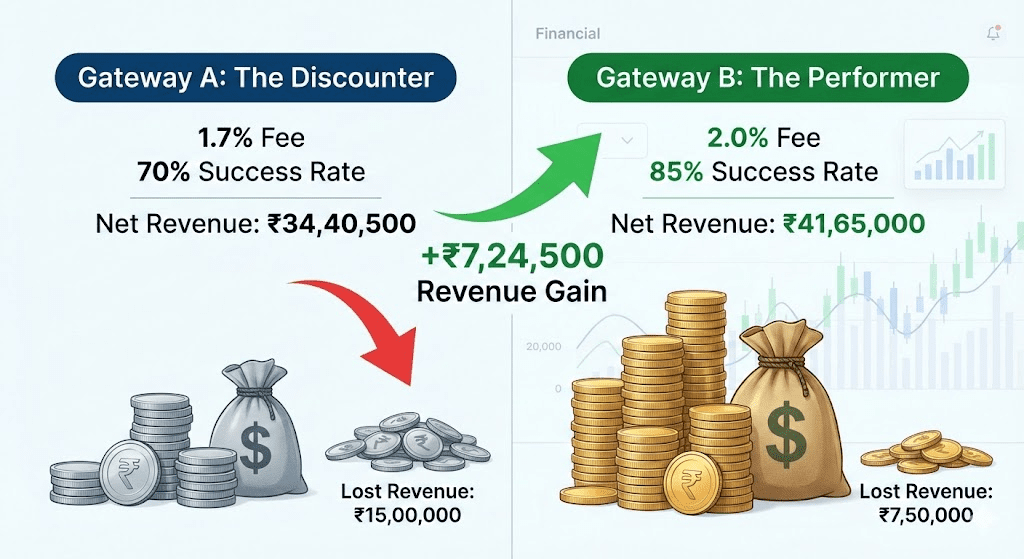
- Gateway A (“The Discounter”): Offers a low 1.7% fee to win business but runs on legacy infrastructure with lower reliability.
- Gateway B (“The Performer”): Charges a standard 2.0% fee but invests in Smart Routing and direct bank integrations.
| Metric | Gateway A (The Discounter) | Gateway B (The Performer) |
| Headline TDR | 1.7% (Looks Cheaper) | 2.0% (Premium) |
| Annual Maintenance (AMC) | ₹10,000 | ₹0 |
| Setup Fee | ₹5,000 | ₹0 |
| Avg. Success Rate (SR) | 70% | 85% |
| Potential Sales Traffic | ₹50,00,000 | ₹50,00,000 |
| Realised Revenue (Pre-Fee) | ₹35,00,000 | ₹42,50,000 |
| Gateway Fee Cost | ₹59,500 | ₹85,000 |
| Revenue Lost to Failure | ₹15,00,000 | ₹7,50,000 |
| NET REVENUE LANDED | ₹34,40,500 | ₹41,65,000 |
The Verdict
- The “Expensive” Fee: You paid Gateway B ₹25,500 more in transaction fees.
- The Revenue Gain: You earned ₹7,24,500 more in revenue because the transactions actually succeeded.
The ROI Lesson: By trying to save ₹25k on fees with Gateway A, you lost ₹7.2 Lakhs in sales. Gateway B didn’t cost you money; it made you money.
Why Does This Happen? (The 3 Hidden Killers)
- Downtime vs. Routing: Budget gateways often have single points of failure. If HDFC’s server blips, your payment fails. Premium gateways use Smart Routing to instantly switch that transaction to ICICI or Axis rails, saving the sale.
- The AMC Trap: Many “cheap” gateways hit you with a ₹10k–₹20k annual bill (AMC) regardless of your performance. This raises your effective cost per transaction significantly if your volume is low.
- CAC Wastage: If you spent ₹500 on Facebook Ads to bring that customer to your site, and Gateway A fails the transaction, you haven’t just lost the sale—you’ve burned the ₹500 ad spend.
Now that we have established that Success Rate > TDR, let’s look at which Indian players actually deliver on that promise.
Below is a practical, scale-focused breakdown of five popular Indian payment gateways—Razorpay, Paytm PG, Cashfree, PhonePe, and PayU—through the lens of ROI. The goal isn’t to crown a “winner for everyone”, but to show what each product tends to be optimised for, and where ROI usually comes from (or leaks).
How to read the sections
For each gateway, we will cover:
- Best for (what kinds of businesses see the strongest ROI)
- Pricing reality (headline rate + what to double-check)
- ROI levers (what can improve realised revenue at scale)
- Watch-outs (where teams get surprised)
1) Razorpay Payment Gateway
Ranked in terms of ROI: Number #1
Rated: Gateway B, The Performer
Best for: High-growth startups, SaaS, D2C brands, and enterprises.
Pricing model: Standard pricing at 2% + GST, with custom enterprise pricing for higher-volume businesses.
The ROI verdict: Razorpay is the classic “Performer” payment gateway from the earlier model. You might pay a higher headline rate than a discount offer, but the combination of better payment completion, ZERO AMC and setup fees, and fewer failure-led drop-offs typically creates more realised revenue than the fee delta.
Razorpay has positioned Optimizer as delivering measurable uplifts in success rates (including mentioning ~10% improvements in some contexts), which is the core reason ROI can beat a “low-TDR” choice once volumes are meaningful without any doubt.
AMC and setup fees: Zero Setup and Zero Annual Maintenance Charges
Razorpay payment gateway remains a market leader not because it is the lowest-cost option on paper, but because it is the most invisible in production. The long term growth and ROI, when a customer clicks “Pay”, the experience is built to complete reliably, and that reliability compounds as volume grows. Razorpay’s own product narrative leans heavily on improving transaction success rate through optimisation features like dynamic routing and retries.
Read More: Q4 Checklist For Business Owners
2) Paytm Payment Gateway
Ranked in terms of ROI: Number #2
Rated: Gateway B, The Performer
Best for: Mass market utilities, ticketing platforms, and high-frequency gaming apps.
Pricing model: Standard pricing typically around 1.99% + GST, with custom rates available for high-volume enterprise merchants.
The ROI verdict: Paytm operates on a logic of sheer scale rather than feature optimization. While a 1.99% fee is competitive and aligns with standard market rates, the ROI here is derived from throughput capacity rather than “smart” revenue recovery. For businesses where the primary goal is processing millions of micro-transactions (like metro tickets or utility bills) without bells and whistles, Paytm delivers functional ROI. However, for brands looking to increase conversion rates through superior checkout experiences, the value proposition is utilitarian compared to other performer payment gateways.
AMC and setup fees: Zero Setup and Zero Annual Maintenance Charges
Paytm PG offers a direct advantage for businesses utilizing the Paytm Wallet ecosystem, which remains a sticky payment mode for a specific demographic. However, the focus remains on “processing volume” rather than the “revenue optimization” suite (like Flash Checkout or Smart Routing) that defines the pioneer class of gateways. It is a reliable pipe for money, but less of a growth partner.
| At a Glance:Payment failure rate is a direct revenue leak: if 8% of 10,000 payment attempts fail at an ₹1,200 AOV, that’s ₹9.6 lakhs in potential revenue lost. |
3) Cashfree Payment Gateway
Ranked in terms of ROI: Number #3
Rated: Gateway A, The Discounter
Best for: Startups and SMEs optimising for headline pricing, plus teams that want a wide coverage of payment methods.
Pricing model: Cashfree is currently running a 1.6% limited-period offer for new merchants (valid for 12 months from signup) instead of its stated standard 1.95% for domestic transactions (cards, UPI, net banking), and it also lists a 2.0% platform fee in its charges page context.
The ROI verdict: Cashfree’s ROI proposition is straightforward: win on pricing and breadth, then layer additional value through features and support packages. It can be a good “start cheap” option on a spreadsheet, but at scale ROI depends on what the final effective fee structure looks like after the offer period and after adding any fixed annual costs.
AMC and setup fees: Cashfree explicitly states ZERO setup fees, but states an Annual Maintenance Contract (AMC) of ₹4,999 per year, which makes the overall cost higher even at 1.6%.
Cashfree tends to work best as a “pricing-first” gateway choice where the operating model is centred around keeping the platform fee low and accepting that total cost will include fixed annual charges. For growth-focused brands, the key question is whether the lower headline rate compensates for the full lifecycle cost (AMC + any add-ons) and the checkout completion outcomes at their scale.
4) PayU Payment Gateway
Ranked in terms of ROI: Number #4
Rated: Gateway B, The Performer
Best for: Mid-market and enterprise merchants that want a long-established gateway with broad payment method coverage and structured operational processes.
Pricing model: Standard pricing at 2% (with merchant-specific customisation available based on business category and volume).
The ROI verdict: PayU’s ROI proposition is anchored in being a steady, mainstream payment rail rather than an “optimisation-first” revenue recovery platform. The value typically shows up when the primary requirement is consistent processing at scale across multiple payment methods, with a more traditional enterprise engagement model.
AMC and setup fees: PayU’s pricing page states no setup, onboarding, or annual fees.
Description: PayU tends to fit businesses that prioritise “reliable processing and coverage” over “maximum conversion optimisation”. It works well as a dependable pipe for payments, but businesses chasing aggressive ROI through success-rate uplift should validate performance levers (routing, retries, checkout UX tooling) during a pilot instead of assuming the headline 2% fee alone predicts outcomes.
5) PhonePe Payment Gateway
Ranked in terms of ROI: Number #5
Rated: Gateway A, The Discounter
Best for: UPI-heavy businesses and mass-market merchants that want a familiar consumer brand at checkout.
Pricing model: PhonePe’s official pricing page lists a Standard Plan at 1.95% and also highlights that it is FREE* under a limited-period “Super Savings Offer”.; the effective rate card can change after promotional periods and is typically finalised during onboarding/contracting.
The ROI verdict: PhonePe’s ROI story is primarily driven by UPI-led checkout behaviour and distribution. If your payment mix is dominated by UPI and your customers are already comfortable with PhonePe, the gateway can deliver functional ROI by reducing checkout friction. For teams optimising hard for revenue recovery (routing, retries, optimisation analytics), PhonePe should be evaluated through a pilot: measure success rate by bank/issuer, failure reasons, and peak-day performance, then compare the net revenue landed against the fee savings.
AMC and setup fees: PhonePe explicitly states there are no setup fees or hidden charges.
For anything plan-specific beyond this (e.g., enterprise commercials), confirm the final signed rate card and any optional service pricing during onboarding.
PhonePe PG tends to fit businesses that are UPI-first and value a clean, low-friction checkout experience tied to a widely used consumer payments brand. It can be a solid “coverage + simplicity” gateway, while performance-led ROI (success-rate uplift mechanisms) should be validated with real traffic data rather than assumed from headline positioning.
Summary: The Best ROI Payment Gateway Landscape
Here is how the top players stack up when you look beyond the marketing headline and focus on total cost of ownership.
| Payment Gateway | Category Rating | Pricing Model (Standard) | Hidden Costs (AMC/Setup) | The ROI Verdict |
| Razorpay | Gateway B (The Performer) | 2.0% | Zero / Zero | Best Overall ROI. Higher success rates and zero fixed fees make it the most profitable choice for growth-focused brands. |
| Paytm PG | Gateway B (The Performer) | ~1.99% | Zero / Zero | Best for low ticket Scale. Ideal for high-frequency, low-ticket volume (gaming, ticketing) where raw throughput matters more than UX. |
| PayU | Gateway B (The Performer) | 2.0% | Zero / Zero | Best for Legacy. A stable, reliable pipe that prioritize coverage over modern optimization features. |
| Cashfree | Gateway A (The Discounter) | 1.6% – 1.95% | ₹4,999 / Year | Good for Price-First. Attractive headline rate, but the annual AMC raises the effective cost for smaller merchants. |
| PhonePe | Gateway A (The Discounter) | 1.95% / Free* | Zero / Zero | Best for UPI-First. Excellent if your audience is mobile-only, but requires validation for non-UPI success rates. |
Final Verdict: Which One Should You Choose?
The math is clear: Success Rate is the new Pricing. In 2026, saving 0.2% on fees is irrelevant if your gateway drops 10% of your customers during the OTP stage.
For high-growth businesses, the data points to one clear winner: The Performer (Gateway B).
While “Discounter” gateways may tempt you with lower headline rates or temporary offers, they often introduce hidden costs through annual maintenance fees (AMC) or, more painfully, through revenue leaks caused by lower reliability.
The “Performer” archetype delivers the superior ROI because:
- It Protects Revenue: By using smart routing and advanced retries, it captures transactions that budget gateways lose.
- It Lowers Total Cost: With Zero AMC and Zero Setup fees, you only pay for success. You don’t start your year in debt to your provider.
- It Scales: The features that seem “extra” today (like saved card networks and instant settlements) become “essential” as soon as you hit scale.
The Golden Rule: Don’t step over dollars to pick up pennies. When choosing a partner for your revenue, always prioritize Net Realised Revenue (Money in the Bank) over the invoice cost. The gateway that ensures your customer completes the purchase is always the cheapest option in the long run.
Related Posts:
 A Complete Guide to the Types of Invoices
 Solopreneur’s Guide to Lead Generation Strategy to Scale Their Team & Business in 2026
 Everything You Need to Know About Payment Receipts
 Your Complete Guide to GSTR 3B: Filing Process, Due Dates, Penalties, and FAQs
 Your Complete Guide to GSTR 5: Filing Process, Due Dates, Penalties, Amendments, and FAQs
 Your Complete Guide to GSTR 4: Due Dates, Formats, Filing Process, Penalities, and FAQs.
 The Ultimate Guide to Inventory Management Metrics: Key Ratios, Costs, and Calculation Methods
 Maximizing ROI: Cost Reduction Tactics for Cloud Storage
 Top 10 Best Recurring Billing Software Options for Your Business (Updated 2025 List)
 Everything To Know About GSTR-3A: Issuance, Actions to Take, and Consequences of Non-Compliance
 Leveraging an All-in-One Operating System to Scale Your LLC Without Burnout
 What Indian Businesses Are Asking AI?
 Complete Guide to GSTR 9A: Eligibility, Filing Process, Amendments, Mistakes to Avoid, and FAQS
 Best Accounting Software in India: Features, Pricing, Reviews, and more (Updated 2024 List)
 Top 8 Problems When Planning Large-scale Company Events
 Everything To Know About GSTR 3
 Q4 Action Plan for Indian Business Leaders: 9 Proven Tactics to Finish FY26 on a High Note
 33 Best Startups in Surat Hiring For 250+ Job Roles