
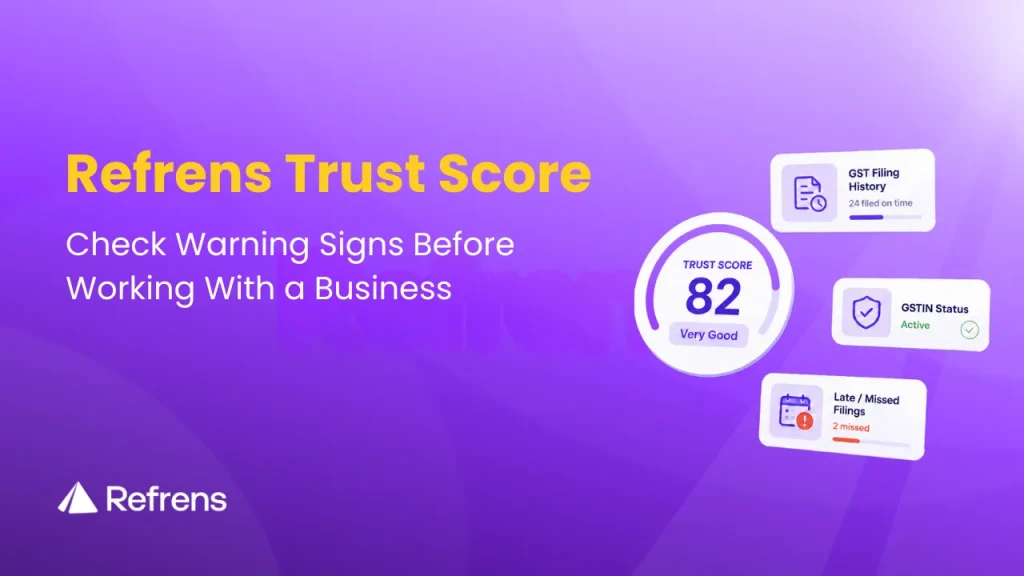
For years, businesses have run vendor and client relationships on trust built over invoices, payment cycles, and follow-up calls. If a vendor delivered on time and the invoice looked right, that was usually enough to keep working with them.
That’s no longer the full picture. Under GST, your input tax credit depends not just on receiving a valid invoice, but on your vendor actually filing their returns correctly and on time.
A vendor can look completely reliable and still put your ITC at risk:
- Good service, on-time delivery, professional communication
- But inconsistent or delayed GST return filings behind the scenes
By the time this shows up as a mismatch in your GSTR-2B or a blocked ITC claim, the transaction is already done and the correction is already your problem.
The real issue: GST filing behavior has always been invisible until it affects you directly, usually during reconciliation, when it’s too late to do anything but chase corrections. Businesses want to know this earlier: before the invoice is booked, before the deal is signed, before ITC is on the line.
That’s what Refrens Trust Score is built for. You already understand this shape of scoring from CIBIL, an ongoing behavior score rather than a one-time check, updated as a pattern builds over time rather than frozen at a single lookup. Refrens Trust Score works the same way, considering a business’s GST filing behavior, their return filing history, late or missed filings, and whether their GSTIN is active. It gives you visibility into that behavior before you rely on it, not after.
What Refrens Trust Score Actually Shows You
Refrens Trust Score gives you real visibility into a counterparty’s GST filing behavior before you’re locked into a deal.
Right now, most businesses are working blind on this front. You know if a vendor delivers. You know if an invoice looks right. What you don’t know, until reconciliation time, is whether they’ve actually been filing their GST returns on schedule.
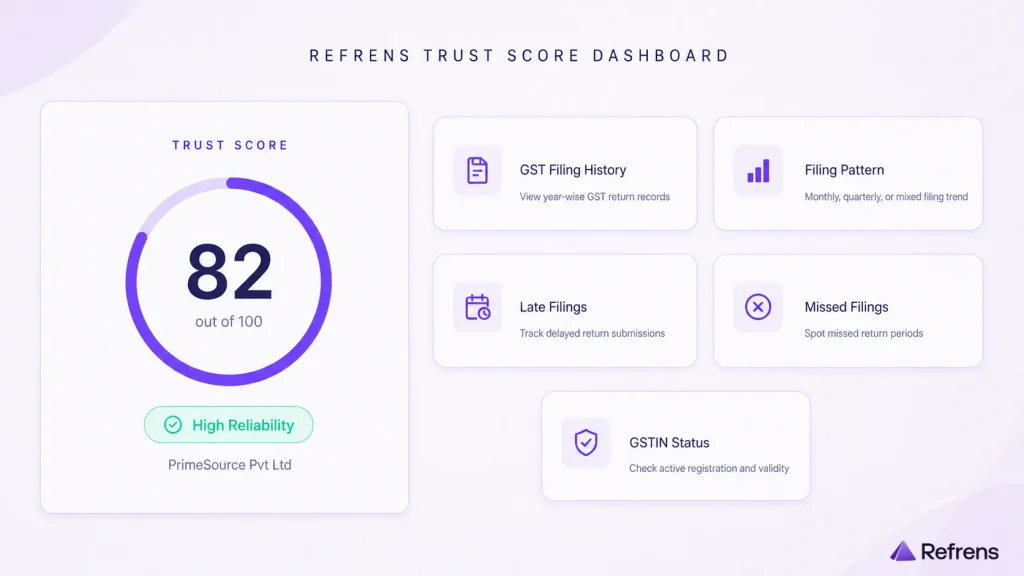
Trust Score changes that:
- Filing history – a track record, not a guess
- Late or missed filings – patterns, not one-off slips
- GSTIN status – active, or a red flag you’d otherwise miss
It’s built on real GST filing behavior, the one signal that directly determines whether your ITC is safe.
Here’s what each of those actually looks like, and how to read them before you act on a deal.
How Refrens Trust Score Works
Trust Score is built from a business’s actual GST filing record, pulled directly from filing data tied to their GSTIN. Here’s what goes into it and what each part tells you.
1. GST return filing history
This is the track record: how consistently a business has filed its GST returns over time. A business that files on time, month after month, shows a stable pattern. A business with frequent gaps or irregular filing shows the opposite, regardless of how the relationship looks on the surface.
2. Late or missed filings
Not every late filing means a business is unreliable at GST compliance, a single delay can happen for many reasons. What matters more is the pattern:
- Occasional, isolated delays: lower concern
- Repeated late filings across multiple periods: higher concern
- Consistently missed filings: a clear red flag
This is the piece most directly tied to ITC risk. If a vendor files late or not at all, your ability to claim ITC on their invoices can be delayed or blocked, even when your own filings are perfectly on time.
3. GSTIN status
This checks whether a business’s GST registration is currently active, or whether it’s been suspended or cancelled. A cancelled GSTIN is a hard stop: invoices from a business without a valid, active registration carry immediate compliance risk for you, not just a delay.
4. Keeping records accurate
Trust Score also pulls live details straight from GSTN, so you’re not relying on what a client or vendor told you when they were onboarded. Legal name, trade name, registered address, state, PIN code, and tax type can all be checked against GSTN and auto-filled if anything’s changed. If the fetched details differ from what’s on file, you get a side-by-side comparison to review before confirming the update, so your records stay current without manual re-entry.
Putting it together
Trust Score combines these three factors into a single, checkable rating for any GSTIN, so you’re not pulling filing history manually or waiting to find a mismatch during reconciliation. You check it before the invoice is booked, before the deal is signed, while there’s still time to act on what you see.
That timing is the whole point, and it’s easiest to see in the place where it matters most: protecting your ITC.
Why These Warning Signs Matter
GST filing issues rarely look serious at the beginning.
A vendor sends the invoice. The GST amount is mentioned correctly. Your team records the purchase. Payment may even be released. From the outside, everything looks normal.
The problem usually appears later.
Maybe the invoice does not show up properly in your GSTR-2B. Maybe the vendor filed late. Maybe the GSTIN is inactive. Maybe the legal name or state does not match your records. Now your accounts team has to pause, check, reconcile, follow up, wait for corrections, and sometimes explain why the ITC expected for that period is not available yet.
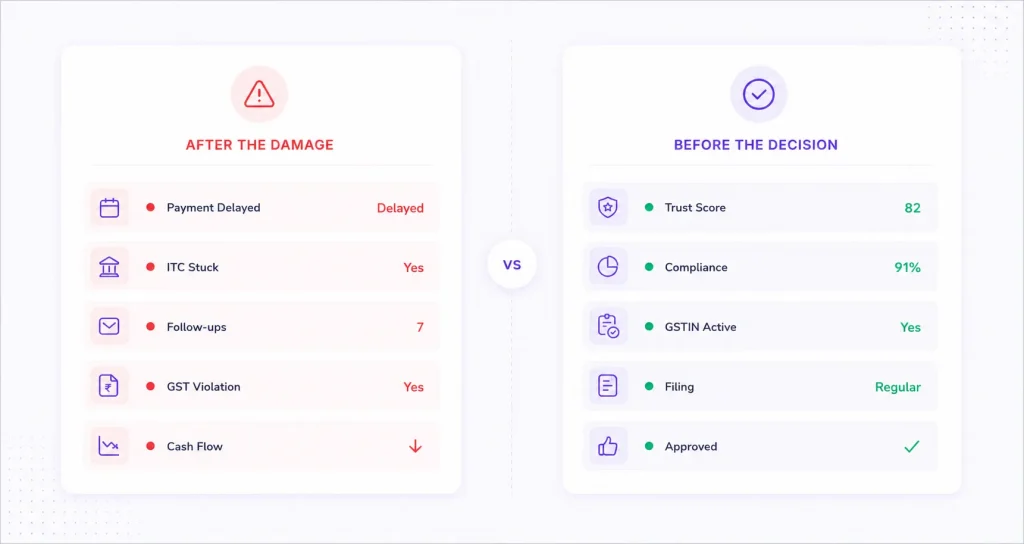
That is where the real cost begins.
It is not only about tax. It becomes a business operations problem. Your accountant spends time chasing vendors. Your finance team delays payment release. Your purchase team has to recheck vendor details. Your invoice may need correction. Your cash flow may get affected because the ITC you expected is delayed or stuck.
Most of these issues are not visible if you only look at the invoice or the relationship. A vendor can deliver on time and still file GST returns late. A client can communicate professionally and still have mismatched GST details. A business can look fine from the outside, while its filing record shows repeated delays, gaps, or inactive registration status.
Refrens Trust Score brings these GST-related warning signs upfront. It helps you see filing history, late or missed filings, GSTIN status, and filing consistency before the issue reaches reconciliation, payment, or ITC.
The point is not to reject every business with a weak score. The point is to know what you are walking into, so your team can decide whether to onboard, follow up, verify, review, set conditions, or proceed with extra checks.
Where Businesses Can Use Refrens Trust Score
Refrens Trust Score becomes useful wherever a client or vendor’s GST filing record can affect your invoices, payments, ITC, or finance follow-ups. It does not replace your regular business checks, but it adds one important GST-related signal before you move ahead.
1. Before onboarding a new vendor
Say you are onboarding a new printing vendor for monthly packaging material. Their rates look good, delivery timeline is fine, and the invoice format looks proper.
But if that vendor has a history of missed or delayed GST filings, your accounts team may keep facing ITC mismatches every month after the purchase is already done.
Refrens Trust Score helps you check the vendor’s GST filing record before adding them to your vendor list, so price is not the only thing driving the decision.
2. Before releasing payment to a vendor
A contractor completes work and sends a high-value invoice. The work is done, so the operations team wants the payment released.
But from the finance side, there is still one more question: has this vendor been regular with GST filings, or do they usually delay reporting?
Refrens Trust Score helps finance teams add a GST verification step before payment release, especially when the GST amount is large or the vendor has a history of delayed filings.
3. Before claiming Input Tax Credit
You buy services from a vendor, pay GST, and record the invoice in your books. But during reconciliation, the invoice does not reflect properly in your GSTR-2B.
Now your accountant has to chase the vendor, wait for correction, and recheck the records later.
Refrens Trust Score helps you identify vendors whose filing patterns may create repeated ITC delays or mismatches, so you are not discovering the problem only during month-end reconciliation.
4. Before giving credit terms to a client
A new client asks for 45 or 60 days credit. Your sales team knows the client, the order value looks promising, and commercially the deal feels worth it.
Refrens Trust Score should not be used as a credit score. It does not tell you whether the client will pay on time.
But it can still help your finance team check whether the client’s GSTIN is active, their taxpayer details match, and their filing record looks regular before approving business terms.
5. Before making a high-value purchase
Imagine you are buying laptops, equipment, furniture, or software for your team. The GST amount itself can be significant.
If the vendor’s filing record is weak, the issue may not show up when the purchase order is approved. It may show up later, when the expected ITC does not reflect properly.
Refrens Trust Score helps you check the vendor’s filing history before depending on a large ITC amount.
6. Before creating invoices with GST details
A client shares their GSTIN over email, and your team creates the invoice using those details.
Later, the client’s accounts team says the GSTIN belongs to another branch, the state is wrong, or the legal name does not match. Now the invoice has to be corrected, reissued, or delayed.
Refrens Trust Score helps you verify GSTN-linked details like GSTIN status, legal name, trade name, state, and address before billing, so your invoice starts with cleaner data.
7. When a GSTIN looks suspicious or inactive
Sometimes the GSTIN format looks correct, but the details behind it do not.
The registration may be cancelled. The legal name may not match the business you are dealing with. The GSTIN may belong to a different branch or entity.
Refrens Trust Score brings these GST-related warning signs into the review process before your team creates invoices, releases payment, or continues transactions with incorrect details.
8. When setting safer payment terms with a vendor
A vendor may be important to your business even if their GST filing record is not perfect.
Maybe they offer a niche service. Maybe they are the only available supplier in your area. Maybe their pricing is strong, but their filing pattern needs closer review.
Refrens Trust Score helps your finance team set process-based controls, such as extra invoice checks, closer review for large payments, or periodic GST verification, instead of making the decision personal.
9. During vendor and client reviews
Most business reviews focus on price, delivery, response time, quality, payment history, and relationship.
But finance teams often know another side of the story: which vendors create repeated GST mismatches, which clients send wrong GST details, and which relationships create unnecessary accounting follow-ups.
Adding Refrens Trust Score to reviews helps make these hidden finance issues visible, so your team can discuss them with actual GST filing signals instead of scattered complaints.
10. To reduce manual GST verification work
Checking one GSTIN manually may not feel like a big task.
But checking GSTIN status, legal name, trade name, filing history, missed returns, and filing pattern for hundreds of clients and vendors can quickly become a time-consuming process.
Refrens Trust Score brings these GST filing signals into one place, so your team does not have to keep jumping between manual portal checks, spreadsheets, and client/vendor records.
The Simplest Way to Think About It
Every use case above comes back to one question: is this client or vendor disciplined about their GST filings, and can you see that before you’re already committed to the transaction?
A strong Trust Score doesn’t guarantee a perfect relationship. A weak one doesn’t mean the other business is acting in bad faith. What it gives you is a clear, verifiable signal, in place of no signal at all, at the point where you can still act on it.
In practical terms, that helps you decide:
- Who to onboard
- Who to buy from
- Who to extend credit to, and on what terms
- Whose payment needs an extra check before release
- Whose GST details need correcting before you invoice
See it for yourself. Open any client or vendor with a GSTIN on file and check their Trust Score directly inside Refrens, no separate portal, no manual lookup.
Related Posts:
 Mastering Input Tax Credit (ITC) Under GST: A Comprehensive Guide for Businesses in India
 Your Complete Guide to GSTR 3B: Filing Process, Due Dates, Penalties, and FAQs
 Everything To Know About GSTR 3
 GSTR 6: Filing Process, Eligibility, Recent Updates, and FAQs
 Top 15 Vendor Management Software in India for 2026: Features, Pricing, Ratings & Reviews
 Everything to know about GSTR 9C: Eligibility, Filing Process, Amendments, and FAQS
 GSTR 2A: How It Works and Why It Matters
 Complete Guide to GSTR 9: Filing Process, Penalties, Tips, Mistakes to Avoid, and FAQs
 Master GST Reconciliation: Process, Tools, and Best Practices
 Vendor Onboarding Process: Steps, Checklist & Documents
 Understanding Reverse Charge Mechanism (RCM) Under GST: A Complete Guide for Businesses
 A Quick Overview of GSTR-2B: Features, Benefits, and How to Use It
 Everything To Know About GSTR-3A: Issuance, Actions to Take, and Consequences of Non-Compliance
 GSTR: What is GST Return? Types, Rules, Procedures, and Penalties
 A Comprehensive Guide to GST Compliance for E-Commerce Operators in India
 GSTR 2: Everything You Need To Know
 Vendor Approval Process: Prequalification, Vetting, Due Diligence & Risk Checks
 A Complete Guide to the Types of Invoices