

In the Indian business calendar, January isn’t just the start of a new Gregorian year, it is the beginning of the “Final Sprint.” With only 90 days left until March 31st, the pressure to hit Annual Operating Plan (AOP) targets is at an all-time high.
For many SMEs and mid-market enterprises, Q4 (January–March) can account for up to 35-40% of annual revenue. If you haven’t hit 70% of your target by now, January is your “make-or-break” month.
Here are 9 actionable strategies Indian businesses must implement immediately to ensure they cross the finish line with a win.
1. The “Clean-Up” Audit: Reconcile GST and AIS
Before chasing new revenue, protect what you’ve already earned. January is the deadline for the Q3 TDS returns (due Jan 31st) and a critical window to reconcile your books with the Annual Information Statement (AIS) and GST portals.
- The Action: Reconcile your GSTR-2B with your purchase register. Any unclaimed Input Tax Credit (ITC) is essentially “free cash” sitting on the table.
- Why Now? Identifying discrepancies now gives you time to follow up with vendors before the year-end rush, ensuring no leakage in your cash flow.
2. Leverage “Use-It-or-Lose-It” Budgets via Strategic Bundling
In the Indian B2B landscape, January is the month of “Budget Panic” for department heads. Most large corporations and PSUs operate on a strict “Use-it-or-Lose-it” policy. If a manager has a remaining budget surplus by March 31st, they don’t just lose that money, they often face a budget cut for the following year because they “proved” they didn’t need that much.
The Strategy: The “FY-End Advance Bundle” Your goal is to help your clients exhaust their remaining FY25 funds by providing value that extends into the next year. Instead of selling a single unit or a one-month service, offer a high-value bundle that requires a 100% upfront payment in January.
- The “Service Bank” Model: If you are a service provider (IT, Consulting, Marketing), sell a “Block of Hours” or a “Maintenance Credit” at a 15% discount. The client pays the full invoice now using their remaining 2025 budget, but they can utilize the services through September 2026.
- The Pre-Purchase Incentive: For product-based businesses, offer to lock in current year pricing. With inflation and the new fiscal year usually bringing price hikes on April 1st, tell your clients: “Purchase 6 months of supply now at 2025 rates, and we will stagger the delivery to suit your warehouse space.”
- The “Pro” Tip for 2026: Frame the conversation around the client’s tax benefits. An upfront payment for a deductible business expense can help them lower their own taxable profit before the March 31st deadline.
A Real-World Example: An industrial lubricant manufacturer approached their top clients in January with a “Q4 Stock-Up Plan.” They offered a 10% discount on bulk orders, provided the invoice was settled by January 31st. This allowed the clients to utilize their remaining “Operations & Maintenance” budget, while the manufacturer secured enough cash flow to settle their own advance tax obligations without taking a working capital loan.
3. Aggressive Debt Recovery (The 60-Day Rule)
Cash is king, especially in a quarter where you need to pay advance tax and year-end bonuses. Any invoice older than 60 days is a threat to your liquidity.
- The Action: Categorize your Receivables into Green (0-30 days), Amber (31-60), and Red (60+).
- The Tactic: Empower your sales team with a small “collection incentive.” Sometimes a personal phone call from a senior executive is all it takes to move an invoice from a client’s “pending” pile to “processed.”
4. Optimize Inventory: “Liquidation Over Storage”
Sitting on “dead stock” during the March audit is expensive. Every rupee locked in slow-moving inventory is a rupee you can’t spend on marketing or R&D.
- The Move: Run a January Clearance for any stock that hasn’t moved in the last six months.
- The Benefit: It’s better to sell at a 5% margin (or even at cost) in January than to pay for warehouse space and insurance through March, only to write it off later.
5. Calculate and Plan the Final Advance Tax Installment
The final installment of Advance Tax is due on March 15th, but calculating it on March 10th is a recipe for a cash flow heart attack.
- The Step: Work with your CA to project your full-year profits based on January’s performance in order to have an idea of where you might stand at the year end.
- The Goal: Ensure you have the liquidity set aside. Under-calculating can lead to heavy interest penalties under Sections 234B and 234C of the Income Tax Act.
Tip: Check out the blog on Advance Tax to know more about the same – https://www.refrens.com/grow/advance-tax/
6. Pivot to “High-Velocity” Sales Channels
Q4 is not the time for long-term experimental branding. It is the time for direct response and high-conversion tactics.
- The Shift: Reallocate your remaining marketing budget from “Top-of-Funnel” awareness to Retargeting and Bottom-of-Funnel lead gen.
- Pro Tip: For Indian B2B, LinkedIn InMail and targeted WhatsApp Business campaigns often have a faster turnaround than SEO or traditional cold calling during the year-end crunch.
7. Fixed Asset Planning for Tax Depreciation
If your business is profitable and you were already planning to buy machinery, vehicles, or IT hardware, do it before March 31st.
- The Rule: Under Indian Tax laws, if an asset is “put to use” for less than 180 days, you get 50% of the normal depreciation. However, even 50% can significantly lower your taxable income.
Example: If you are planning to buy a machinery of INR 1 Crore, depreciated at 15% p.a, it leads to depreciation of INR 15 Lakhs. However, since we are planning to buy and put it to use in the last quarter, it is being used for less than 180 days, allowing a depreciation deduction of INR 7.5 Lakhs.
That’s a clear tax saving by deducting your profits by INR 7.5 Lakhs! - The Strategy: Finalize these purchases in January to ensure delivery and “put to use” status before the March 31st cutoff.
8. The “Eighth Pay Commission” & Talent Retention
With the 8th Pay Commission discussions and revisions active in 2026, employee expectations regarding inflation and wage realignment are high.
- The Action: Don’t wait for April to talk about performance. Hold mid-quarter reviews in January.
- The Result: Acknowledge your top performers now and tie their year-end bonuses to the specific Q4 targets you need to hit. A motivated team in January will work twice as hard in March.
9. The “Compliance Shield”: Audit Contracts & MSME Dues
In India, legal compliance isn’t just about paperwork; it’s about cash flow. Under the MSMED Act, if you haven’t paid your MSME-registered vendors within 45 days, you cannot claim those expenses as a deduction from your taxable income until you actually pay them.
- The Legal Check: Review your “Sundry Creditors” list. Identify which vendors are MSMEs. If you have outstanding dues, pay them before March 31st to ensure you get the tax deduction for this fiscal year.
- The Contractual Audit: January is the time to review auto-renewal clauses in your annual contracts (AMC, Rent, Software Subscriptions). If you plan to scale down or switch providers in April, you often need to give a 60 or 90-day notice period, which means you must act in January to avoid being locked into another year of costs.
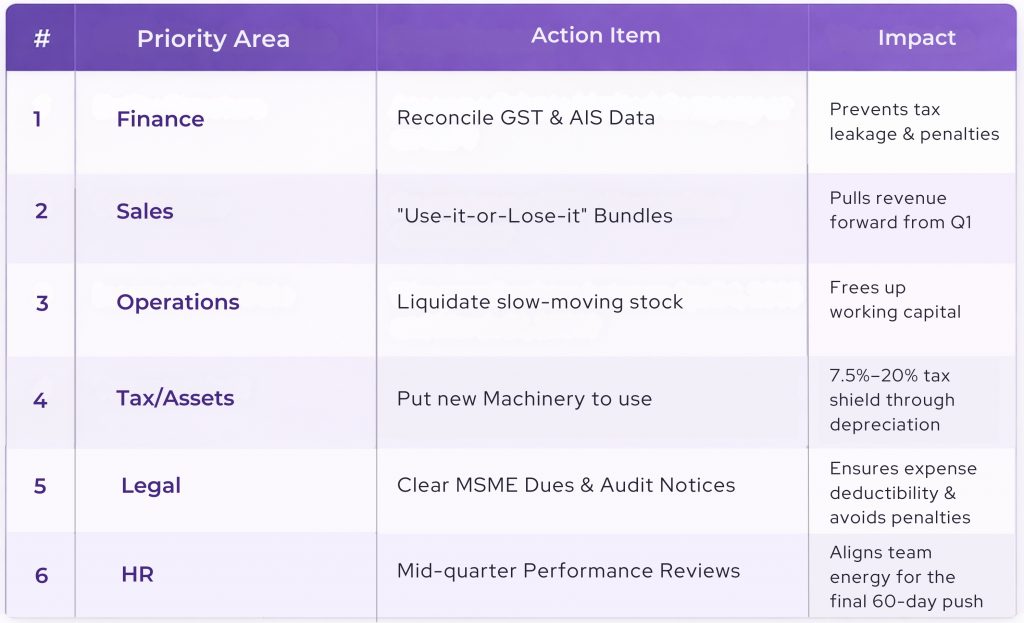
Summary Table: The January Sprint Checklist
Conclusion: Don’t Just Finish: Launch
The most successful Indian entrepreneurs don’t view March 31st as an ending, but as a launchpad. By tackling your MSME dues, maximizing machinery depreciation, and securing pre-paid bundles in January, you aren’t just “hitting a target.” You are clearing the deck so that on April 1st, while your competitors are still struggling with last year’s paperwork, you are already sprinting toward next year’s growth.
The January Rule: Every hour spent on strategy today saves ten hours of “firefighting” in March.
About the Author: Kajal Agarwal is a qualified Chartered Accountant and Assistant Vice President – Finance at a U.S.-based multinational corporation, where she manages financial operations for clients generating over $100 million in revenue. A mentor to aspiring CAs and author of a widely acclaimed book on Company Law, she has also appeared live on DD News as a Budget 2025 expert, sharing insights on national fiscal policy. Outside her professional life, Kajal is deeply committed to holistic living as a long-time practitioner of Iyengar Yoga and a certified Pranic Healer, finding balance through yoga, meditation, and mindful leadership.

Related Posts:
 A Complete Guide to the Types of Invoices
 Are You Ready for the New Income Tax Act? 75-Day Action Plan for Business Leaders & CFOs.
 Your Complete Guide to GSTR 3B: Filing Process, Due Dates, Penalties, and FAQs
 Advance Tax: Who Needs to Pay, When to Pay & How to Avoid Penalties
 Mastering Input Tax Credit (ITC) Under GST: A Comprehensive Guide for Businesses in India
 Everything To Know About GSTR 3
 Complete Guide to GSTR 9A: Eligibility, Filing Process, Amendments, Mistakes to Avoid, and FAQS
 The Ultimate Guide to Inventory Management Metrics: Key Ratios, Costs, and Calculation Methods
 A Comprehensive Guide to GST Compliance for E-Commerce Operators in India
 Navigating the 180-Day ITC Reversal Rule: What Businesses Must Know in 2026
 Everything to know about GSTR 9C: Eligibility, Filing Process, Amendments, and FAQS
 Complete Guide to GSTR 9: Filing Process, Penalties, Tips, Mistakes to Avoid, and FAQs
 Your Complete Guide to GSTR 5: Filing Process, Due Dates, Penalties, Amendments, and FAQs
 Your Complete Guide to GSTR 4: Due Dates, Formats, Filing Process, Penalities, and FAQs.
 Everything To Know About GSTR-3A: Issuance, Actions to Take, and Consequences of Non-Compliance
 Understanding the Structure of GST: Simplifying Compliance and Driving Growth in India
 GSTR: What is GST Return? Types, Rules, Procedures, and Penalties
 GSTR 9B: Eligibility, Filing Process, Amendments, Mistakes to Avoid, and FAQS