
In the high-stakes world of Indian startups, “burn rate” is often the only metric that matters in the early days. While founders spend months chasing venture capital, many overlook a massive, non-dilutive source of funding: Government Tax Incentives.
The Indian government has transitioned from a regulator to an active “silent partner” in the startup ecosystem. With the landmark abolition of the Angel Tax in the 2024-25 Budget and the extension of tax holidays until 2030, the fiscal landscape for 2025-26 is the most founder-friendly it has ever been. This guide breaks down exactly how to navigate these benefits to keep more cash in your business.
1. The 100% Tax Holiday (Section 80-IAC)
The “Holy Grail” of Indian startup incentives is Section 80-IAC. This provision allows eligible startups to claim a 100% tax deduction on their profits for any three consecutive financial years out of their first ten years since incorporation.
What’s New?
The government has extended the incorporation window to March 31, 2030. This means if you start your company today, you have a decade-long window to choose your “Golden Years” when your profits are highest, and income tax will be zero.
The “Innovation” Bar
To get this, Department for Promotion of Industry and Internal Trade (DPIIT) recognition isn’t enough; you need an Inter-Ministerial Board (IMB) certificate. The IMB is strict. They don’t just look for a new business; they look for Innovation.
- The Litmus Test: Does your startup solve a problem using a new technology, a disruptive process, or a significantly improved service model?
- Founder Tip: When applying, focus your pitch deck on “Technical Scalability” and “Wealth Creation.” If you’re just a digital version of a traditional business (like a standard consultancy with a website), the IMB will likely reject the application.
2. The Death of the “Angel Tax” (Section 56(2)(viib))
For years, the “Angel Tax” was the most controversial law in the ecosystem. It treated the “share premium” (the difference between what an investor paid and the “fair market value”) as taxable income. If you raised ₹5 Crore at a ₹50 Crore valuation, but the taxman valued you at ₹10 Crore, you were taxed on the “excess” ₹40 Crore.
As of the latest budget, Angel Tax has been abolished for all classes of investors.
Why this matters: It removes the “valuation friction” between founders and the Income Tax Department.
Strategic Impact: This move has triggered a wave of “Reverse Flipping,” where Indian startups that moved to Delaware or Singapore are now moving their headquarters back to India (GIFT City or Bangalore) because the tax disadvantage of being an Indian entity has vanished.
3. Section 54GB: Turning Real Estate into Startup Equity
One of the biggest hurdles for early-stage founders is “Seed Capital.” Section 54GB creates a bridge for this.
If an individual or a Hindu Undivided Family (HUF) sells a residential property and invests those capital gains into an eligible startup, they are exempt from paying Long-Term Capital Gains (LTCG) tax.
- Latest Update: This benefit is available for property sales and subsequent investments made until March 31, 2026.
- The Catch: The startup must use that money to purchase “new assets” (like servers, computers, or specialized machinery) within one year. It’s an incredible way to tap into family wealth or “Angel” money from traditional investors who want to offset their real estate taxes.
4. Intellectual Property (IP) & R&D Rebates
In a “Digital India”, your code and patents are your most valuable assets. The government now subsidizes the protection of these assets.
The 10% Patent Box (Section 115BBF)
If you register a patent in India and earn income from it (royalties or sales), that income is taxed at a concessional rate of only 10%. Compared to the standard corporate tax of 25%, this is a massive saving for deep-tech or biotech startups.
IPR Cost Reductions
The SIPP (Startups Intellectual Property Protection) scheme offers:
- 80% Rebate on patent filing fees.
- 50% Rebate on trademark filing fees.
- Free Legal Facilitation: The government pays the “Facilitators” (Lawyers/Patent Agents) to help you file. You only pay the actual (rebated) statutory fees.
5. Simplified Compliance: The “3-Year No-Inspection” Rule
Regulatory “Red Tape” can kill a startup faster than a competitor. To prevent this, the government allows startups to self-certify their compliance with 9 Labour Laws and 3 Environmental Laws.
- The Benefit: For the first 3 to 5 years, no labor inspector will visit your office unless there is a verified, written complaint of a violation.
- Environmental Ease: Startups in the “White Category” (non-polluting sectors like Software and Electronics) don’t need environmental clearances at every turn.
Eligibility Criteria: The “DPIIT” Gateway
All these benefits require one thing: DPIIT Recognition. If you haven’t done this, your startup officially “doesn’t exist” in the eyes of the incentive programs.

How to Claim: A Step-by-Step Roadmap
- Register on Startup India: Create a profile and upload your Certificate of Incorporation and a description of your “Innovative Concept.”
- Apply for 80-IAC (IMB): Once you have your DPIIT number, fill out Form 1 on the portal. You will need a CA-certified balance sheet and a 2-minute video explaining your product.
- File Your ITR-6: When filing your annual tax return, ensure your CA claims the deduction under the specific “Startup Exemption” tabs to avoid processing errors.
30 seconds Eligibility Quiz for IMB Criteria
The 30-Second “Founder’s Audit”
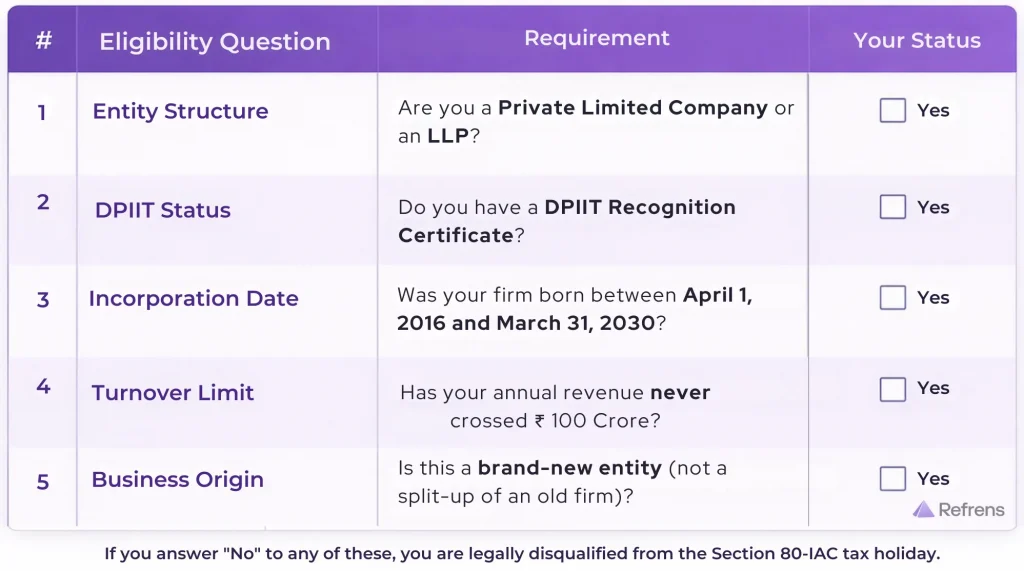
Before you spend hours on paperwork, check if your startup meets the “Golden Criteria” for the Section 80-IAC 100% Tax Exemption.
Part A: The Mandatory “Legal Filters”
If you answer “No” to any of these, you are legally disqualified from the Section 80-IAC tax holiday.
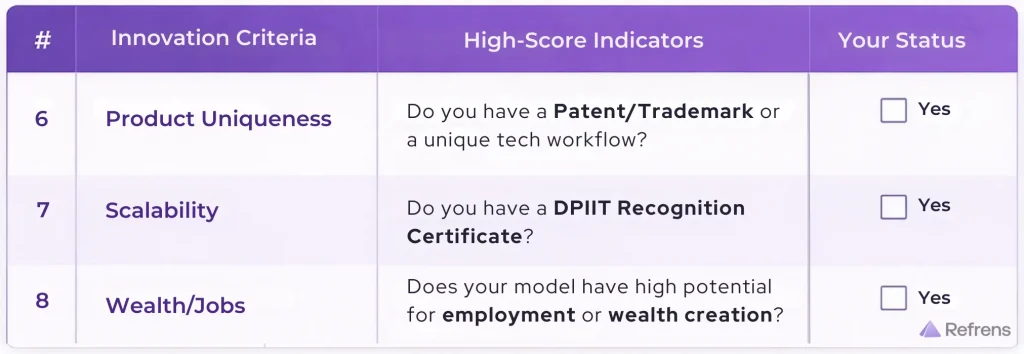
Part B: The “Innovation & Scalability” Pillars
The Inter-Ministerial Board (IMB) uses these to decide if you are “Innovative” enough for the tax break.
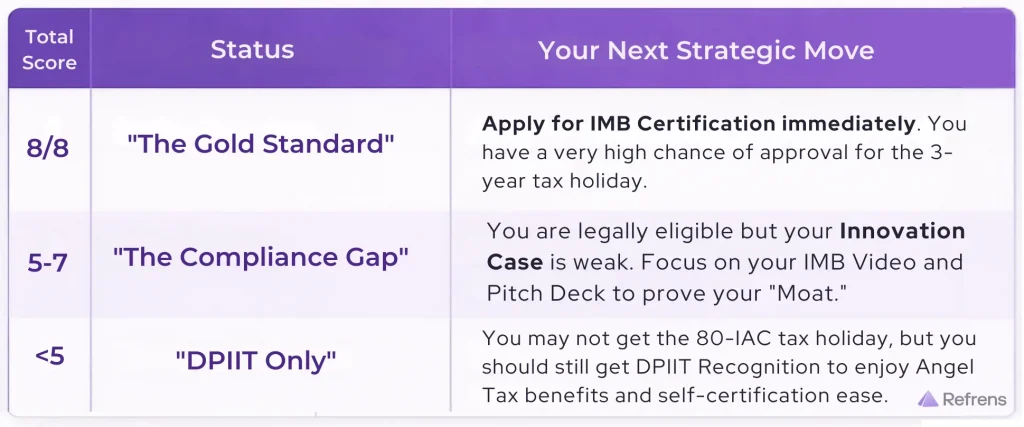
Result: Where Do You Stand?
Count your total “Yes” marks and find your roadmap below:
About the Author: Kajal Agarwal is a qualified Chartered Accountant and Assistant Vice President – Finance at a U.S.-based multinational corporation, where she manages financial operations for clients generating over $100 million in revenue. A mentor to aspiring CAs and author of a widely acclaimed book on Company Law, she has also appeared live on DD News as a Budget 2025 expert, sharing insights on national fiscal policy. Outside her professional life, Kajal is deeply committed to holistic living as a long-time practitioner of Iyengar Yoga and a certified Pranic Healer, finding balance through yoga, meditation, and mindful leadership.

Related Posts:
 Forget Bengaluru – These Are The Best Startups to Build Your Career in Surat
 Mastering Input Tax Credit (ITC) Under GST: A Comprehensive Guide for Businesses in India
 Your Complete Guide to GSTR 3B: Filing Process, Due Dates, Penalties, and FAQs
 E-Invoicing Around the World: A Global Overview
 A Comprehensive Guide to GST Compliance for E-Commerce Operators in India
 Why Your Startup Should Hire JavaScript Developers: Benefits and Insights
 Your Complete Guide to GSTR 5: Filing Process, Due Dates, Penalties, Amendments, and FAQs
 Everything To Know About GSTR 3
 Understanding Reverse Charge Mechanism (RCM) Under GST: A Complete Guide for Businesses
 Advance Tax: Who Needs to Pay, When to Pay & How to Avoid Penalties
 Understanding the Structure of GST: Simplifying Compliance and Driving Growth in India
 SST vs. GST: Understanding Tax Systems in Malaysia
 Everything To Know About GSTR-3A: Issuance, Actions to Take, and Consequences of Non-Compliance
 A Complete Guide to the Types of Invoices
 Complete Guide to GSTR 5A: Filing Process, Key Features, Penalties, and FAQs
 GSTR 7: Eligibility, Key Components, Penalties, and FAQs
 GSTR: What is GST Return? Types, Rules, Procedures, and Penalties
 Complete Guide to GSTR 8: Eligibility, Format, Procedure, Penalties, and FAQs