
The Union Budget 2026 has signaled a fundamental departure from traditional economic policy. For decades, the Indian Micro, Small, and Medium Enterprise (MSME) sector has been treated as a “social sector” requiring protection. With the 2026 Budget, the narrative has shifted. Finance Minister Nirmala Sitharaman has unveiled a roadmap that treats MSMEs as high-performance investment assets.
The centerpiece of this strategy is the ₹10,000 crore SME Growth Fund, but the roadmap extends far beyond a simple capital infusion. It is a structural redesign of how small businesses in India operate, scale, and compete globally. This budget focuses on three critical pillars: Equity, Liquidity, and Capability.
Pillar 1: Equity Support – The ₹10,000cr Patient Capital Catalyst
The most significant “wow” factor in this budget is the move away from debt-only financing. Historically, Indian MSMEs have been trapped in a “Debt Loop”, taking high-interest loans to fund growth, only to have their profits eaten up by monthly EMIs.
The Mechanics: How the Equity Fund Works
The ₹10,000 crore fund is not a subsidy or a loan that needs to be repaid with interest. Instead, it operates on a “Fund of Funds” (FoF) model, managed by SIDBI (Small Industries Development Bank of India).
- The Mother Fund: The government places the ₹10,000cr into a central pool.
- The Leverage Factor: This Mother Fund doesn’t invest directly. It anchors several “Daughter Funds” i.e. private venture capital and private equity firms. For every rupee the government contributes, these private funds are expected to bring in 3-4 rupees from institutional investors. This effectively turns a ₹10,000cr government corpus into a massive ₹40,000cr+ pool of growth capital.
- The Minority Stake: These funds take a minority equity stake (ownership) in your company.
The Champion Benefit: Growth Without the Noose
The real depth of this initiative lies in the balance sheet advantage. Because this is equity, there are no monthly interest payments (EMIs).
- Net Worth Enhancement: The investment shows up as “Equity” rather than “Liability,” drastically improving your debt-to-equity ratio.
- Patient Capital: The fund earns its return only when your company grows in value. You don’t “pay back” the fund until a “Liquidity Event”, usually an IPO on the NSE Emerge or BSE SME exchange, or a strategic buyback once your company has scaled.
- Governance & Mentorship: By having a government-backed fund on your cap table, you gain institutional credibility, making it easier to attract global partners and top-tier talent
Pillar 2: Liquidity Support – The TReDS 2.0 Revolution
If equity is the fuel for expansion, liquidity is the oxygen for daily survival. The perennial crisis for Indian MSMEs has been “Delayed Payments,” where large buyers hold onto MSME cash for 90 to 180 days. Budget 2026 has introduced a “wow” factor that fundamentally changes the power dynamic through the Trade Receivables Discounting System (TReDS).
The Mandatory Shift
Previously, TReDS was an optional platform. Large corporations often avoided it to preserve their own cash flow. The 2026 Budget has made it mandatory for all Central Public Sector Enterprises (CPSEs) and large companies above a certain turnover threshold to onboard and use TReDS for all MSME procurement.
The Innovation: The Credit Guarantee Shield
In a first-of-its-kind move, the government has integrated the CGTMSE (Credit Guarantee Fund Trust) into the TReDS ecosystem.
- Instant Cash: When you ship an order to a CPSE on Monday, you can upload the invoice to TReDS. Banks then “bid” to buy that invoice.
- Zero Risk for Banks: Because the government provides a credit guarantee on the invoice, the bank’s risk is virtually zero.
- Lower Discounting Rates: This zero-risk status means banks offer much lower interest rates (discounting rates) to MSMEs. You get your cash in 48 hours rather than 45 or 90 days, at a fraction of the cost of a working capital loan.
This creates “Working Capital Velocity.” If you get paid every 48 hours instead of every 60 days, you can churn your inventory significantly faster, allowing you to grow your revenue by 3x to 4x without taking on additional debt.
Pillar 3: Capability & Professional Shield – The Corporate Mitra
Scaling a business from a small workshop to a medium-sized factory often leads to a “Compliance Black Hole.” Many MSME owners deliberately stay small to avoid the complexity of GST audits, ROC filings, and labor law documentation.
The Innovation: Accredited Growth Navigators
The “Corporate Mitra” Initiative is a partnership between the government and premier institutions like ICAI (Accountants) and ICSI (Company Secretaries).
- Accredited Para-Professionals: The government is training a new cadre of “Corporate Mitras”—specialized professionals whose job is to “hand-hold” MSMEs through the formalization process.
- Subsidized Services: The fees for these Mitras are partially subsidized, making professional corporate governance accessible to a small factory owner in a Tier-II city.
- The “Safe Harbor” Status: One of the most significant “wow” factors is that MSMEs working with an accredited Corporate Mitra will be granted a “Safe Harbor” for technical compliance errors. This means that honest mistakes in filing will be treated as rectifiable errors rather than grounds for aggressive penalties or audits.
The Global Leap: Breaking the Export Ceiling
To truly turn MSMEs into “Global Champions,” the budget addressed a long-standing logistical bottleneck: The Courier Export Cap.
For years, Indian artisans and tech-hardware makers were restricted by a ₹10 lakh value cap on exports via courier. Anything above that required a massive amount of customs paperwork and formal shipping agents. Budget 2026 has removed this cap.
- Impact on D2C Brands: A jewelry designer in Jaipur or a precision-tool maker in Bengaluru can now ship high-value goods globally with the same ease as sending a personal document.
- E-commerce Integration: This move is expected to trigger a 25% surge in MSME-led e-commerce exports, allowing “Made in India” products to reach global consumers directly through platforms like Amazon Global and Etsy without the middleman’s margin.
Sector-Specific Boosts: The Cluster Revival Plan
Budget 2026 performs precise surgery on India’s industrial DNA through Sector-Specific Boosts. These initiatives move MSMEs from being mere “suppliers” to becoming “strategic anchors” in global value chains.
1. Electronics & Semiconductor Deep-Tiering
The standout “wow” factor is the Electronics Components Manufacturing Scheme (ECMS) outlay, nearly doubled to ₹40,000 crore.
- The Goal: To move beyond assembly. The roadmap incentivizes the production of display modules, PCBAs, and sensors.
- Semiconductor Mission 2.0: This includes a focus on equipment and materials, opening doors for MSMEs to supply specialized chemicals and gases required for chip-making.
2. Modernizing Legacy Clusters
The government plans to revive 200 legacy industrial clusters such as the leather hubs of Kanpur or brassware of Moradabad.
- The Benefit: Through Common Facility Centers (CFCs), small units can access high-end 3D printing and testing labs on a “pay-per-use” basis, removing the need for heavy upfront capital investment.
3. Labour-Intensive & Strategic Sectors
- Textiles & Footwear: Integrated parks and modernization grants aim to regain India’s competitive edge in global exports.
- Container Manufacturing: A new ₹10,000 crore scheme aims to build shipping containers domestically, creating a brand-new niche for engineering MSMEs to solve global logistics shortages.
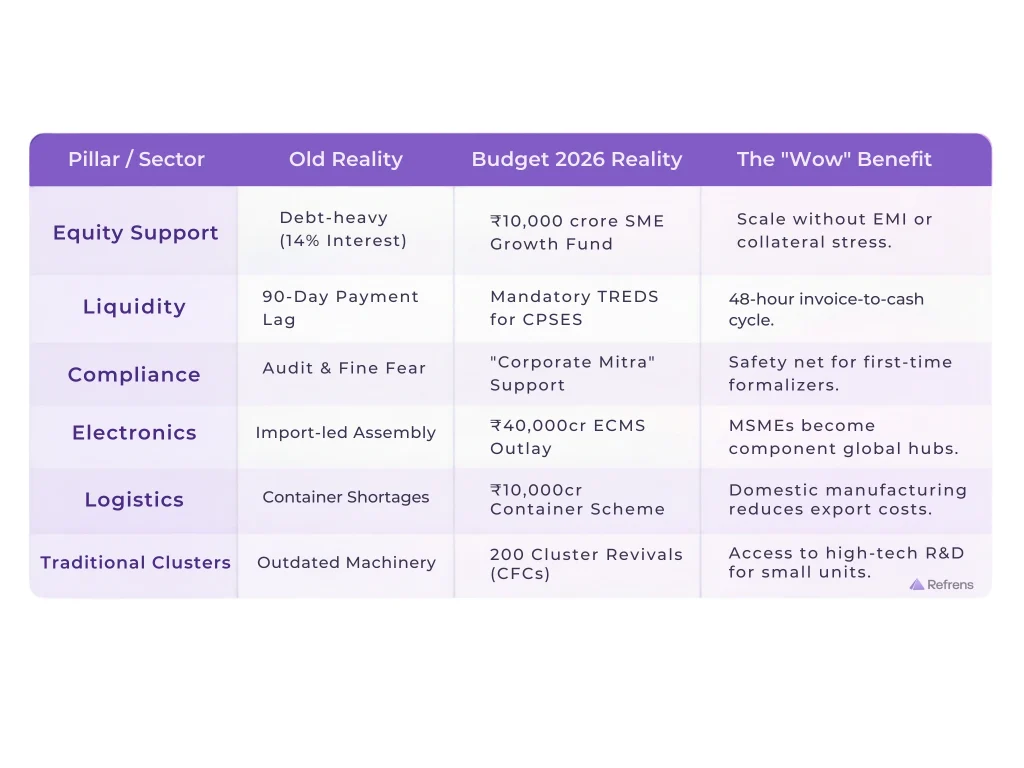
Summary: The Champion MSME Roadmap
About the Author: Kajal Agarwal is a qualified Chartered Accountant and Assistant Vice President – Finance at a U.S.-based multinational corporation, where she manages financial operations for clients generating over $100 million in revenue. A mentor to aspiring CAs and author of a widely acclaimed book on Company Law, she has also appeared live on DD News as a Budget 2025 expert, sharing insights on national fiscal policy. Outside her professional life, Kajal is deeply committed to holistic living as a long-time practitioner of Iyengar Yoga and a certified Pranic Healer, finding balance through yoga, meditation, and mindful leadership.
Related Posts:
 TDS & TCS Filing Deadlines FY 2025-26: A Complete Guide
 Don’t Leave Money on the Table: Startup Tax Incentives Every Founder Should Know (And How to Qualify)
 Manufacturers’ Guide to Recovering 90% of IDS Refunds Quickly
 Forget Bengaluru – These Are The Best Startups to Build Your Career in Surat
 Navigating the 180-Day ITC Reversal Rule: What Businesses Must Know in 2026
 The Ultimate Guide to Inventory Management Metrics: Key Ratios, Costs, and Calculation Methods
 Are You Ready for the New Income Tax Act? 75-Day Action Plan for Business Leaders & CFOs.
Republic Day Marketing in India: Dos, Don’ts, and Case Studies for Brands
Are You Ready for the New Income Tax Act? 75-Day Action Plan for Business Leaders & CFOs.
Republic Day Marketing in India: Dos, Don’ts, and Case Studies for Brands
 Q4 Action Plan for Indian Business Leaders: 9 Proven Tactics to Finish FY26 on a High Note
 Top 15 Critical Tools to Set Up Your New Business for Success
 E-Invoicing Around the World: A Global Overview
 Small Business Financing Options: Navigating Loans, Grants, And Funding Sources
 Mastering Input Tax Credit (ITC) Under GST: A Comprehensive Guide for Businesses in India
 Best Accounting Software in India: Features, Pricing, Reviews, and more (Updated 2024 List)
 Which Indian Payment Gateway Delivers the Best ROI at Scale? (2026 PG Pricing Guide)
 The Ultimate Guide to Basics of Inventory Management
 Solopreneur’s Guide to Lead Generation Strategy to Scale Their Team & Business in 2026
 Your Complete Guide to GSTR 5: Filing Process, Due Dates, Penalties, Amendments, and FAQs