

How Refrens simplifies accounting for small businesses
Get a clear view of your business finances, including revenue, expenses, and cash flow, while eliminating manual data entry.
Automatic Ledgers & Vouchers: Sales, purchases, payments, receipts, expenses, and other supported transactions automatically update the relevant accounting records.
Chart of Accounts: Organise income, expenses, assets, liabilities, and other transactions under the right accounting heads.
Manual Journals: Record adjustments, non-cash transactions, loans, corrections, and other entries whenever manual accounting is required.
Keep Your Books Up to Date: Reduce duplicate work by keeping everyday business transactions and accounting connected from the start.

- Create invoices, quotations, orders, receipts, credit/debit notes, and more.
- Customize documents with your branding, fields, columns, formulas, and terms.
- Convert quotations into invoices and other documents easily.
- Handle partial and bulk document conversions.
- Track paid, unpaid, partial, and overdue payments.
- Record payments and generate receipts quickly.
- Automate recurring invoices, reminders, due dates, and follow-ups.
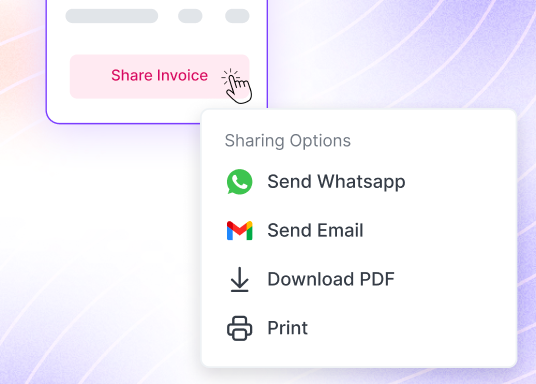
Share Anywhere: Send invoices, quotations, receipts, and other documents via WhatsApp, email, links, PDF, or print.
Track & Schedule Emails: Monitor email activity and schedule documents to be sent automatically.
Use Business Email: Send documents from your connected business email address.
Signatures & Approval: Add signatures and collect customer acceptance when needed.

Customer Outstanding: See how much each customer still owes your business.
Vendor Outstanding: Track unpaid vendor bills and amounts your business still needs to pay.
Customer & Vendor Statements: Generate statements showing invoices, purchases, payments, balances, and transaction history.
Receivable & Payable Ageing: See how long balances have remained outstanding so you can prioritise collections and plan vendor payments.

Upload Bank Statements: Bring your bank transactions into Refrens for reconciliation.
Match Transactions: Match bank entries with recorded invoices, payments, purchases, expenses, and other transactions.
Find What Needs Attention: Identify unmatched or missing transactions that still need to be recorded, reviewed, or corrected.
Keep Your Books Accurate: Regular reconciliation helps keep your bank balances and accounting records aligned.

Profit & Loss: Track revenue, expenses, and profitability over any selected period.
Balance Sheet: See your assets, liabilities, and overall financial position.
Trial Balance: Review ledger balances and quickly check your books.
Cash Flow Statement: Understand how cash moves into and out of your business.
Daybook: See a chronological record of daily business transactions. Ledger Reports: Review balances and transaction history for individual accounts or across all ledgers.
Outstanding & Ageing Reports: Monitor receivables, payables, overdue balances, and payment ageing.
Order & Profitability Reports: Track order utilisation and fulfilment, project-wise P&L, product profitability, and other business reports.

Real-Time Stock: Keep inventory updated as purchases, sales, transfers, returns, and stock adjustments happen.
Stock Valuation: See the value of inventory held by your business.
Product Profitability: Understand revenue, costs, and profit by product.
Advanced Inventory: Manage multiple warehouses, stock transfers, reorder points, stock alerts, batches, serial numbers, expiry dates, packaged items, barcode scanning, and strict stock controls.

Refrens is designed specifically for Malaysian businesses, with built-in SST rules, local tax formats, and compliant reporting. Create invoices and generate tax reports confidently, knowing your records always meet government requirements.
Simple Plans That Fit Every Business and Every Budget
Affordable and scalable pricing plans designed for Malaysian Small Business to simplify accounting, bookkeeping, and e-Invoicing.

Frequently Asked Questions (FAQ)
Refrens offers a free plan that covers core invoicing and basic accounting features, ideal for small businesses just getting started. As your business grows and you need advanced features like MyInvois integration, multi-user access, or detailed inventory management, you can upgrade to a paid plan that fits your needs. You can explore the platform and its pricing tiers before committing to anything.
Yes. Refrens works whether or not you're currently SST-registered. You can create and send professional invoices without any tax setup if you're not yet registered, and the moment you do register, simply set up your applicable SST rates once inside Refrens. From that point on, every invoice automatically applies the correct rate, so you're ready to go the day your registration comes through.
No, you're not required to. Businesses with annual turnover below RM1 million are not required to issue e-invoices, though they're encouraged to adopt the system voluntarily. This threshold was raised from RM500,000 to RM1 million, after the government's decision to double the exemption threshold, which led to the cancellation of what would have been a fifth compliance phase.